3 months ago
122
3 months ago
122
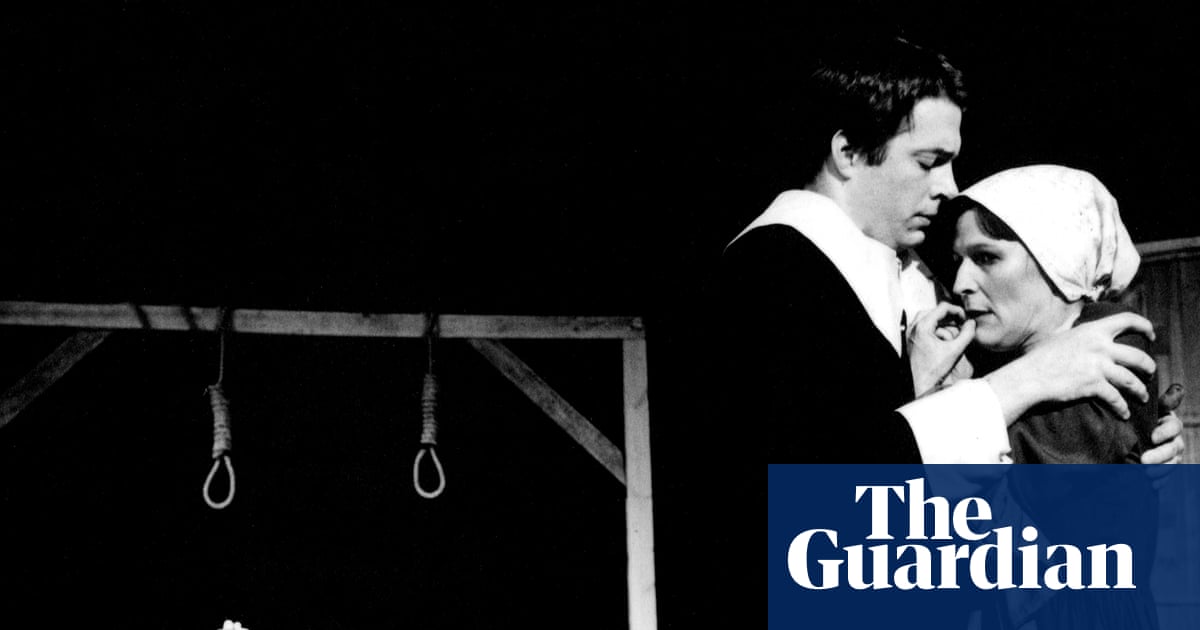
The ammunition boxes stacked on the stage opened up to reveal figurines of angels and an infant Jesus lying in his manger. Six actors sang plaintive carols, accompanied by readings of the brooding poetry of Kharkiv writer Serhiy Zhadan. The audience sat, transfixed by the almost unbearable intensity of the spectacle.
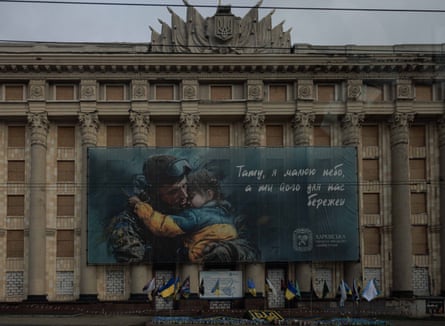
The nativity play, performed on a recent evening at Kharkiv’s puppet theatre, was a reminder that conflict has seeped into the fabric of almost everything in Ukrainian life over the past four years. “We can’t just put on comedies and escape from reality,” said Oksana Dmitrieva, the nativity play’s 48-year-old director. “The stage is a mirror, and we have to live through our emotions again, but this time from outside ourselves, together with others,” she said.
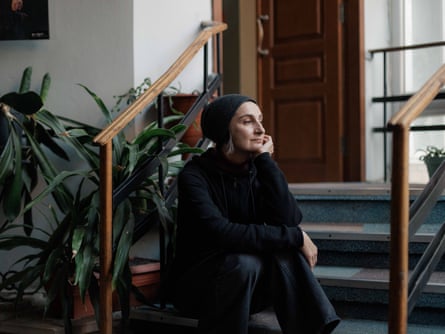
She admitted, however, that dissecting the darker emotions on stage does not always translate to a lighter mind in real life. “Sometimes it’s possible to immerse yourself in the work, but sometimes I also lose my bearings and I wonder, ‘What comes next? What should we talk about? What buttons should we press? I guess that’s what every Ukrainian is living through now.”
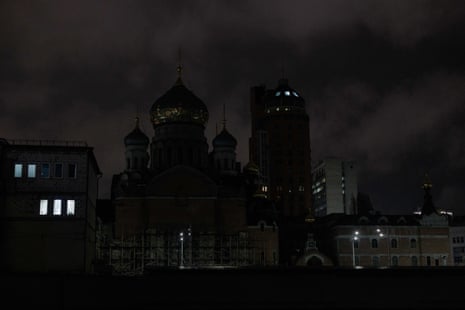
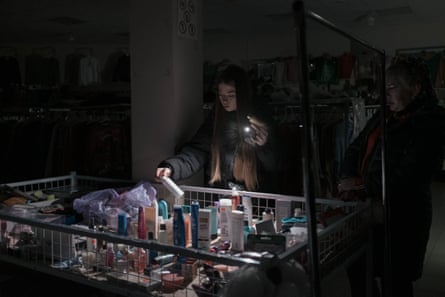
This winter, the fourth since Russia’s full-scale invasion, threatens to be the bleakest yet for Ukraine. Trump, during his first year in office, has proved much more receptive to Moscow’s talking points than to Kyiv’s, Russian troops continue a slow but grinding advance in the Donbas region and missile attacks on energy infrastructure have left cities without power for hours on end, day after day. There are holes in the budget, a crisis in conscripting new recruits and – perhaps most devastatingly – the absence of a plausible positive outcome on the near-term horizon.
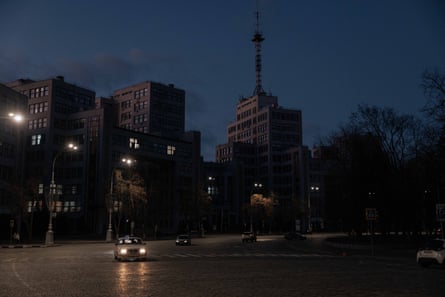
The glass-half-full view is that Ukraine’s continued existence as a state is in itself a positive outcome, and that while things are tough, there is no sign of an imminent collapse at the front. Military innovation in spheres such as drone production is booming, and in big cities like Kyiv and Kharkiv, there is still a vibrant metropolitan life, even amid the air alerts and blackouts. Growling generators on every street corner keep supermarkets, restaurants and bars open, and on a recent Friday evening, a 12,000 hryvnia (£212) champagne tasting event in Kyiv was sold out days in advance.
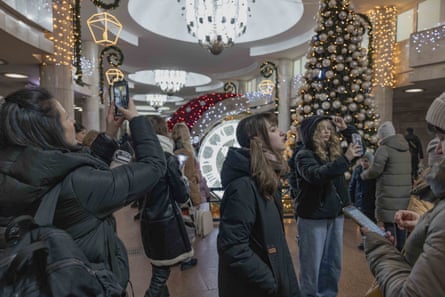
But as Donald Trump’s negotiators attempt to push the country towards the peace that so many crave but on terms that terrify them, and with questionable guarantees that Russia won’t simply resume its attacks in future, exhaustion and existential questions are rarely far from people’s minds.
“This is one of the most difficult moments in our modern history, when every one of us is living on the edge between exhaustion and strength, between compromise and our principles,” said Sevgil Musaieva, the editor-in-chief of the popular news outlet Ukrainska Pravda, at a recent awards ceremony in Kyiv, honouring the 100 most influential Ukrainians of the year.
“We know that this winter will be difficult, we understand that our army lacks people and weapons, we also see that the positions of some of our allies are changing. We are facing questions to which there are no simple answers,” she added.
Simple answers are indeed in short supply these days. Ask people what they feel about the continuing peace negotiations and the answer will probably be long, anguished and often contradictory. Most people are ready for compromises, but few are ready for the kind of sacrifices that might persuade Vladimir Putin to stop fighting.
Dmitrieva is originally from Kramatorsk, one of the Donbas cities controlled by Ukraine, but which Trump has suggested Kyiv should cede to Russia as part of a peace agreement. “My niece is still in Kramatorsk, she didn’t run away, she’s working there. And what should we say to people like her, ‘Leave, this will be Russia now’? And what will happen to those who stay?”
The closer to the frontline, the more tangible are the stakes, given that the Russian army’s mode of advancing has largely been by destroying the towns and cities in its path. One of the places to have already suffered that fate is Vovchansk, north-east of Kharkiv and just across the border from Russia.
Vovchansk was occupied in the first months of the war, but Ukraine won it back in September 2022. Oleksiy Kharkivskyi, the head of the town’s police force, raised the Ukrainian flag in the main square that month. Then, last summer, Moscow launched a surprise offensive on the city, attacking it from land and air. Kharkivskyi spent weeks driving towards the frontline in missions to rescue civilians and evacuate them to safety.
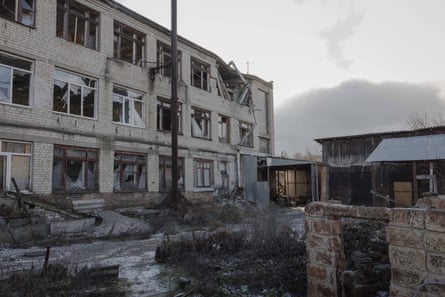
Ukraine halted the Russian advance, but Vovchansk lies abandoned and in ruins. A few months ago, drone footage suggested three or four people may be still eking out a living in a house in one suburb of the city – a few remaining residents in a town that was recently home to 20,000 people.
Kharkivskyi compared his home town to Pripyat, the abandoned town near Chernobyl that was evacuated after the 1986 nuclear disaster. “The difference is that you can at least walk around Pripyat now. I don’t think anyone will be walking in Vovchansk for years. There are a huge number of corpses, dead livestock, all the unexploded shells and mortars. Half the Mendeleev [periodic] table lying around on the ground. It would take years to clean up,” he said.
Now, as villages south of Vovchansk come under intense Russian drone attacks, Kharkivskyi is again spending his days driving towards the frontline to evacuate civilians.
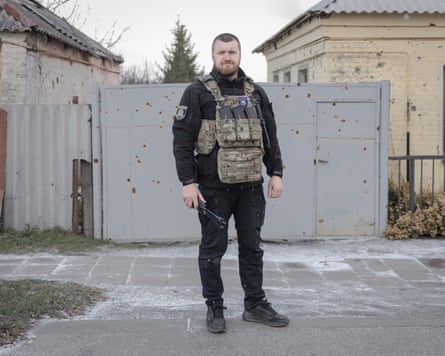
Some of those are people he evacuated last year, who went back home and now want to leave again. It feels a bit like the film Groundhog Day, he conceded, as his mud-spattered police car slalomed along a cratered dirt track on another visit towards danger. A drone detector on his lap beeped to let him know that, somewhere nearby, a drone was flying. If a drone gets within a mile, the handheld device intercepts its camera signal and relays it on to a small screen.
“Once you see a picture on the screen, it’s better to turn around and drive away quickly. If you see yourself on there, then you’re in real trouble,” he said. He laughed, but darkly: last year, a drone hit the car behind him during an evacuation. His friend and colleague was killed. Several others have been injured during evacuations.
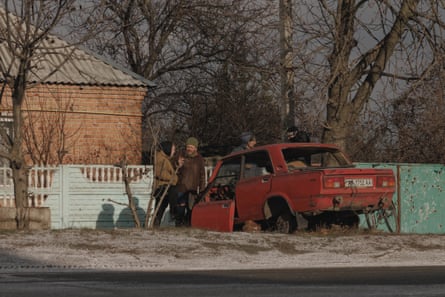
He admitted that he was exhausted by the continuing struggle, but said he was in no mood to surrender: “I think everyone would be ready to stop the war on the current contact line. But to just give away territory, how can we do that? What have we been fighting for for four years, then?”
Kharkivskyi’s base since his home was destroyed is in the town of Staryi Saltiv, south of Vovchansk. Staryi Saltiv has not seen active conflict since Ukraine regained control in September 2022, but war damage is everywhere.
The school building, reduced to rubble in 2022, had been under reconstruction for nearly two years, but was completely destroyed again in a missile strike last spring, just as it was almost finished. Now, an underground school is being constructed next to the ruins of the building.
“Some people say, ‘Why do you bother building anything here when you’re so close to Russia?’ But without a school, people who work and pay taxes won’t come back,” said Konstiatyn Gordienko, who works in the local administration and went to the same school, in the 1980s when it was newly opened.
Gordienko railed against what he described as Europe’s indifference to Ukraine’s fate and blindness to the danger posed by Russia, but then relented, conceding that he too had not taken the threat seriously after the annexation of Crimea. “To be honest, I don’t blame the Europeans. When 2014 happened, I also didn’t understand the war in the way I understand it now,” he said. “When you have your tooth pulled out, you can’t explain the pain to someone who’s never had toothache.”
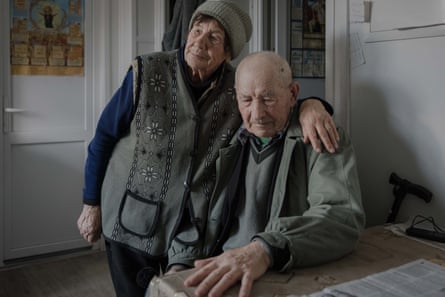
There are few buildings in Staryi Saltiv that do not bear signs of war damage, and many are completely destroyed. Mykola Spivak and his wife Halyna, both 87, live in a temporary container home, provided by a Christian charity. From the window, they can see the remains of their old house, where Halyna was born in 1938 and from which the Nazis deported her as an infant in 1942.
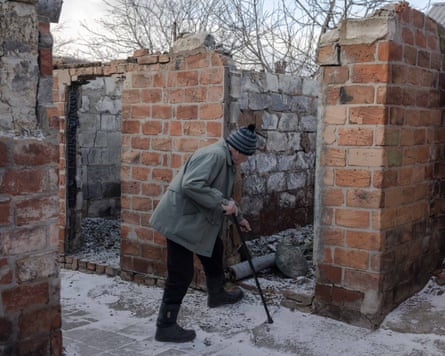
Spivak gave a mournful tour of the ruins, pointing with his walking stick at piles of rubble and cracked tiles, announcing what they had once been: “The bathroom … the summer kitchen … the living room … here there was parquet flooring.”
A worried relative bought them a small apartment in Kharkiv, but after trying it for a few months they decided it was better to be back in Staryi Saltiv, where both had spent their entire lives, whatever the conditions. “Birds migrate home, and so do we, it’s only natural,” said Spivak.
Each evening, the couple walk a few hundred metres down the road to stay the night at a friend’s house, where the noise from drones and air bombs is a little quieter and the heating works better. Every day, they listen to the radio. They don’t care much for geopolitics, but hope to hear that a peace deal has been struck that would make the nights quieter and the last years of their lives a little more bearable.
“Peace, peace, peace, we are just waiting for peace,” said Spivak. “Maybe they’ll all sit at the table, have a shot of vodka and finally hammer it all out.”