3 months ago
85
3 months ago
85
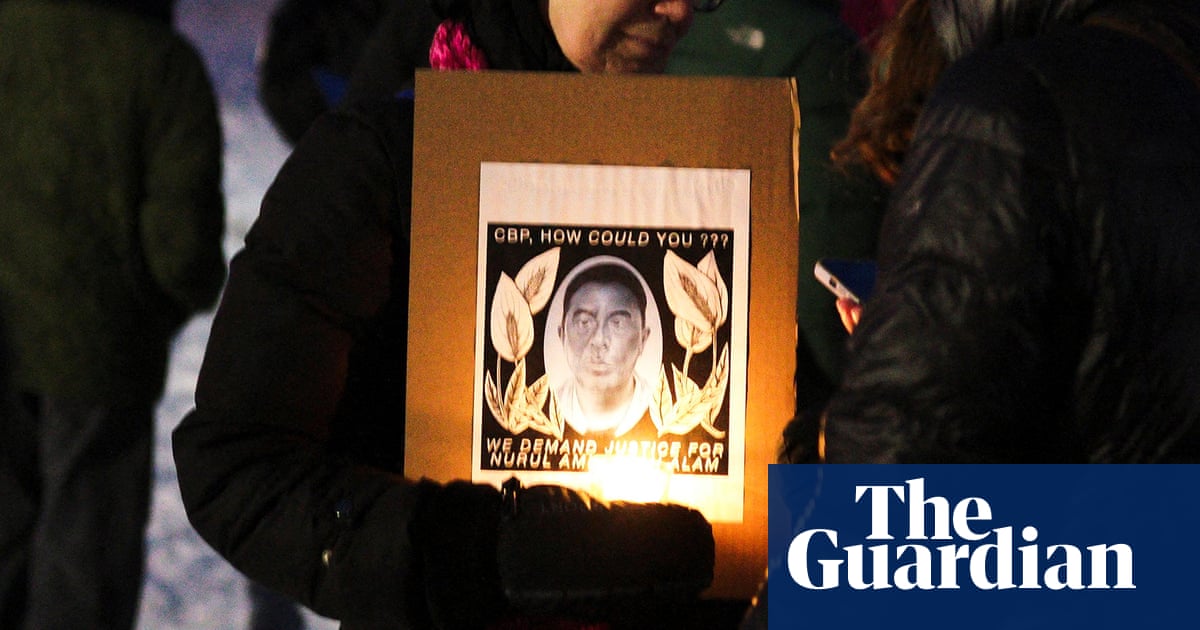
The shooting at a mosque and school in San Diego has forced Muslim Americans to ask themselves painful questions. After the killing of three people in an armed attack last week, they now wonder if other places of worship will be targeted next, whether they can still send children to school and trust that they will return home unharmed, and whether they can still safely walk the streets as people identifiable by their faith.
These are also questions that Jewish communities are reckoning with, most recently after the stabbings in London’s Golders Green neighborhood. Over the past three years, against the backdrop of wars in the Middle East, antisemitism and anti-Muslim hate have flared across the west, with each rising to record levels. But these two hatreds have rarely been seen as related dangers, let alone confronted as a common threat to societies.
On the weekend before the San Diego attack, tens of thousands rallied in London behind the anti-Muslim agitator Tommy Robinson, who declared a “battle of Britain” and called for “remigration”. “It’s time for many Muslims to leave this country,” he said. Across the west, as support for the far right surges, hostility towards Islam and Muslims has become central to its political platforms, and has spread beyond it. When Muslims prayed publicly in London’s Trafalgar Square in March to mark Ramadan – just as other religions have done on their own holy days – leading Conservative politicians denounced it as an act of “intimidation” and “domination”.
The violence in San Diego came out of the demonization of Islam and the dehumanization of Muslims that has been around for decades – by politicians, in the media, in popular culture and across social media. Islam is now widely, and even casually, described as a backward or inherently violent religion that represents a civilizational threat. Meanwhile, Muslims are portrayed as people whose customs and values are irreconcilable with western ones. They are cast as a threat to the majority’s identity, culture, security and demography.
Antisemitism has its deep roots in vile conspiracy theories about hidden power, claiming that Jews form a shadowy elite that manipulates events through the secret control of governments, banks, the media and courts. These libels are centuries-old, and they persist today. George Soros – a Holocaust survivor and the founder of the philanthropic organization I lead, the Open Society Foundations – is a frequent target of antisemitic attacks that deploy ugly tropes to allege his human rights philanthropy is a plot to subvert societies. In 2018, these conspiracy theories led to a pipe bomb being sent to his home and were used by an attacker to justify the shooting at the Tree of Life synagogue in Pittsburgh.
Sometimes, anti-Muslim conspiracy theories fuse with antisemitic ones. The clearest case is with the white nationalist “great replacement theory”, conjured up by the French polemicist Renaud Camus, who falsely claims that a conspiratorial elite is replacing white majority populations with non-whites, mostly from Muslim backgrounds. The term “replacist elites” is used as a code for Jews. In 2017, white nationalists marched through Charlottesville, Virginia, chanting “Jews will not replace us.” Nigel Farage accused Soros of encouraging people to “flood Europe” and claimed Soros didn’t want the continent “to be based on Christianity”. It’s a single conspiracy theory that requires two elements at once: a Muslim population to fear, and a Jewish elite to blame.
There are also echoes across time. The anti-immigration campaigns of today carry reminders of the antisemitic laws that were imposed in the UK and the US in the early 20th century to prevent Jews fleeing persecution in eastern Europe from finding refuge, including after the Holocaust. The “Aliens Act” of 1905 was the first British law to restrict immigration, with champions of the legislation describing Jewish people as “a race apart” and warning of the need to “push back this intolerable invasion”. Far-right groups marched into neighborhoods, claiming jobs were being taken from them. The press attacked Jewish communities for the “foreign” languages they spoke and the customs they practiced.
Today, the two communities are frequently pitted against each other. When Zohran Mamdani was campaigning to become New York City’s first Muslim mayor, there was a torrent of hate directed at his identity, sometimes framed as concern for Jewish safety. In Germany, the chancellor has claimed that antisemitism has been “imported” by migrants, ignoring his own country’s history. And in France, Marine Le Pen – whose party has antisemitic roots – says her National Rally is a shield to protect Jewish people from “Islamist ideology”. In each case, the message was the same: for one community to be safe, the other must be feared.
These divisions have been deepening since the 7 October 2023 massacre of Israelis and through the wars on Gaza, Lebanon and Iran. There has been a dangerous blaming of Jewish people for the crimes of the Israeli government and of Muslims for the crimes of Hamas and other armed groups. There must be space for the legitimate criticism of any state, government or ideology, but collective blame – the holding of a whole people responsible for the actions of an extreme few – must be refused.
We see that refusal in the response of Jewish communities in San Diego, who have been among the first to condemn the attack and stand in solidarity with Muslims. We’ve seen it in the wake of the massacre at the Tree of Life synagogue, when Muslim Americans raised funds for the grieving congregation. When gunmen attacked a Hanukkah gathering at Sydney’s Bondi Beach last year, the man who ran at one of them and wrestled away his weapon was a Syrian-born Muslim, Ahmed al-Ahmed. These moments show how the defense of one community is strengthened, not weakened, when extended to the other.
These are the stories we must tell, and the lessons we must learn from. These forms of solidarity are the foundation of a different vision – not a society organized by fear, where people are targeted for who they are and old hatreds are weaponized to decide who belongs and who does not.
If these hatreds rise together, feeding on conspiracy theories and the politics of fear, they cannot be defeated apart. The pernicious bargain that insists on trading in the safety of one community for the rejection of another is a false one. The danger does not end with Muslims and Jews. The threats to these communities today will follow others tomorrow. To defend them, and to defend them together, is how an open society defends itself.
-
Binaifer Nowrojee is president of the Open Society Foundations