3 months ago
144
3 months ago
144
The Bank of England is in no rush to raise interest rates while the outcome of the Iran war remains uncertain and the UK’s growth rate stays weak, the governor, Andrew Bailey, has said.
In a signal that borrowing costs will remain at 3.75% at least during the summer, Bailey said it was tolerable for inflation to stay above the Bank’s 2% target during the current crisis. However, that would change if a more permanent increase in prices began to take effect, he said.
“Given the context of softness in the real economy and uncertainty around the scale and duration of the shock, tolerating temporarily above-target inflation to provide some support for the real economy is an appropriate way to approach the trade-off [between inflation and activity],” Bailey said.
“But that tolerance would weaken if signs of second-round effects begin to emerge.”
At the start of the year, financial markets had expected the Bank to cut interest rates twice this year to 3.25%. Since the Iran war began, the situation has reversed, and now a rise of 0.25 percentage points to 4% before December is forecast.
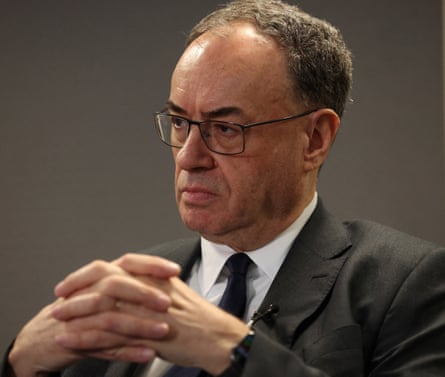
Speaking at a conference in Reykjavik organised by Iceland’s central bank, the governor said the economic situation had deteriorated since the start of the bombing of Iran by the US and Israel.
“We have to monitor the situation in the Middle East and how it affects the UK economy and inflation very closely and adjust policy as required,” Bailey said.
Central banks across the world have struggled to cope with the shock increases in energy costs sparked by the Iran war.
The Federal Reserve, under pressure from the US president, Donald Trump, was expected to reduce interest rates this year but is now forecast to hold them steady after the new Fed chair, Kevin Warsh, took the helm on 22 May.
Policymakers at the European Central Bank have signalled a likely rate rise in June after it cut rates by more than the Bank of England before the Middle East conflict.
Bailey said that one reason the Bank was prepared to wait was that borrowing costs had risen for homeowners and businesses without the central bank needing to adjust interest rates.
He said mortgage costs had increased since hostilities broke out as lenders reversed their expectations of rate cuts, dampening the housing market. Hedge funds and other financial institutions that lend money to businesses had also increased borrowing rates, he said.
“We have, in effect, tightened policy in my view. I was quite clear that I thought we probably would cut rates once or twice this year. That’s off the table,” he said. “So we’ve had about a 1 percentage point increase in the cost of new five-year fixed-rate mortgages. And that is obviously a tightening of financial conditions.”
Rising borrowing costs have also increased the cost of financing the government’s £2tn debt load, although Bailey said that in recent weeks this trend had eased. He said there was a hangover from the inflation increase in 2022 after the Russian invasion of Ukraine, which sent inflation soaring into double figures.
However, he said the central bank was now better prepared to assess the likely impact of rising energy costs on the economy and inflation, after adopting scenario planning.
The Bank now highlights the wide range of factors that could turn a temporary increase in inflation into something more permanent. So it was unlikely to allow a repeat of the previous inflation increase without taking swift action, Bailey said.