3 months ago
159
3 months ago
159
This week’s Hodge Report has formally identified problems that have long been anecdotally evident. Arts in the UK are underfunded and overburdened with bureaucracy to gain what little money there is in a contracting industry. It’s heartening, then, to see a major new charity step into the breach.
Veteran London-based violin dealers J&A Beare have supported students and professional players with loan-instruments for nearly five decades. Now they up the ante with a new Cultural Trust, founded to supply masterclasses, scholarships and practical support for string players. A biennial mini festival, featuring Beare’s instruments and their international players, launched last night at a sold-out Cadogan Hall, with a second concert at the Wigmore Hall this evening.
Talk about a supergroup. The sheer weight of star-power marshalled here was dizzying: violinists Janine Jansen, Ning Feng and Alexander Sitkovetsky; French quartet Quatuor Ébène; violists Timothy Ridout and Amihai Grosz; cellists Kian Soltani and Daniel Blendulf. But an army of musical generals needs serious musical terrain to conquer, and they got it in Schubert’s monumental String Quintet in C major – the composer’s 1828 farewell to chamber music and to life – and Schoenberg’s rule-breaking, harmony-bending 1899 sextet Verklärte Nacht. The opening sextet from Strauss’s Capriccio was a buffer zone between.
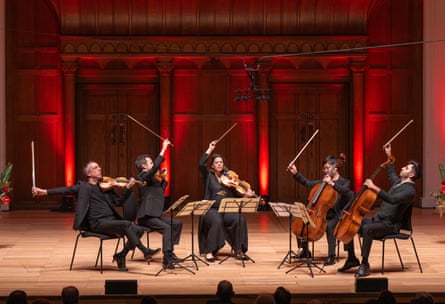
The Schubert saw the Ébènes joined by Soltani; where Mozart and Beethoven added an extra viola to their quintets, Schubert chose a cello. The effect is anchoring, spacious, rooting a musical glimpse of heaven absolutely in earth. And it was Soltani who provided this guide-rope, the ghostly violin’s insistently corporeal double in the famous adagio, a defiant life-force in the fanfares of the scherzo, holding us fast through the convulsive dance of the finale. If the quartet’s instinct was to skate with Gallic elegance on the surface of this vast work, Soltani’s was to dig in. The resulting conversation, sometimes debate, was compelling.
Where Schubert teeters on the brink of life, Schoenberg stands at the edge of harmony itself, one foot suspended over the void. When Jansen recorded it in 2013, she and her hand-picked group leaned hard into that extremity, underlining the musical melodrama of a narrative that sees a woman confess to her lover that she is pregnant by another man. The Dutch violinist’s approach has since audibly softened, her own moonlit tone – glinting high and sweet through the ensemble, silver to viola Grosz’s bronze warmth – drawing out the strange, transformative mystery of this “Transfigured Night”. Collegiate intimacy was uppermost here, letting the supple score find its own shape without undue intervention. It takes a lot of skill to wrestle Schoenberg’s score into submission, still more to surrender so completely to it.