1 month ago
93
1 month ago
93
It’s lunchtime in Stratford-upon-Avon and Helen Hunt has 30 minutes to spare. She’s preparing for her Royal Shakespeare Company debut and is taking time out to speak to me via Zoom, just her head and shoulders, with what looks like a sleek-surfaced kitchen in the backdrop. Hunt is all sleek surfaces herself: polite smiles, even tones and an inscrutability so strained it makes me wonder what might be bubbling underneath.
Hunt is starring alongside Kenneth Branagh and Bill Pullman in a new version of The Cherry Orchard. She plays Madame Ranevskaya, the Russian aristocrat and matriarch who returns home to find her family estate in jeopardy. The play, like so many of Chekhov’s, is about the apathy of the elite class in the dying days of the Russian empire. So why this play, for her, and why now?
“Honestly,” she says, “it’s the perfect question for the director, mostly.” Oh? “It’s different if I direct a movie or direct a play. Probably a version of it is right for me as an actor. Why this play, for me, why now? I guess …” Yes, for you. She lists the reasons: “One of the great playwrights. An impossible beast of a part. A wonderful director [Tamara Harvey] whose ideas and approach interested me.”
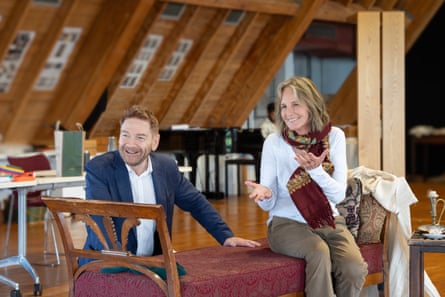
And there’s Branagh, who plays the self-made businessman Lopakhin. Hunt did not know he’d be in it when she came on board but she is A Very Big Fan. “My father was an acting teacher who took me to see his Henry V movie and I thought, ‘Wait, that’s possible?’ That the verse could come to life that clearly and passionately and poetically, that I could understand it in such a crystal clear way, that it could be as exciting as any action movie.”
Hunt, now 63, is excited about making her RSC debut too. “My favourite kind of work is what’s been done here so I’m thrilled and flattered, honestly.” Since The Cherry Orchard is a play about class and entitlement, I wonder if she thinks it speaks to us today, given the wealth divide and the profligacy of the 1%? “I see us in it,” she says, but doesn’t believe it’s a perfect fit. “I think it’s even more timeless than the political situation right now, even though there’s lots of resonance.”
Ultimately, she believes, it’s about the “overwhelming terror we all have of change. It’s wanting the best for your fellow man, but wait, what if it actually costs me something meaningful? In the case of my character, she is rich and she is maybe incredibly generous day-to-day [but also] participating in and profiting from a system that is causing a lot of suffering. And as a human being, she’s suffered a lot.” This includes the loss of a child. “So, on a personal level, if we step away from the politics of it, how do you move through your life as a person who has been through a lot of trauma?”Hunt’s father was a film, voice and stage director, and she fell in love with that world at the age of nine while taking an acting class. Did she ever want to do anything else? “It’s so strange, it just happened. I went to an acting class not because I wanted to be an actor but because my aunt did. She’s my age – we grew up as sisters and I spent summers with her. And that’s what she did on Saturdays. So I went too. There was no big design. Honestly, 50 years later, I’m still studying. The thing that was added was my writing and directing – trying to get my own thing off the ground, which was born from not getting enough jobs.”
She’s spoken before about the dearth of meaty female parts, which led to her taking things into her own hands. Does she feel the market narrows as a result of Hollywood’s oppressive focus on women’s ages, bodies and faces? If so, how does she navigate that? “You just don’t – because there’s nothing you can do. I guess you could try to change how you look, but short of that there’s nothing to do but make art if you are an artist. Whether you’re hired or not, whether people like you or not, whether they like how you look or not, you just have to keep finding a way to be making work. That’s how I have dealt with it.”
Her last London appearance was at the Old Vic four years ago in Jonathan Spector’s Eureka Day, a satire about liberal America in which she brilliantly played a passive-aggressive California liberal. There have been a few flashpoints in London theatres of late, involving actors and audiences: Lesley Manville expressed her disapproval of people taking videos during a final ovation and Rosamund Pike felt compelled to return to the stage after a show to talk about an audience member’s texting.
Does Hunt feel audience behaviour has changed and are there things she doesn’t like? “Well, phones have changed everything. I think we all just have to be on guard from how they keep us from being present. If you’re looking at Rosamund Pike being brilliant through a five-inch rectangle instead of having your heart open and doing yourself the favour of being present with what she’s doing – I think we all have to be careful.”
Hunt learned to do herself this favour early. “I would go to rehearsals with my father or see early productions of plays in New York. I knew I liked being in that room with creative people who were telling a story that could be sad or scary or funny. It wasn’t real so there wasn’t a danger. I never thought of being on the stage or off the stage. I just wanted to be around it. Then I took the [acting] class and someone saw me and put me in a movie and then another. I kept studying and kept working and you turn around and here you are.”
She speaks about being influenced by two legendary RSC teachers: Cicely Berry and John Barton. “I watched their work. When I began to think, ‘Uh-oh, what if I get bored of being an actor?’, I realised, well, when you really work on wonderful playwrights, Shakespeare and Chekhov to name two, you’re never going to get bored because you’re never going to be good enough to get bored. There will always be more to learn and the language will keep giving to you in a way that other kinds of language won’t. So I’ve so far not been bored.”
Is she driven by the desire to work in itself – or is it the role and the learning? “Number one, if I had to put it in order, would be the story. It doesn’t have to be the best or biggest, but if I like the story, that’s compelling. Good part: wonderful. Working: terrific. Money: also good when it’s there. But I would say being part of telling a story that you find compelling would be the number one draw for me.”
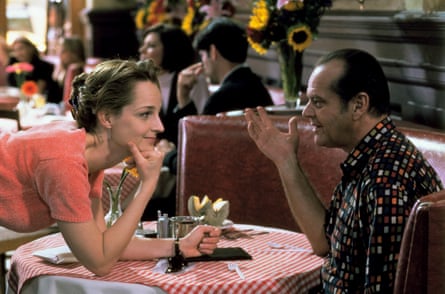
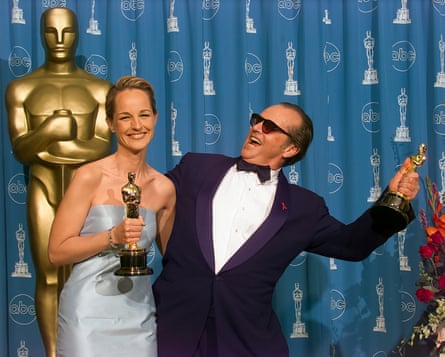
Among her considerable film accomplishments are blockbusters such as Twister and As Good As It Gets, the latter opposite Jack Nicholson, for which she won an Oscar (she has also won four Emmys and four Golden Globes). What’s striking about her Oscars speech is how composed she is. What did she actually feel? “I don’t think ‘composed’ would be a word that many people would use in that moment. I felt … I don’t know how I felt. Probably exhausted. Certainly, there’s a little bit of a dream-come-true moment that happens alongside a whole lot of stressful focus on what are you wearing, who did you thank, who didn’t win and a lot of other things.”
She also namechecked her fellow contenders and suggested the Oscar might have gone to Judi Dench for her performance in Mrs Brown (a film she said she watched three times). Was there an element of impostor syndrome? “No, I felt very proud of my work and very impressed by the work of those other women. Awards are fun and it’s fun when it lands in your lap. But you can’t help noticing that there’s no comparing Judi Dench’s work in that movie. It’s not an Olympic relay – they can’t quite be compared. [But] I’d feel like an impostor if I didn’t include the other performances.”
As someone who took part in the Women’s March of 2017 – a protest on the day after the first inauguration of Donald Trump – how does Hunt feel about his second term? Does she feel it is a hard time to be creative, to be an actor? “I think now’s a hard time to be a human being, in my country certainly. But I’m not sure how to translate it into what it’s like to go to work.” She pauses then rounds off her thoughts: “Yeah. It’s a challenging time for sure.”