3 months ago
129
3 months ago
129
Brazil’s congress has approved a bill to reduce the prison term of Jair Bolsonaro, the former president who was sentenced to more than 27 years in prison for masterminding an attempted coup to overturn the 2022 elections.
Approved last week by the lower house and late on Wednesday by the senate, the bill now goes to President Luiz Inácio Lula da Silva, who has 15 working days to sign or veto it.
Brazil’s leftist president – who, investigations showed, was the target of an assassination plan as part of the coup plot – has already indicated he is likely to veto the bill, but that decision would probably be overturned afterwards by the largely conservative congress.

Legal experts estimate the bill will reduce Bolsonaro’s time in a closed regime, currently a minimum of six years, to just over two, depending on sentence reduction mechanisms such as good behaviour or reading books.
The far-right leader is already serving his sentence in a special cell at the federal police headquarters in Brasília, and his lawyers are seeking supreme court authorisation for him to undergo hernia surgery.
Although the legislation falls far short of the full amnesty Bolsonaro and his sons had been demanding, its approval is being celebrated by the former president’s family.
“It wasn’t exactly what we wanted … but it’s what was possible,” posted the senator Flávio Bolsonaro, the former president’s son and, for now, the family’s choice to take on Lula in the 2026 election.
The bill reduces time in prison by combining the sentences for two different crimes – such as “attempted coup” and “violent abolition of the democratic rule of law” – but counting only the offence with the higher sentence.
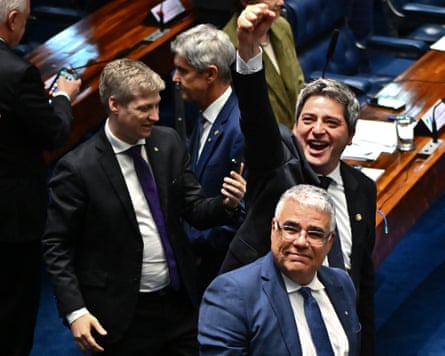
It benefits not only Bolsonaro but all of his aides, including high-ranking military officers who, for the first time, were also convicted of attempting a coup in Brazil, as well as hundreds of people who ransacked the capital, Brasília, on 8 January 2023.
For that reason, the approval is being seen as a significant setback for those who had widely celebrated the convictions as a sign of democratic progress in Brazil. A recent opinion poll showed that most Brazilians opposed reducing the sentences.
The journalist and writer Miriam Leitão, a prominent political analyst, described the bill’s passage as the reopening of Brazil’s “historic cycle of impunity”: “2025 was set to go down in history as the year in which Brazil punished coup plotters for the first time, but the bill … threatens to make the country repeat the past,” she wrote in her column for O Globo newspaper.