1 month ago
90
1 month ago
90
Human hands – nimble, nerve-filled appendages that are the most flexible part of the human skeleton – are exceptionally complex. Many tasks that most people can do largely without thinking, from tying a pair of shoelaces to buttoning up a shirt, in fact require a complex set of neurological instructions and precise choreography. In thousands of years of human history, no machine has been able to truly replicate human’s greatest tool.
But now, as artificial intelligence (AI) races forwards, some companies think they are close to surpassing this final but most difficult hurdle in robotics. Most of them are in China.
A new suite of Chinese start-ups are leveraging China’s advantages in manufacturing and enthusiasm for what the government calls “embodied AI” to build the fully dextrous robotic hands that are needed to transform humanoid robots from dancing gimmicks into useful products.
Ever since Unitree’s troupe of dancing humanoids tottered on to the stage at 2025’s Spring Gala, the annual variety show televised at Lunar New Year, China has been going gaga for robots.
Technologists and policymakers see robotics as the key to unlocking China’s future economic potential as it grapples with an ageing and shrinking workforce. Marketing materials for robotic companies show their products performing all kinds of tasks that humans will supposedly soon be free of: folding laundry, cooking, cutting hair.
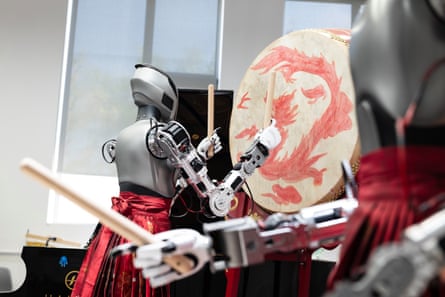
Beijing has repeatedly emphasised the importance of “embodied AI” in China’s development plans. In May, the Chinese Communist party’s theoretical journal, Qiushi, published a report that said “embodied-intelligence robots” were among the sectors “opening up new trillion-yuan markets”.
But although China is racing ahead in the deployment of automatons – more than half of the factory robots that are installed each year are in China – the use cases for humanoids remain minimal. “True multipurpose humanoids are far off yet,” concluded the International Federation of Robotics in a report published last September.
That is because many of the tasks that would make humanoids useful in daily settings require human-like hands. And making them is extremely difficult. Last year, Elon Musk, whose company Tesla makes the Optimus humanoid, said hands represented the “majority of the engineering difficulty of the entire robot”.
‘100 times more difficult’
In an office brimming with writhing, floating robotic hands of various weights and sizes, the founder of LinkerBot, one of China’s leading dextrous hands companies, explains the challenge.
Making a robotic hand is “one hundred times more difficult” than making a humanoid, Zhou Yong says. “Its dexterity is 10 times that of other body parts. But its volume is only one tenth of other body parts”.
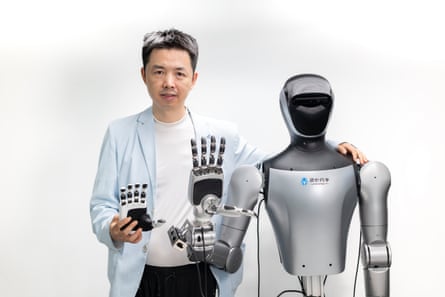
Like many Chinese entrepreneurs, Zhou is inspired by the American greats. Having graduated from Huazhong University of Science and Technology, one of China’s top schools, Zhou was interested in designing apps as well as robotics. But he listened to the quote from Steve Jobs about the importance of focus (“Innovation is saying no to 1,000 things”) and decided to focus just on hands, launching LinkerBot in 2023. The company now makes about 5,000 hands a month and has plans to double that figure as it chases a valuation of $6bn. “Human hands are the most important ability of human beings,” Zhou says. “If we focus on this one point, it is easier to realise many human skills.”
Among Zhou’s ambitions are to make mass-market prosthetic hands for amputees at a fraction of the current price, which can be tens of thousands of dollars. Zhou believes his company will be able to bring the price down to just $1,000 per hand.
Making robotic hands requires solving hardware and software problems.
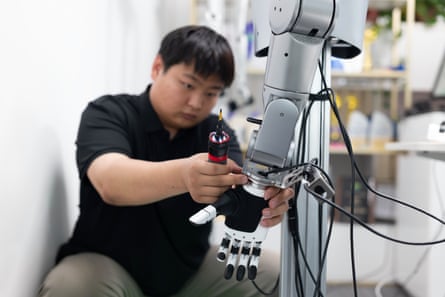
Thanks to a cheap, sophisticated and nimble manufacturing supply chain, Chinese companies are racing ahead on the hardware side. The rise of China’s electric vehicle industry has produced many companies that are capable of producing the components needs for robots at scale, from lithium-ion batteries to miniaturised motors.
Pan Yunzhe, the founder of Wuji Technology, a Shenzhen-based robotic hands company, says the ease of sourcing components in China is the reason he founded his company there rather than in the US, where he graduated in 2018.
“It was really impossible to do hardware in the United States because the supply chain problem is just so constraining,” he says. When he tried to start a company in the US, he needed to ask his father to post parts to him. So he decided to return to China to start his company there instead.
Teaching hands to move
Zhou and Pan are two of the thousands of entrepreneurs betting on China’s robotics hype. China has now registered more than 1m robotic companies, with registrations in 2025 up 40% on the previous year. The companies focused only on hands represent a fraction of that market, but it is growing fast. Last year the dextrous hand industry in China surpassed 50bn yuan ($7.4bn), according to Chinese media, up from 13bn yuan in 2024.
Pan says he decided to focus on hands because “the problem of manipulation is much more important than the problem of locomotion”. Humanoids can move through space, but until they can manipulate tools, they are all but useless.
The more challenging problem is software – how to teach the hands how to do things.
“The challenge of making these hands is getting solved now,” says Nathan Lepora, a professor of robotics and AI at the University of Bristol. “Controlling them, now that’s a whole different game … nobody knows how to do that.”
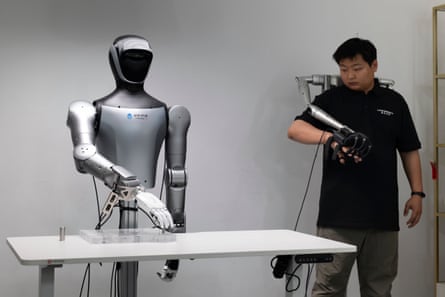
Anyone who has tried to operate a claw machine at a funfair to grab a stuffed toy knows how difficult it is to control a machine from afar – a process known as teleoperation.
But that is exactly what many start-ups are trying to do at scale to harvest the vast amounts of data needed to train spatial intelligence models. Unlike large language models, which can be trained on the virtually infinite reams of text available on the internet, data sources for three-dimensional models are scarce.
As well as teleoperating robotic hands, which can require hundreds of training hours to teach a robot to do a task as simple as packing a bag of groceries, researchers are increasingly moving towards more seamless methods, such as getting humans to wear sensors that can collect data as the human goes about their daily life.
One of Wuji’s flagship products is the Wuji glove, a sensor-filled wearable device that can collect movement data as well as more subtle but vital information about pressure and touch. That kind of information is intuitive to humans and allows someone to crack an egg on the edge of a frying pan rather than crush it with their bare hands, skills that are still alien territory for robots.
“The two most fundamental problems in dextrous manipulation in terms of data collection are capturing how a human moves and what humans are touching or feeling,” says Pan. Those questions are “super complicated and not solved yet”.
But China’s entrepreneurs are betting they will be the ones to solve it. LinkerBot’s Zhou dreams of a future where a factory of robotic hands builds more robotic hands – a self-perpetuating loop that has minimal human input. Further down the line, with the right hands, robots might be able to become fully-fledged household helpers.
“We are not creating robots to replace labour,” Zhou says. “We are creating robots so that humans can live a better and more prosperous life.”
Additional research by Lillian Yang and Yu-chen Li