3 months ago
164
3 months ago
164
Citizen scientists have discovered what they believe is one of the largest coral colonies ever documented on the Great Barrier Reef.
The coral spans approximately 111 metres in maximum length and covers an estimated area of 3,973 sq m – about half the size of a soccer field.
The Pavona clavus coral was first found by Jan Pope in waters a few hours offshore from Cairns. It was identified as part of the Great Reef Census, a citizen science project run by Citizens of the Reef.
“It was quite glassy and I could see this very strange pattern in the water,” Pope said. “When I jumped in the water, it became obvious to me that I’d found something, that I’d never seen anything like it before.”
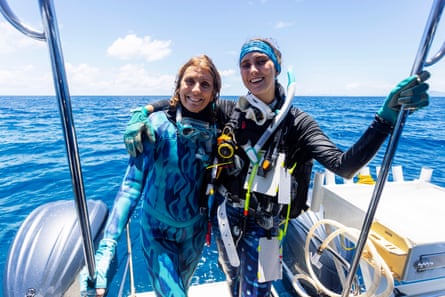
Pope, who has been diving on the Great Barrier Reef for 35 years, described it as “a very surreal underwater landscape. It looks like a rolling meadow.”
Pope’s daughter, Sophie Kalkowski-Pope, surveyed the site with her mother a fortnight later. “We had no idea that something so significant was right here on our doorstep,” she said.
Kalkowski-Pope, marine operations coordinator at Citizens of the Reef, said the census project used crowd-sourced images to monitor coral cover across the Great Barrier Reef. The organisation estimates it has surveyed a quarter of the reef since 2020.
Sign up: AU Breaking News email
An aim of the project is to identify key source reefs – “hotspots of resilience” that can supply other reefs with larvae when they spawn, Kalkowski-Pope said.
The curator of corals at the Queensland Museum, Dr Tom Bridge, who was not involved in the research, said Pavona clavus was an uncommon and “quite hard to find” coral. “But where it is [found], it can form really, really ridiculously huge colonies,” he said.
In 2024, a coral of the same species, measuring just over 1,000 sq m, was discovered in the waters of Solomon Islands.
Bridge, also a senior lecturer at James Cook University, said: “Very large coral colonies are going to be exceedingly rare because we’re finding bleaching is increasing in severity but also in frequency.”
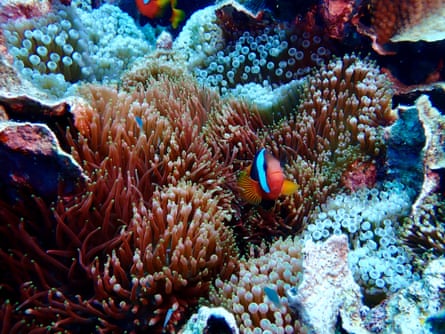
For a coral colony that was dozens or hundreds of years old, the chances of escaping bleaching conditions or being tough enough to withstand hot waters were diminishing, he said.
But Bridge added genetic testing was required to confirm whether the Cairns coral truly was one colony – that is, all formed from one original polyp.
Another possibility is instead of being one individual, the coral consists of multiple colonies that settled in close proximity and coalesced together as they grew.
For genetic testing, “we would need over 300 individual samples from across the colony because it’s so big,” Kalkowski-Pope said.
To estimate its size, the coral colony was mapped using a technique known as photogrammetry, in which photographs of the coral from the water’s surface were stitched together into a 3D model.
Serena Mou, a research engineer at the QUT Centre for Robotics, described the mapping as “a bit of an interactive process”.
“The coral ended up being bigger than what Sophie initially thought,” she said.
Bridge said the coral species, now classified as Pavona clavus, was set to be reclassified as part of an overhaul of coral taxonomy.
Another citizen science project called Map the Giants, run by the University of Milano Bicocca, tracks giant coral colonies around the world.