2 months ago
110
2 months ago
110
Elliot Anderson is running. It’s the 88th minute against Croatia, and the game is won, and the game is done, and this is the 60th game of his season and there are deeper challenges to come. But as long as the ball is loose, he’s going to chase it down: first Josip Sutalo and then Josko Gvardiol, a simple recycling of defensive possession rapidly mutating into an unpleasant ordeal. As the ball is worked across defence, Anderson single-handedly follows it all the way across the pitch, over to the far touchline, where he eventually forces a rushed pass and a turnover of possession.
And in an opening win defined by mood swings and tectonic shifts, in a team savouring the wealth of options and contingencies at its disposal, it’s worth dwelling on just how quickly Anderson has become indispensable. Declan Rice is carrying a knock and looks a little short of gas. Harry Kane will almost certainly not have the legs to play eight full games plus extra time. The wingers, the centre-half pairing, the full-backs are not yet set in stone. Beyond Jordan Pickford, virtually every area of this team is operating in a kind of managed flux.
In the midst of which Anderson has assumed the role of its spirit animal, its mathematical constant, its barometer, the reliable rock to which – for better and worse – England’s fate over the coming weeks will be inescapably yoked. In short, if you want to know how England are doing in the coming weeks, you basically just need to watch him. Central to Anderson’s role, paradoxically, is the fact that it is not always a central role. Indeed, if you look at his heat map from the Croatia game the most striking element was how much of it he spent in wide areas: linking play with the full-backs, creating overloads and triangles, playing the first-time long ball over the top that appears to be a specific and very deliberate tactic.
In essence, it works like this: Reece James gets the ball on the right touchline. Draws the pressure from the opposing winger. Retreats towards his own goal, waits for Anderson to run towards him, and then plays a little sideways pass inside. Anderson then launches it first touch, rugby-style, into the right channel for one of the forward runners to chase. A simple move, but one that requires coordination, the physical strength to hold off the challenge, and a clean ball contact. Done right, it successfully provokes the opposition press, drags them out of position, forces them to turn and run.
In the 36th minute, we got a glimpse of what happens when it’s not done right. Anderson fluffed his lofted pass, Croatia won back possession and a few seconds later Martin Baturina had equalised. But then, shortly after half-time, the same move worked to perfection: James inside to Anderson, Anderson first-time up the touchline, and with the Croatia defence scrambling Jude Bellingham converted beautifully.
Even here there are caveats to offer. Anderson’s pass was almost intercepted by Gvardiol, and probably intended for Noni Madueke rather than Bellingham in any case. Clearly, Thomas Tuchel has drilled this move in advance against teams enterprising enough to press England high. But what happens against opponents who either do not press, or press better than Croatia, or who are wise to the tactic and lurk in ambush?
And really, these are questions that strike at the broader theme of what Anderson’s function in this team should really be, how best to use a player who in terms of skill set may well be one of the complete young midfielders English football has ever seen at his age. Anderson can genuinely do it all: pass, tackle, screen, jockey, cross, shoot. He’s good in the air, strong in duels, delivers a mean set piece, will quite literally run all day. Is there a realistic role in this team that does not, in some way, sell him short?
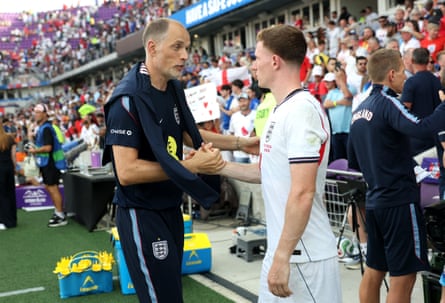
Curiously, as the game opened out in the second half we got an answer of sorts. Rice went off; first Bellingham and then James slotted in to replace him; Anderson moved over from the right side of midfield to the left. As a right-footer, the first-time ball over the top from Nico O’Reilly was no longer an option. But instead, he offered much more of an individual threat. He bombed on into the area. He pressed much higher than in the first half. Partly, of course, this was a shift dictated by the momentum of the game. But it was a reminder, if anyone ever needed it, that this is a midfielder with so many different tools to his game.
It was interesting to watch an interview Anderson did with the BBC last month, in which he explained how his role has evolved since his days as a winger or No 10 at the Newcastle academy, and how he sees his role on the pitch now. “Six or eight, I really don’t care,” he said. “Getting on the ball and finding the attacking players, getting them the ball early in the pockets and letting them do their stuff.”
This is, of course, why Tuchel adores him: the ability to take the ball, ride the challenge, move it on early and forwards. All the same, it is worth asking whether punting long balls up the channels is in fact the best use of him. In hotter conditions, against the weaker opponents who will sit back, and the stronger opponents who will try to dominate midfield, where poise and control of the ball will be critical, England will need to show different sides to their game, measure the risk and reward a little more judiciously.
Ultimately, this comes down to an assertion of principle. Do you want to keep the ball in midfield, or get it out of there as quickly as possible? And in the deployment of Bellingham and James to replace Rice in the second half, the decision to leave Kobbie Mainoo on the bench and Adam Wharton at home, Tuchel has made his priorities subtly clear. He appears less concerned with midfield control than midfield mobility, as preoccupied with physical resilience as technical ability.
Anderson can do it all. But sometimes being able to do it all can be a double-edged sword. The roads are littered with prodigious young midfielders who seemed destined to rule the world and eventually had to settle for being quite good: Eduardo Camavinga, Saúl Ñíguez, Rúben Neves. Even Gavi and Warren Zaïre-Emery, now 21 and 20, have already lived through at least one cycle of boom and bust, struggled to reconcile their developing game with the explosion of teenage hype they inspired.
Anderson is 23, but a comparatively late developer with just two seasons of regular top-flight football and one major tournament game behind him. Already, Manchester City are circling and a nine-figure transfer feels inevitable. This is a player about to arrive in a very big way. And perhaps this is what makes him so compelling to watch right now. You know that on some level he must still be raw and fragile, and yet he never really looks it. You know that his importance is colossal, and yet he never seems fazed by it. You know at some point he will have to stop running. And yet, what if he never does?