3 months ago
100
3 months ago
100
David Koelsch, a former immigration judge based in Maryland, was in Minneapolis visiting his mother and sister the day Alex Pretti was shot and killed by federal agents. He drove to Nicollet Avenue, parked a few blocks away, and walked toward the scene.
“I didn’t go there to protest. I didn’t bring a sign. I didn’t bring anything. I just went to stand and bear witness,” Koelsch said.
What he saw shook him. Koelsch, 59, had never seen Immigration and Customs Enforcement (ICE) and Customs and Border Protection officers up close in full tactical gear, masked, armed with rifles and pistols, blocking off the street. About 50 to 75 agents stood in the road. Dozens of civilians watched from the sidewalk. People were yelling. Then the teargas came.
“My chest started getting tight,” he said. “I felt like throwing up.” He dropped to his knees, then scrambled half a block away. After a few minutes, he could breathe again.
Koelsch had spent four years as a supervisory asylum officer at the Department of Homeland Security before nearly eight years on the bench as an immigration judge in Baltimore. He investigated individuals with alleged ties to terrorism and later presided over asylum cases. He had taken the same oath as the agents now filling the street with gas.
“I was proud to do my part in protecting the country. But then to see these officers out in the streets, basically harassing civilians, I just felt kind of sad,” he said. “It just really repulsed me because they and I took the same oath. And I didn’t think they were living up to it.”
Four months before the Pretti killing, Koelsch had resigned. “I was actually planning on retiring in two years when I turn 62,” he said. His departure came amid a broader push by the Trump administration, supported by Elon Musk’s “department of government efficiency” (Doge), to offer buyouts to federal employees seen as obstacles to its deportation agenda.

Since January 2025, the Trump administration has fired more than 113 immigration judges, pushed out others through buyouts and reassignments and replaced them with military lawyers and political appointees.
The Guardian spoke with a dozen judges who had been fired or accepted buyouts, and others still on the bench to understand what is unfolding inside the immigration courts and what it may signal for the broader American justice system. Many said the purge was not just about immigration. It reflects a growing effort to exert political control over the courts, pressuring judges to align with enforcement goals. Some warned that if such pressure became normalized, it could reshape how justice is administered far beyond immigration.
All current judges and several former judges requested anonymity for fear of retaliation.
Some of the targeted judges across the country had been granting asylum at higher rates. Koelsch feared he might be next. He said: “Judges were being fired left and right. I knew my grant rate was higher than others. Maybe that would be a factor. So I thought, better to leave on my own terms.”
Koelsch said the erosion of judicial independence did not begin with Trump. He also criticized the Biden administration’s use of prosecutorial discretion to remove cases from immigration courts, calling it “a numbers game” designed to reduce the backlog. “They didn’t really care so much about the people,” he said. “They just wanted good headlines.” Since leaving the bench, Koelsch taught law, was able to have health insurance through his wife’s job and secured a full-time position at the faith-based refugee resettlement organization World Relief. It seemed like things were working out.
For others, that was not the case.

‘Bias is in favor of an alien’
Just months after Koelsch’s resignation, on 21 November 2025, Jeremiah Johnson, 52, a judge at the San Francisco immigration court, was having what he described as a normal day.
Johnson had been on the bench since 2017, appointed by then-attorney general Jeff Sessions during the first Trump administration (Koelsch was also a Sessions appointee). According to data from the Transactional Records Access Clearinghouse, he granted asylum in a large share of his cases, a rate significantly higher than the national average.
That afternoon, he granted asylum to a family of four in a case he described as well-prepared on both sides and then returned to the office.
Johnson said: “I was sitting in my colleague’s chambers with the supervising judge when someone walked by and said Chen and Savage, two other judges, had been fired.”
When he rushed back to his office, he found out he was also dismissed. “I logged on to my computer that afternoon. I had received a termination letter. I opened the PDF file. And before I could even print it, I was locked out of the system,” he said.
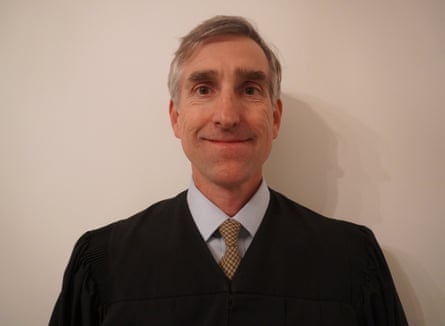
The firing of judges in the San Francisco area came as the administration moved to shutter the San Francisco immigration court, which went from 21 judges at the start of 2025 to just four early this year, according to NPR. The court closed 1 May, leaving a backlog of 120,000 cases and transferring much of its operations to a smaller court 35 miles away.
Johnson was one of five immigration judges fired that day in the San Francisco area, part of a pattern that had been building for months. Just four months prior, on 27 June 2025, Sirce E Owen, acting director of the Executive Office for Immigration Review (EOIR), issued a policy memorandum to all staff warning that “there are some Immigration Judges who appear to believe – based on their own personal policy preferences – that exhibiting bias is justifiable in certain situations, as long as that bias is in favor of an alien and against the Department of Homeland Security.” The memo threatened “corrective or disciplinary action” and suggested that judges who disagreed should “consider transitioning to alternate career paths”.
Johnson, now an executive vice-president of the National Association of Immigration Judges (NAIJ), rejected the suggestion that his record reflected bias. “They claim they have to reverse the Biden era, that judges have implicit bias, and they have a duty to weed it out,” he said. “Well, then, tell me I have an implicit bias. Tell me that’s why I’m being fired. If you say I have implicit bias, show me the statistics. Be exact.”
The Guardian submitted detailed questions to the White House’s office for immigration review about the firings, the Owen memo and reports that sitting judges have been threatened with removal for granting bond. EOIR declined to comment, calling them “personnel matters”.
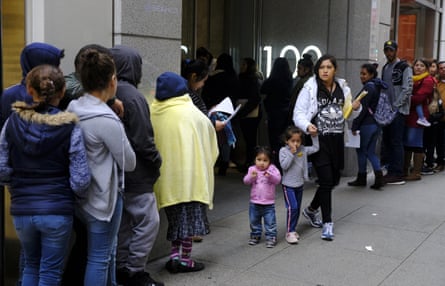
Abigail Jackson, a White House spokesperson, defended the Trump administration’s approach, saying that “Joe Biden’s open border allowed millions of illegal aliens to flood into the country and claim asylum despite lacking any legitimate claims.” She added that the president was fulfilling his promise to enforce federal immigration law.
The White House directed questions about the immigration courts to the Department of Justice, which did not respond.
‘The government doesn’t state a reason’
For Johnson, the lack of a clear explanation from the Trump administration is deeply concerning. He believes the firings are being justified under executive authority to accelerate what he calls “mass deportation”, often without due process.
A group of fired judges has already filed suit against the Department of Justice, challenging the administration’s authority to terminate immigration judges without cause or explanation. In a landmark ruling, the Merit Systems Protection Board, an independent federal agency created to protect federal employees from being terminated or disciplined for political reasons, said it had no jurisdiction to review their removal. The fired judges are appealing against the decision to the US court of appeals for the federal circuit, calling it a departure from more than a century of civil service precedent.
But some fired judges have pointed to a contradiction in the government’s own actions. Carmen Maria Rey Caldas, 46, noted that the government paid her severance, a benefit typically reserved for employees separated without cause.
“The government doesn’t state a reason,” she said. “And in fact, they just paid me severance. So arguably, that means they are admitting that there’s no cause because otherwise I wouldn’t be due severance.”
An NPR analysis found that many of the fired judges came from immigrant defense backgrounds, though the Department of Justice has denied targeting judges based on prior experience.
Rey Caldas, a first-generation immigrant herself, was born in Spain during the country’s fragile transition to democracy, just four years after the death of Francisco Franco, who had ruled as dictator for nearly four decades. She moved to the US at age 11 with her family, whom she describes as “economic migrants”.
In 2022, she was appointed to the bench by former attorney general Merrick Garland after nearly two decades working in immigration law. She was initially assigned, as a probationary judge, to one of the most challenging dockets in the country, handling detained cases at the Stewart detention center in Georgia.
“I worked inside a detention facility, which is one of the most difficult environments in the immigration courts,” she said.
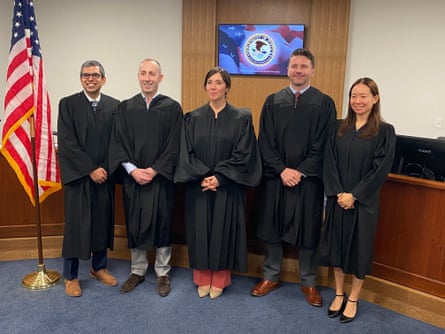
During her two-year probationary period, she said she received strong evaluations from across the courtroom, including her supervisor, ICE officials and defense attorneys. The Guardian independently confirmed her evaluations.
“The supervisory immigration judge at Stewart spoke with ICE officials in Georgia and at headquarters, and with defense counsel,” she said. “They all recommended me. So I was made permanent.”
Not long after, she was terminated.
Military judges fill in the slots
As immigration judges are being fired across the country, the Trump administration has also launched a public hiring campaign to fill the vacancies, advertising for candidates to “become a deportation judge” – language that reflects the broader agenda of the administration.
“The announcements are clearly written to solicit applicants that may not be able to demonstrate the type of impartiality and demeanor that are generally required of a judicial officer,” said Rey Caldas.
On 27 August 2025, the defense secretary, Pete Hegseth, authorized up to 600 military lawyers from the Judge Advocate General (JAG) Corps to serve as temporary immigration judges – a move the justice department paired with waiving longstanding requirements that temporary judges have at least 10 years of immigration law experience. The New York City Bar Association and many experts in immigration law condemned the move as “an unprecedented departure from established practice” and “a dangerously flawed solution to a manufactured crisis”.
Asked about the deployment, Sean Parnell, a Pentagon spokesperson, said military attorneys would “augment existing resources” and “deliver justice, restore order, and protect the American people”. A Pentagon official, speaking on background, said training would be provided by senior Department of Justice personnel, but did not specify its length or content.
The Department of Defense declined to provide a figure for how many JAG attorneys have been deployed to immigration courts. As of December 2025, only 30 military lawyers had been detailed to the courts, according to the Associated Press.
Even those jobs are not safe. In December 2025, Christopher Day, a US army reserve lawyer serving as a temporary immigration judge in Annandale, Virginia, was fired after just five weeks on the bench. According to the Associated Press, federal data shows that Day granted asylum or other relief in six of his 11 cases, a rate that diverged sharply from other military-appointed judges, who ordered removal in about 78% of cases. (Day could not be reached for comment.)
The US Department of Justice declined to comment on his specific case, calling it a “personnel matter”.
‘This devil on your shoulder’
As the administration began assigning military judges and less-experienced appointees to fill the growing vacancies, those with immigration backgrounds who remain on the bench described a deepening culture of uncertainty.
Rey Caldas, who remains in contact with judges still on the bench, described more intimidation. “They’re going into meetings and being told directly that if they grant a bond in certain cases, they will be taken off the bench,” she said. Supervisory judges, she said, were entering judges’ offices to demand explanations for routine continuances.
“Suddenly you have this devil on your shoulder,” she said. “Is your career going to be affected? Are you going to be able to pay your bills? Are your children going to be able to continue in school? That is counter to the whole idea of having a neutral adjudicator.”
Koelsch said many of those sitting judges were experienced and principled.
“I know several excellent immigration judges, some of whom I mentored,” he said. “They’re fantastic judges, and they’re not liberal, they’re not conservative. They’re like umpires or referees in a game. They call it as they see it.”
Several current and former judges described an administration aggressively pushing for third-country deportations and setting no bond, or imposing higher bond amounts. Some said the internal pressure had, at times, felt like “bending the knee” to politics rather than principle. The administration has reached deportation agreements with numerous countries, many of which advocates and Democratic senators believe were pressured by US officials through financial incentives, eased visa restrictions or diplomatic leverage.
“What really bugs me now is these third-country agreements, where people are not even being allowed to have their day in court,” Koelsch said. “They’re being sent to countries they have no connection to. We’re sending people to Uganda now, and they may be from Africa, but they’re not from Uganda.”
The overhaul of the immigration courts – the mass firings, the intimidation, the threats to remove judges from the bench – has created an impossible tension for those who remain: between their ethical obligations and the need to keep their jobs. Several current judges who spoke to the Guardian on condition of anonymity said the strain had taken a deep emotional toll.
“Everyone has a breaking point, where they’re asked to do something unethical, and then that’s too much,” Koelsch said. Koelsch fears that the loss of seasoned immigration judges will have consequences far beyond the courts – including for American citizens. A ProPublica investigation in October 2025 found that more than 170 US citizens had been detained by immigration agents during raids and protests.
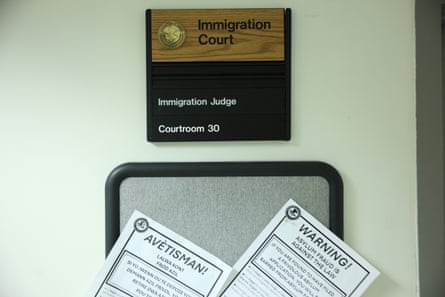
At the same time, the strain on the system has deepened as courts face a backlog of more than 3m cases. The second Trump term has also seen a historic rise in habeas corpus petitions – legal challenges filed by immigrants claiming their detention is unlawful. According to ProPublica, more habeas cases have been filed since January 2025 than under the last three administrations combined.
But the administration’s focus has remained squarely on deportation. Since the start of Trump’s second term, ICE has deported more than 605,000 people, according to DHS records, with the administration publicly setting a goal of 1m removals a year.
In many ways, Trump has achieved much of what he promised: historic deportation numbers, the halting of nearly all refugee admissions – except a small number of white South Africans who, as Rey Caldas noted, “categorically do not qualify as refugees under US law” – and asylum grant rates that have plummeted to historic lows.
But many judges fear the consequences will shape the foundations of American democracy itself as they see alarming use of executive orders to reconfigure immigration courts across the country.
“If such a thing exists in the United States as a tribunal where you’re never going to be heard, where the outcome of your case is predisposed, then why would that be different in any other type of tribunal?” said Rey Caldas. “If we’re willing to accept this here, then obviously this can also be the case in criminal courts. And in tax court. And in any other type of federal proceeding.”
She paused, adding: “It erodes the idea that the US is in fact a country of law.”
Many judges who spoke with the Guardian believed that much of the purging had been possible because immigration judges sat within the justice department, part of the executive branch, which means they serve at the pleasure of the attorney general – and, by extension, the president.
Several expressed support for establishing an independent immigration court, free from executive control. But those who have witnessed the overreach of this presidency first-hand warned that the damage may already extend beyond what structural reform alone can repair.
“If the president can effectively say who gets immigration status and who doesn’t, whether or not the law would give them the right to immigration status, then we’re past a system of laws, and we are fully living at the whim of an individual,” said Rey Caldas.