2 months ago
85
2 months ago
85
Shove them in a fridge, stash them in a cellar – this is how most people store their favourite bottles of wine. But if you have warehouses full of thousands of vintages, you have to think a little differently.
For the last eight winters, Lanchester Wines has used heat from a disused coalmine to maintain ideal storage temperatures at its facilities in the north-east of England, helping to prevent freezing or spoilage.
“For wine, we like it to be 8-10C,” says Veronica Cleary, a director at the company. “For staff, obviously, a bit higher. We do still encourage them to wear fleeces and what have you.”
Few wine companies use geothermal heat to control the temperature of their warehouses; fewer still source that heat from disused, flooded mines. But Lanchester Wines hopes its experience of the pitfalls and wins will make things easier for other companies hoping to take advantage of subterranean warmth. That warmth, once accessed, reduces dependence on fossil fuels and can make a real difference to heating bills.
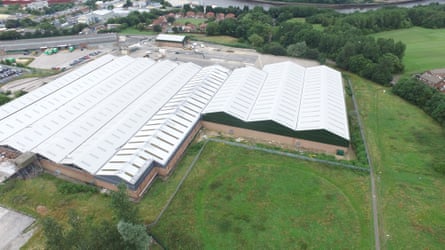
Thousands of vintage wines are stored at the cluster of warehouses in Gateshead owned by Lanchester Wines. Water in the mine near the warehouses sits at roughly 19C year-round. The company’s system works by pumping some of the mine water out, extracting a portion of its heat, boosting that heat with a heat pump, and distributing it through pipes.
In the UK and Europe, a handful of similar schemes are also making use of the heat in mine water but are relatively rare. Businesses in the UK are often left struggling in the face of permitting complexities and the risks that come with drilling into the ground, according to a report published in February by the US-based research organisation Project InnerSpace.
“To our mind, it was a relatively simple thing to do,” said Cleary, recalling the early years of the Lanchester Wines system. “[But] it didn’t prove that easy at all.”

Some of the boreholes drilled to reach the mine water turned out to be poorly located. And a previous access agreement with the government-run Mining Remediation Authority (MRA) caused many headaches. After nearly two years of renegotiations, however, a new streamlined deal between the two parties is now in place until 2044.
“It’s opened up greater potential,” said Joanne Eynon, principal mine water heat-licensing manager at the MRA. “It gives them a better return, I understand, on their system.”
Lanchester Wines estimates the system has cut heating bills at its Gateshead warehouses by roughly 35%.
The redrafted agreement has also become a template for others who want to access the heat available in mine water around the UK. It was redesigned, in part, to allow for a swifter application process.
“What we wanted to try and do was pioneer a path so others could follow on from our experience,” said Cleary.
It was a welcome development, said Matthew Jackson at Imperial College London, who contributed to the Project InnerSpace report. “There have been a lot of barriers in the way. One of those barriers was the relatively onerous regulatory framework.”
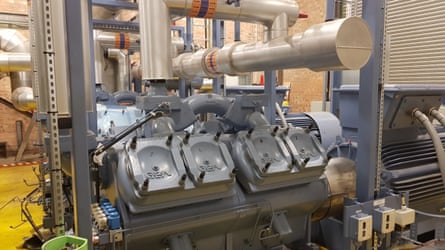
Using mine water for heating presents technical challenges. Drilling into old mines can release toxic gases, so venting these away is important. Plus, minerals present in mine water can cause corrosion or blocking of heating system components.
Nonetheless, the relatively high temperatures of mine water, even as high as 40C at depths of 1km, mean it is sometimes an attractive option compared with other forms of geothermal energy.
“The reward on offer is potentially greater but there’s a little more risk in getting there,” said Fleur Loveridge, professor of geo-energy engineering at the University of Leeds.
There are 23,000 flooded coalmines in the UK: about 25% of UK homes, and many businesses, are located above or near to disused coalmines, meaning there is much more potential for supplying properties with heat from mine water.

The north-east currently leads the way. Great Britain’s largest mine water heat network, a stone’s throw from Lanchester Wines’ warehouses, supplies Gateshead college, the Baltic Centre for Contemporary Art, and 350 social homes. There are plans to expand it to 270 private homes, and a conference centre and hotel.
A similar network links homes in the city of Heerlen, the Netherlands, to heat sourced from mine water. Many thousands of dwellings there are due to be added to that scheme in the next two decades.
There is also the town hall in Bad Ems, Germany. A study published in February found the mine water from which it has drawn heat for the past seven years is warmer than most people’s living rooms: 25C. This significant resource is “far from reaching its full potential”, the study authors wrote – many more buildings could access it.
The Lanchester Wines’ system “does show that it works, and it works in UK conditions”, said Loveridge. “It’s great that they’re securing the future of it.”