2 months ago
155
2 months ago
155
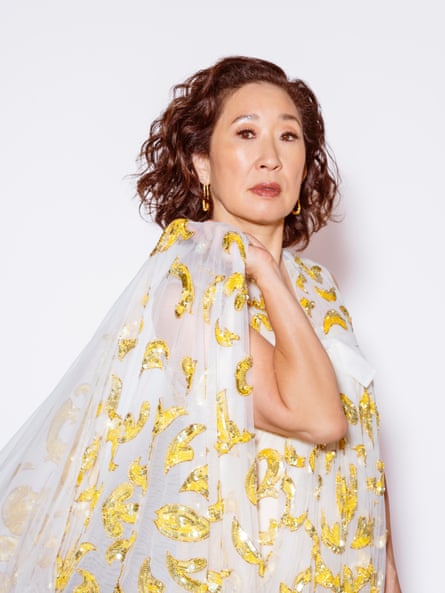
Sandra Oh bursts into a back room at the National Theatre in London with wayward post-rehearsal energy. The 54-year-old, long one of the most stylish actors in Hollywood, is in brown linen, a herringbone jacket and hat and sunglasses, which she removes before collapsing into a chair and throwing her head forward, arms outstretched, hair splayed across the table. “It’s just the fucking process of it,” she groans. “We just finished our first stagger-through, which if anyone is an actor – it’s early days, so the fact we made it through was great. It’s brutal. We started in the Lyttelton, and it’s interesting to be in that space and to hear verse. You can really hear it. It’s not just about volume or speed. It’s not even solely about intention. You learn so much just being in that space, but the big thing is – sorry.” She catches herself. “I’m just marching on.” And she bellows with laughter.
Oh has been in London for just over a month rehearsing her role as Alice in a modern reimagining of Molière’s Le Misanthrope. It’s a happy return; eight years ago, she was in the capital to film the first of four series of the hit show Killing Eve, which became a phenomenon and changed her life as an actor for ever. Oh played Eve Polastri, the shambolic but brilliant British intelligence agent, who, along with Jodi Comer’s Villanelle, made for one of the best spy capers of recent years. Now, she is playing a novelist – gender-flipped from the 17th-century original, in an adaptation by Martin Crimp – who is fed up with the flattery and dishonesty of the people around her. It’s a deliberate pivot to theatre; last summer, she appeared as Olivia in a starry production of Twelfth Night at the Delacorte Theater in Central Park, New York. In the autumn, she made her debut at New York’s Metropolitan Opera in a production of Donizetti’s comic opera La Fille du Régiment. Unlike the sometimes fraught me-me-meism of screen work, says Oh, working in theatre in general and at the National in particular “is a collaborative thing” – not least, she adds drily, because no one does it for the money. “Everyone has to bring their best and most open selves. And everyone else loves watching everyone succeed.”
It’s a dynamic that suits Oh in her current phase. In the last few years, she has become that rare figure in Hollywood, a famous woman who has only grown more powerful with age, a champion of younger performers and something of a truth-teller in an industry full of people encouraged by flattery to talk absolute rubbish. She is funny, shrewd, insightful and, above all, generous in her insights. A few years ago, in the New Yorker, she spoke about surviving years of racism as a woman of Asian origin trying to get ahead as an actor. (On white male directors not casting her, she said: “It’s like being able to get over a bad boyfriend. They’re not going to call. Just move on and hang out with the young women who want you to be their mom.”) Later, she described to the New York Times a sense of being “deep into this very rich middle part of [my] life” in which “only now do [I] have enough strength and hopefully curiosity to go into the places of asking the question: why did I do that? Who has been steering the ship? Because now, in this back half of my life, I’m the captain of the ship.”
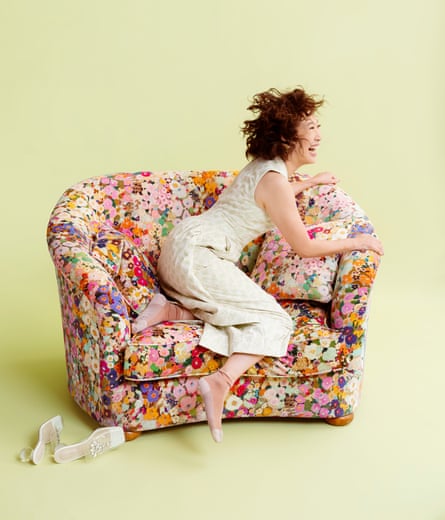
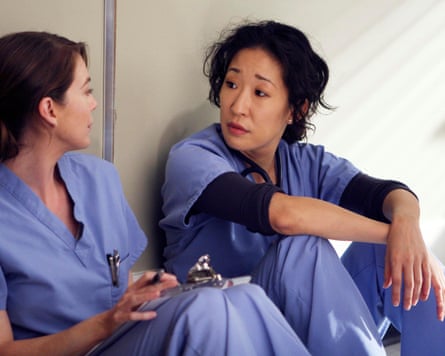
In the diaries Oh has been keeping since she was a child – extracts of which have appeared in papers and podcasts – one gets the sense of an introspective, literary person, with a deep connection to where she came from – the suburb of Ottawa, Canada, where Oh still has friends from grade school. If we loved her 20 years ago as Dr Cristina Yang in Grey’s Anatomy – a blunt, brilliant cardiothoracic surgeon – these days Oh appears as a sage-like person very much in her prime, which, she tells me, she finds, “incredibly liberating and also, like, enraging”.
We’ll get to that. A fortnight before I meet Oh at the theatre, I see her in a studio on the eve of the first week of rehearsals. As an actor gearing up to appear at the National for the first time, Oh had, a few weeks earlier, the amazing good fortune to run into Fiona Shaw at a grocery store in her LA neighbourhood, where her Killing Eve co-star happened to be living while filming. “She’s one of the greatest stage actors of her generation and knows the National,” says Oh. In the supermarket aisle and later, over breakfast at Oh’s house, Shaw gave her a bunch of hacks about the stage at the Lyttelton. “She said, ‘If you’re going to be on this stage, look out for [the sight lines] in this area,’ or, ‘This is the strongest area on stage, do this technicality this way.’ She was giving me the gold. I could not believe it.”
In the studio that first day we meet, Oh is in a cropped leather jacket and soft leather shoes that are “good and supportive. I need structure.” Don’t we all, I say, and Oh cackles. In fact, while it’s the structural and technical aspects of theatre work that she enjoys, it’s TV that made Oh. Her jump to leading roles came relatively late. It’s strange, these days, to stumble across Oh in old movies in parts that seem wildly too small for her – the other day, while watching the 2001 film The Princess Diaries with my kids, I was taken aback to see Oh as the cartoonish Vice Principal Gupta. Other credits from that period include “fourth fired employee” from something called Full Frontal and “marketing person” from the movie For Your Consideration.
Despite enjoying great, early success in TV in Canada and becoming a prominent ensemble player for nine years in Grey’s Anatomy (2005-14), it wasn’t until Killing Eve that she really ascended to leading role status. Famously, when her agent called her with the script for the show, Oh assumed she was to read for a minor character. “‘So Nancy, I don’t understand, what’s the part?’” Oh recounted saying to her agent at the time. “And Nancy goes: ‘Sweetheart, it’s Eve, it’s Eve.’”
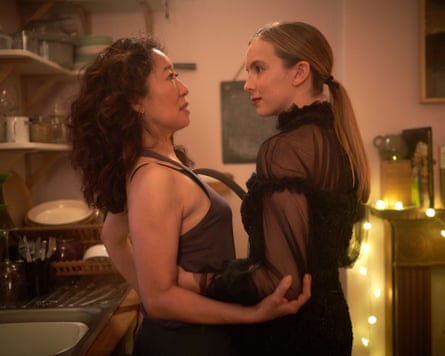
Oh as Eve was a revelation; by turns sardonic, baffled, excavating every nuance of what it is to be a frustrated, overlooked cog in the machine, and all the while harbouring star status that let out in her electric chemistry with Comer.
Eight years and another big show – Netflix’s excellent comedy drama, The Chair – later and Oh’s attitude to all this history is by turns philosophical, resigned and, increasingly, weary of being asked to relive it. She’s that rare actor willing to say crunchy political things such as “Patriarchy runs within all of us” or “If you’re going to put all your stock and wait for the white dude to give you the opportunity … that’s destructive.” Equally, however, raking over and over the bad times gets old. When I ask what makes her angry these days, she says: “Isn’t that just the question and the challenge of life? How do you deal with life not being fair, or/and turning out the way you want? You’ve gotta figure it out. You have to find different avenues to work out what’s going on subconsciously and consciously. Typically women have – I shouldn’t say ‘typically women’.” She thinks for a moment. “No, I will say that. I think this is the one thing that particularly straight men have a much more difficult time with, which is to find friendships where there are deep conversations, and where they can talk things out. I have that relationship with friends, both men and women, because I’m lucky, but also when you’re an artist you’re trying to figure that out all the time in your work.”
Figure out what, exactly?
“Figure out what you’re saying, which is: how do I deal with my rage? Or: how do I deal with what’s going on in the world? You can work that out physically, or talking-wise, or you can work that out in art. I will say I’ve been putting that in every single project.”
The talking part is vital to Oh, a “big believer in therapy” who maintains strong connections with her oldest friends. For two years in the early 2000s she was married to Alexander Payne, the director, with whom she worked on the 2004 movie Sideways, and while she won’t talk about her personal life, she will talk about her other relationships. Oh grew up as one of three children of parents – mother a biochemist, father who worked in business – who moved to Canada from South Korea in the 1960s, and thinks her middle child status has something to do with her self-appointed role as a “bringer-inner. I’m a keeper of people. I’m not an outsider that way. I like the harmony and community.”
Just that morning, she says, she was on a video call with her oldest friend in Canada, a woman she has known since she was six and with whom she has been through many phases of friendship. “You have to grow out of your teenagehood, and then you hit another thing when you’re in your 30s.” This was the period during which she and her friend sought help from a therapist together because, “we were growing into different people and were trying to figure out how to still stay close”. And, “I gotta tell you,” she says, “it was really hard.” Was there a chance it might not have worked out between them? “No. I feel like the people who are closest to me have to be able to confront things.”
She bursts out laughing at my expression. “Look how nervous you got.”
I did!
“You thought about who you’re anxious about and then you thought, could I [confront them]? That would be really bad. But then …” She’s not far off.
It’s useful to remember that Oh isn’t American, and while Canadians can be as avoidant as the British when it comes to emotional honesty, she reminds me that “Korean people are pretty confrontational. There’s a different thing within the [Korean] family structure – although I do think I’m different, even within my family.” It took her time to learn how to confront people without flying off the handle. “I had to go through so much therapy not to be so reactive.”
Her broad rule of thumb in relationships is, “openness, confidence, willingness. Being non-judgmental. I just think the freer you are, the freer you let everyone else be.” She says: “I have a lot of longstanding friendships. I cherish them and I’m good at maintaining them. I’m the connector of the various groups. I’ll start the WhatsApp, or I’ll start the Zoom during Covid. I’m the one, often times, saying: ‘OK, let’s all go somewhere!’ You need to put the work in, you can’t just sail by.” These things take work, of course. There is the question of resentment. “Yes. You think it only happens in love relationships, but that’s not true.”
When Oh was fresh out of theatre school, someone said something to her that she never forgot. Acting hadn’t been her first goal, or rather, she’d disguised to her family how intent she was on pursuing it. “I’m the only person in my family who doesn’t have a master’s,” she has said. She won a place to study journalism at university, which she promised her parents she’d return to if nothing came of the acting gig. Instead, after graduating from the National Theatre School of Canada in Montreal, Oh was immediately cast in the 1994 Canadian premiere of David Mamet’s Oleanna. “And a good friend said to me: ‘Oh my God, congratulations, I’m so happy for you. I’m so jealous, and I’m so happy.’ And I saw that she meant both things and that she held both things, and that I could hold both things as well.”
The crucial lesson Oh took from this exchange is that jealousy can be neutralised as long as you own up to it, and this has been key to her experience of hanging on to old friends. “I kept all my friends from early childhood and my theatre school mates, and my working relationship with people in Canada. I’m hopefully going to shoot something in Toronto and went out to dinner with the producer and I was ‘cheersing’ him, like, you know darling, this is our 30-year relationship. That has great meaning for me.”
She thinks and adds: “Life can be destabilising, so you have to figure out: what are your stabilisers?”
During those early years of her career in Canada, Oh enjoyed huge amounts of success. After the Mamet play, she was cast as the lead in a critically acclaimed TV movie called The Diary of Evelyn Lau, which told the story of a teenage runaway, followed by the title role in a CBC biopic of Adrienne Clarkson, a Chinese Canadian who became an acclaimed journalist and the governor general of Canada. For her lead in a film called Double Happiness, Oh won a best actress award at the Genies, the Canadian equivalent of the Baftas. And so she did what successful Canadian actors do: packed up and headed for Hollywood.
The crash was brutal and instantaneous. Soon after arriving in LA, an agent told her there were no roles for Asian actresses for at least another year and she’d be better off returning to Canada to “get famous” (she was already famous in Canada). Oh had to take encouragement where she could find it, as she had been doing since she was 10 years old and noticed every person of colour on screen, or, later, took heart from the example set by Yoko Ono. She had two personal interactions “in very key moments” during those years that helped her stay the course when it seemed as if the breakthrough would never come. In 1997, Oh won a CableAce award for best actress in a comedy, for her role in an HBO show called Arliss. At the ceremony, she ran into Alfre Woodard, the Oscar-nominated actor currently knocking it out of the park alongside Alfred Molina in the Netflix sci-fi hit The Boroughs. “She didn’t know who I was,” says Oh, “but she took me aside and said something very wonderfully encouraging, which was just, basically, keep going, baby. And that meant a lot to me; I knew who Alfre Woodard was and respected her as an artist, and it was someone just saying, ‘Keep on going.’”
The second encourager was Jamie Foxx, whom she met at another awards do – Oh laughs, “that’s when you meet these people. And he also basically said keep going.” It doesn’t take much. “No. Sometimes when young people will come to you, they are open and vulnerable and it’s a certain responsibility as adults to guide them. It can be just a kind word or you can actually invest in a moment and really talk to the young person.”
Oh does this admirably and with a certain amount of amused tough love. To those in her industry who complain endlessly about the cost of fame, she says mildly, “Nothing is free.” If it all gets too much – the attention, the speculation – she points out, “You can always go away.” (They never do.) Oh says she has never been particularly vulnerable when it comes to being addicted to fame, or to anything else for that matter. “I don’t think that I was ever in danger. Meaning, like, even my lowest times, they were normal lows, like being heartbroken or depressed because you don’t know what to do – normal things. Maybe I’m not willing to say what my addictions are, but they’re not the classic ones. I’ve got to this point where – it’s so boring; it’s so boring,” she says with comic despair, “‘I have to drink less, because of my stomach.’ It’s bullshit. It’s such a bore.”
She meditates. (“Everything you need to figure out in life is found sitting on that cushion.”) And she moves around. Before any new role, Oh leans into the physicality of the piece – she’s a big fan of body work. “But not exercise; not sports. I like dancing; I like moving my body. I think there are answers in the body. I think there are things that are trapped in the body.” She preps for roles on the move and will often walk a circuit to help memorise a script. “I always look for a park and a tree to learn my lines. It works better for me. When I was doing Killing Eve, I was in this garden and there was a specific tree.” Round and round she went, until she had the part down.
She says good writing is the key to good acting, and I ask if Phoebe Waller-Bridge’s scripts for that first series of Killing Eve made her job easier. “Yes, and that has to do – specifically with television and film – that has to do with tone. Something like a play you have a lot more room to interpret it. Something like television, you need the tone to be right there on the page. To write tone, you have to be coming from a very specific point of view.”
While the new version of Le Misanthrope has been put into modern language, the dialogue is still in verse and Oh finds it thrilling – “the challenge of technical language is juicy for me, because you have to work a different muscle. It’s a different way of putting in the emotional discovery. It’s an old play!”
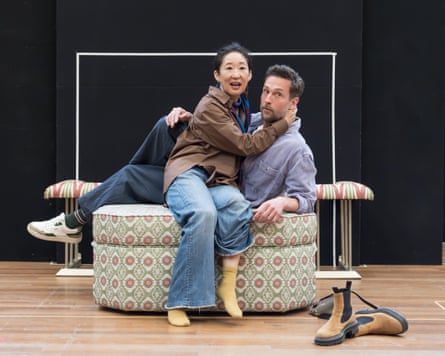
It is; Le Misanthrope opened in 1666 at the Théâtre du Palais-Royal in Paris, though Oh finds it has relevance for our times. “Molière set it in his theatre milieu where there are artists and writers and gossip. It’s a lot about hypocrisy and Alice’s own search for honesty and truth, which has meaning in 2026 – the difficulty in finding truth. I hope it has a wider meaning about what it is to want to tell the truth, want to be honest, and how difficult it is.” In the play, Alice gets into trouble for speaking her mind, and, says Oh, “I need to figure out what that means – not only for the character. What does it mean to speak your mind at this time of your life? What is it about a woman who speaks her mind and then gets shot down because of it?”
A few months ago, Oh voiced her support for Zohran Mamdani, the democratic socialist and newly elected mayor of New York, and was thrilled when he showed up at a performance of Twelfth Night in Central Park. “What was amazing, as a non-New Yorker, was to witness how he affected our entire cast, which was very diverse; half over 50, half very young. And the way the cast lit up meeting Mamdani, it was like, oh, this is who he represents and this is how much hope he elicits in New Yorkers.”
Oh is active in promoting the authentic representation of Asian cultures on screen. In 2021, she gave a passionate speech at a Stop Asian Hate rally in Pittsburgh, in which she repeated what has come to be a famous mantra: “I am proud to be Asian. I belong here.” In 2022, she wrote about her career for an online literary magazine, in which she said, “For the first time, I’m finally getting film roles where my character’s name is Korean.”
It has taken such a long time to get here, both in terms of the industry she works in and what she has had to do to process and absorb the years of being sidelined. She’s not there yet, she says. And yet. “All the work that you’re doing, on your own time, with your own heart, in the middle of the fucking night. That doubt? And the raw depression? And the questioning, and the anger? It’s alchemising into something.” When she talks about owning all the different parts of herself – including the internalised racism and misogyny – the conclusion she often comes to is, “There is no self. Meaning you don’t have to be tied to self. But that’s not easy.”
In the meantime, Oh is here to have fun. Backstage at the National, she’s doing the thing she does best, which is creating community. On the table between us is a water bottle decorated with stickers she had made during the run of Twelfth Night of all her co-stars, including Peter Dinklage and Jesse Tyler Ferguson, pulling a face. “Oh, that’s Jesse, tasting hot sauce,” she says, laughing. Later, Oh asks a production assistant if he can get her candid photos of her present co-stars to be made into stickers for the same purpose – an ad-hoc team building thing that amuses her.
And when she leaves the theatre? “I shit you not, I have to sleep,” she says, eyes wide with amazement; Oh, who is by nature wildly energetic, also knows her limitations. “With this play, I need to sleep 10 hours. I get into bed at 8.30pm, and I get up at 7am.” It’s as single focus as it gets, but after all those years of feeling herself to be in the wrong place, denied the opportunities, that’s a luxury she’s here for. “I’m allowed to concentrate on that one thing. I’m doing this for a purpose. It’s a privilege to be able to focus on that. Then hopefully you deliver.”
The Misanthrope is at the Lyttelton at the National Theatre, London, until 1 August.