3 months ago
155
3 months ago
155
It was the film that was supposed to destroy Hollywood: a vampire horror about life and times in the Jim Crow south peopled by a majority Black cast, and shot on Imax 70mm. Ryan Coogler, the acclaimed director who rose to prominence steering Marvel’s colossal Black Panther franchise, was thought to be out of his depth for trying to midwife a script he himself said he cobbled together in two months. Warner Bros, the studio fronting the film’s near $100m budget, was supposedly out of its mind for not only throwing that much money behind the project, but further agreeing to singularly favorable authorship deal terms that gave him control over the film’ final cut and full rights over the film after 25 years. Hollywood machers were convinced the film would never make money and that Warner Bros’ big gamble “could be the end of the studio system”. But Sinners never let that cynicism in.
Sinners landed in theaters on Easter weekend and delivered its own miracle resurrection, racing to a $368m gate on the way to becoming the highest grossing original film in the past 15 years, and the 10th-highest domestic-grossing R-rated film of all time. (That’s right: higher than Terminator 2 and the Hangovers.) At a time when Black heritage and culture are once again under intense political assault, Sinners provoked zeitgeist-y discourse around Black history, cultural erasure and entertainment industry politics. And the online memes poking fun at juke-joint scenes hit as hard as the thinkpieces unpacking the venue’s under-appreciated contributions to the American musical canon.
For Sinners to resoundingly beat the odds and become the year’s most defining film, one that is already being hyped as a heavy awards favorite, is just yet another testament to Coogler’s singular Midas touch. His script may have taken two months to write, but it was informed by years of research into Mississippi Delta folklore, antebellum cultural motifs and blues history – a deep dive that started with Coogler’s late uncle introducing him to the genre through his record collection as a kid. Coogler lost himself in 1930s photography and Native American mythos; he drew on the expertise of university history professors and the experiences of Chinese immigrants – oft-forgotten figures in the history of the American south, fictional or otherwise. “We were both happy that we could portray Asians speaking English without a stereotypical accent,” the Malaysian actor Yao said in an interview with Sinners co-star Li Jun Li; they play married grocers in the film. “We’re also sexy as fuck.”
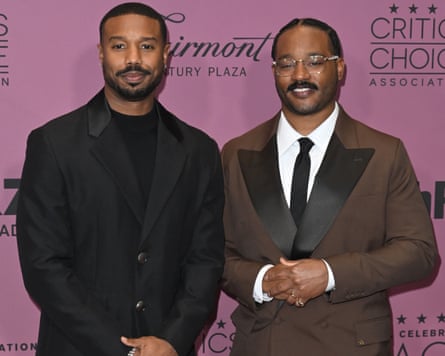
And as ever Coogler manages to fold those thick layers of context and the corresponding religious overtones into the film – with major assists from costume designer Ruth E Carter, set decorator Monique Champagne and his wife and producing partner, Zinzi – without weighing down Sinners’ nighttime survival narrative or holding up his exquisitely capable cast. Hailee Steinfeld was a revelation as Mary, a character so well drawn it apparently had her making discoveries about her own ethnic background. Delroy Lindo, who plays the wino blues man Delta Slim with trademark dignity, said that Sinners reckons with the past in a way that makes private investigators out of the cast “because one is uncovering aspects of history that heretofore had been either expurgated, entirely erased, or diminished”.
Those history lessons would culminate in broader takeaways that challenged Hollywood orthodoxy. Wunmi Mosaku – a full-figured, dark-skinned mature woman – disproved industry conventional wisdom that sexy female leads only come young, skeletal and fair-skinned – and hammered that point home with a recent New York magazine cover. All the while Michael B Jordan showed himself to be more than a pretty-boy leading man.
It feels weird touting his star turn in Sinners as his arrival given his quarter-century long run as a prestige entertainer, and that Sinners was his third collaboration with Coogler. But Jordan delivered the performance of his career while breathing humor, headache and heroism into the double-minded Smokestack twins bootleggers – training his body and his voice to draw nuanced distinctions between the brothers. “The way he was able to create the characters individually made it easy for me to establish my relationship with both of them,” said Miles Caton – the baritone guitar man who imbues Sinners, his feature film debut, with song and soul. And that’s as Jack O’Connell – who gamely plays the foil as Remmick, the culture-vulturing nightwalker – connects Coogler’s early grounding in the blues to his sincere curiosity in Irish folk music.
Whether experienced in the theater as intended or enjoyed via streaming, where it proved a hit for HBO Max, Sinners got people talking – about how it moved them, about how it explains these troubled times, about all the potential in this cinematic universe despite Coogler calling Sinners a standalone project. (As if that’ll stop visions of a Smokestack twins prequel that has them ripping and running with Al Capone’s Chicago Outfit … ) And after all the second-guessing Coogler endured while releasing the film, which turned out not to be the studio extinction-level event involving Warner Bros, there’s sweet poetic justice in seeing the critics who once asterisked the film’s success now ask, with overdue flattery: what’s next? “I believe in cinema,” Coogler wrote in a thank-you letter to Sinners-goers. “I believe in the theatrical experience. I believe it is a necessary pillar of society. To see your response to the film has reinvigorated me and many others who believe in this art form.”