3 months ago
143
3 months ago
143
Two Human Rights Watch (HRW) employees who make up the organization’s entire Israel and Palestine team are stepping down from their positions after leadership blocked a report that deems Israel’s denial of Palestinian refugees the right of return a “crime against humanity”.
In separate resignation letters obtained by Jewish Currents and the Guardian, Omar Shakir, who has headed the team for nearly the last decade, and Milena Ansari, the team’s assistant researcher, said leadership’s decision to pull the report broke from HRW’s customary approval processes and was evidence that the organization was putting fear of political backlash over a commitment to international law.
“I have lost my faith in the integrity of how we do our work and our commitment to principled reporting on the facts and application of the law,” wrote Shakir in his resignation letter. “As such, I am no longer able to represent or work for Human Rights Watch.” The resignations have roiled one of the most prominent human rights groups in the world just as HRW’s new executive director, Philippe Bolopion, begins his tenure.
In a statement, HRW said that “the report in question raised complex and consequential issues. In our review process, we concluded that aspects of the research and the factual basis for our legal conclusions needed to be strengthened to meet Human Rights Watch’s high standards. For that reason, the publication of the report was paused pending further analysis and research. This process is ongoing.”
Shakir said that his experience illustrates that while public opinion has evolved on Israel in the last several years – with “concepts of apartheid, genocide and ethnic cleansing” increasingly voiced in mainstream circles – the right of return remains a third rail. “The one topic,” he said, “even at Human Rights Watch, for which there remains an unwillingness to apply the law and the facts in a principled way, is the plight of refugees and their right to return to the homes that they were forced to flee.”
Israel supporters say that allowing Palestinian refugees and their descendants to return to their homes would end the Jewish state by depriving it a Jewish majority.
But in its messaging, the organization’s leadership has insisted that the core of the disagreement has nothing to do with the right of return, which HRW supports. In an email to staff on 29 January, Bolopion said HRW had commissioned an independent review of “what happened, and what lessons we need to learn”. Bolopion cast the events of the past two months as “a genuine and good-faith disagreement among colleagues on complex legal and advocacy questions”, and emphasized: “HRW remains committed to the right of return for all Palestinians, as has been our policy for many years.”
Shakir and Ansari completed a draft of their report in August 2025, at which time they say it went through HRW’s usual edit process, ultimately being reviewed by eight separate departments. Some colleagues raised concerns to Shakir along the way. In an 21 October email, chief advocacy officer Bruno Stagno Ugarte said he was concerned with the wide scope of the report, which in his view implicated all diaspora Palestinians, and suggested a report on the recent forced displacements from Gaza and the West Bank might “resonate better”. He further said he worried that the findings “will be misread by many, our detractors first and foremost, as a call to demographically extinguish the Jewishness of the Israeli state”.
Concerns about reputational damage were also voiced by Tom Porteous, HRW’s acting program director at the time. He wrote Shakir that the report was well-argued, but “the question is how we are going to deploy this argument in our advocacy without this coming off as HRW rejecting the state of Israel and without it undermining our credibility as a neutral, impartial monitor of events.”
Still, the decision to pull the final report came as a surprise to Shakir and others on staff, who said Bolopion – who has worked for HRW in numerous roles – was a key contributor to the group’s landmark 2021 report accusing Israel of committing the crime of apartheid.
‘Other inhumane acts’
Human Rights Watch has repeatedly called for the right of return – a universal human right grounded in international law – in previous publications. But those earlier reports were focused on other issues, and did not make the case that Israel’s ongoing denial of refugees’ right to return was a crime against humanity.
Work on the report, eventually titled ‘Our Souls Are in the Homes We Left:’ Israel’s Denial of Palestinians’ Right to Return and Crimes Against Humanity, had begun in January 2025. It was intended as a follow-up to a November 2024 report that focused on the internal displacement of Palestinians in Gaza. During interviews for that report, Ansari said, she heard refugees connect their current predicament to “their generational trauma of being uprooted and disconnected from their homelands back in 1948 and back in 1967”.
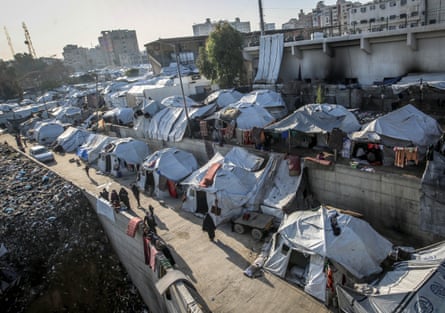
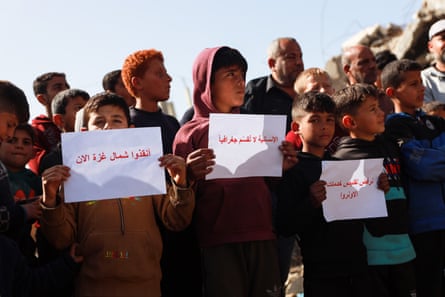
Inspired by those accounts, the unpublished 33-page report, which has been reviewed by Jewish Currents and the Guardian, not only documents the experiences of Palestinians recently displaced by Israeli military forces from Gaza and the West Bank, but also those of some Palestinian refugees in Lebanon, Jordan and Syria who were originally displaced by Israeli forces in 1948 and 1967 – and who have suffered persistent poverty and substandard housing and face severe obstacles to land ownership and employment.
The authors reach a novel conclusion: the denial of these refugees’ right of return falls under the crime against humanity known as “other inhumane acts”. Under the Rome Statute that established the ICC in 1998, this designation was meant to address grave abuses that were similar in character to other crimes that intentionally caused “great suffering” – apartheid, for instance, or extermination – but did not precisely fit into those legal categories.
The report cites a 2018 pre-trial finding by the ICC that determined that preventing the return of Rohingya to Myanmar after they’d been displaced to Bangladesh could be prosecuted as a crime against humanity of “other inhumane acts”. Shakir said that the report introduced a legal argument that had been previously confined to academia into the world of human-rights advocacy, providing an “asset” that could potentially help a refugee displaced in 1948 bring a current case against Israeli authorities.
The report’s slated publication date of 4 December 2025 coincided with the week HRW’s new executive director would begin his tenure, following repeated leadership changes over the last few years.
In November, senior staff began raising the prospect of delaying the report over concerns from colleagues. They felt its conclusion – that denying the right of return constitutes the crime against humanity of “other inhumane acts” – was weak and not established law, according to Shakir and Ansari, and required more evidence to back up.
Shakir raised the prospect of resignation if the report was delayed – but also said he offered to make it clearer that the crimes against humanity determination definitively applied only to those communities that were the focus of the research: those most acutely vulnerable as a result of the denial of their right to return, both in the occupied territories and in Syria, Lebanon, and among a subset of Palestinians living in Jordan.
Shakir said those offers were rejected. Days before Bolopion took up the position as executive director, he called Shakir to tell him the report would need to be paused.
In response, more than 200 HRW employees signed a letter of protest, sent to leadership on 1 December, calling the organization’s “rigorous vetting process” the “cornerstone of our credibility”. Blocking the report, the staffers wrote, could “create the perception that HRW’s review process is open to undue intervention that can reverse decisions taken through the pipeline, undermine trust in its purpose and integrity, set a precedent that work can be shelved without transparency, and raise concerns that other work could be suppressed”. In its statement, HRW said: “Our internal review processes are robust and designed to protect the integrity of our findings. As with any organization conducting such analyses, differences of professional judgment can arise in the process.”
Kenneth Roth, who was HRW’s executive director until 2022 and learned about the controversy from his former colleagues, rejects allegations the decision was political and argues that the leadership transition marred the approval process. He characterized Shakir’s behavior as an effort “to fast-talk through the review system at a time of leadership transition an extreme interpretation of the law that was indefensible. Various staff members expressed concern with the report during the review, but it took Philippe arriving as executive director … to exert the leadership that should have been exercised far earlier and to send the report back for a more defensible interpretation,” he said. Roth – who has not read the report personally but who was briefed on the legal argument by Shakir – insisted that “this had to do with preventing publication of a report that was indefensible and would have been deeply embarrassing if given a Human Rights Watch imprimatur.” (Roth is a columnist for the Guardian.)
In response to doubts over the strength of his research, Shakir said that the report, its press release, and its question and answer document were “fully reviewed and finalized” and prepared for publication on their website. “Were there any credible concerns about the research, this would never have happened at HRW, where major Israel/Palestine reports always attract extra scrutiny.” He added: “In an organization of 500 people, people are gonna have different views. But you do not need a consensus of 500 people. That’s not how we release reports.”
In his resignation letter, Shakir argued that he did everything he could to address the concerns of staff members but that it made no sense to limit the findings to Palestinians recently displaced from the West Bank and Gaza – an approach multiple staffers say Bolopion demanded. “Such a limitation means we would be saying that the suffering caused by the denial of return for a Palestinian displaced for a year from a West Bank refugee camp would meet the threshold of sufficient gravity to be a crime against humanity, but not those denied return for 78 years,” he writes.
Shakir was deported from Israel in 2019 because of his advocacy on behalf of Palestinian human rights. He stressed the organization’s responsibility to Palestinian victims of displacement. “Witnessing the anguish in the Palestinians I interviewed who are effectively condemned to lifelong refugee status is among the hardest things I’ve seen,” he said. “They deserve to know why their stories aren’t being told.”
-
This story was co-published with Jewish Currents. You can find a longer version on their site here