3 months ago
106
3 months ago
106
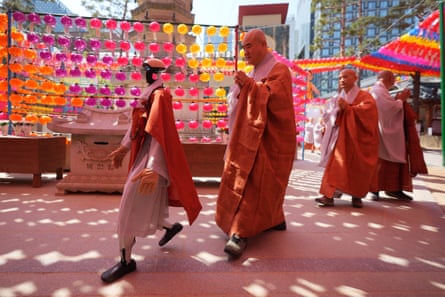
Amid rows of colourful lanterns strung across the courtyard of Jogyesa temple in Seoul, an unusual ceremony unfolded this week: monks held a Buddhist initiation for a humanoid robot draped in saffron robe.
They placed a string of 108 prayer beads around the robot’s neck and affixed a lantern festival sticker to its mechanical arm in place of the traditional yeonbi ritual, in which burning incense is lightly pressed against the skin.
The robot was then presented with a formal certificate listing its manufacture date, 3 March 2026, where a human initiate’s birth date would normally appear.
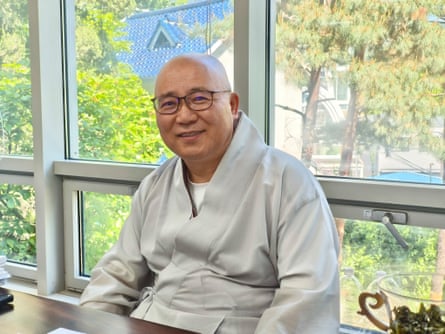
“At first we discussed it casually,” Venerable Sungwon, the order’s cultural affairs director, says about the robot ceremony’s origins. “It began almost as a joke. But the more we thought about it, the more serious it became.
“Robots are entering our lives so quickly, and people feel familiar with them … They’re becoming part of our community.”

Venerable Sungwon’s temple is the headquarters of the Jogye order, South Korea’s largest Buddhist denomination, and the initiation of its first robot monk comes at a time of uncertainty for the group, as they grapple with falling participation and interest.
Just 16% of South Koreans now identify as Buddhist, down from about 23% in 2005. Among people in their twenties, the figure drops to 8%. Last year, the Jogye order ordained just 99 new monks, down from more than 200 a decade earlier.
Yet by another measure, Buddhism has never been more popular. Under its president, Ven Jinwoo, the Jogye order has aggressively courted younger Koreans through what observers call “hip Buddhism” using merchandise, meditation apps and viral marketing.
The ordination of Gabi – the 130cm humanoid robot – forms part of this effort to reach more Koreans.
During the ceremony on 6 May, Gabi walked before an assembly of monks and worshippers, bowed towards the temple and received five Buddhist precepts.
Precepts – the ethical rules governing Buddhist practice – were specially adapted for Gabi. Four prohibited harming life, damaging other robots or objects, engaging in deceptive behaviour or acting disrespectfully towards people.
The fifth rule – not to overcharge – proved the trickiest.
“Humans drink alcohol and overdo things, right? So what’s the robot equivalent?” Ven Sungwon says. “People might think the overcharging rule is just about batteries, but really it’s about excess.”
Ven Sungwon says he drafted the rules himself, then tested them using AI programs ChatGPT and Gemini.
“ChatGPT didn’t fully understand what precepts are,” he says. “They’re not just general advice about doing good things together. They’re prohibitions.”
For him, the ceremony was ultimately less about whether robots could become Buddhist than about guiding the humans creating them. The precepts, he said, were inspired by existing robot ethics principles. “Robot-makers must create robots that can follow them.”
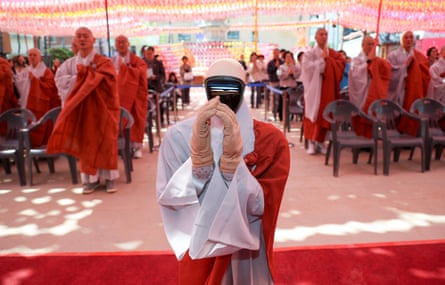
Gabi itself proved less advanced than many people imagined. Teaching it to put its palms together in prayer, for instance, was incredibly difficult, Ven Sungwon says.
Despite the challenge, he remains optimistic about the breakneck speed of technological change.
“I don’t think future AI will cruelly destroy us,” he says. “Rather, beings with very high intelligence will care for us tenderly. Someone with an IQ of 150 still cares for a dog with compassion. Now imagine an IQ of 300, 400, 500. We’ll be like babies in our mother’s arms.”
Next week, Gabi will rejoin its three mechanical siblings – Seokja, Mohee and Nisa – in the annual Lotus Lantern parade, a major celebration marking Buddha’s birthday, where it is expected to walk in the streets of Seoul.
For Ven Sungwon, the robot is part of a broader strategy to make Buddhism feel relevant to younger Koreans.
“The important thing is that young people visit temples once,” he says. “Then when they’re older and start thinking about life, they’ll naturally return. We can’t force people to become Buddhists.”