2 months ago
47
2 months ago
47
I was lying on my back in an east London hospital, sometime in August 2023. I don’t know what day it was, exactly; by that point I’d mostly given up caring. My phone rang. I managed to answer, even though I had largely lost the use of my hands. (Luckily, a member of staff had left it lying on my chest.) Also, I wasn’t feeling great. In the early stages of coming to terms with the fact I was paralysed, I had just been informed that the doctors wanted to drill a hole directly into my guts, inserting a plastic tube to drain away my urine, effectively making my penis redundant. It was proving quite a lot to take in.
Nonetheless, I answered.
The person on the other end said they were calling from my local wheelchair service. I sort of registered this was important. By this point, I’d started to get my head around the fact I was never going to walk again. Wheelchairs were going to be a big part of my life. But given I wasn’t going to be discharged from hospital for at least six months, I figured the local wheelchair service could wait until I was a bit more up for the conversation. I apologised, probably somewhat incoherently, and said I wasn’t able to talk right then. I assumed they would understand it wasn’t a good time, and call back later.
I assumed wrong.
A month or so went by. My mum was down from Merseyside, staying in my old flat in north-east London while I remained in hospital. (I never saw that flat again. The stairs made it just another inaccessible location for me, my former home part of a cut-off world.) She checked the post and found a letter from AJM Healthcare’s Waltham Forest wheelchair service, a regional subsidiary of AJ Mobility Ltd – described in its annual report as “leading integrated wheelchair service provider for the NHS, delivering services to a population base of over 8.1 million people”. The letter stated that because AJM had been “unsuccessful in our attempts to contact you … your referral has now been closed”. In other words, because I had failed to engage on the phone the one time that it called me, I had been removed from the waiting list for a wheelchair.
Just to spell that out: I was in hospital, paralysed. I could not leave hospital until I had a wheelchair. The local wheelchair service notified me that I wouldn’t be getting a wheelchair, after speaking to me on the phone for less than 30 seconds. It did so by writing to my home address. Which I could not reach, because I was in a hospital. Without a wheelchair.
So began my involvement with England’s wheelchair services, the patchwork of private companies contracted by the NHS to provide disability equipment to some of the people who need it most. It would prove to be quite a ride.
The rock climbing accident that left me paralysed from the collarbones down happened in June 2023. It took a lot away from me. Continence (both kinds), sexual function, the ability to wash, dress and feed myself and basically anything that requires the proper use of hands (I’m writing this using voice dictation). And yes, most obviously, it also took away my ability to walk.
But it also gave me some new things. Like a sudden introduction to being dependent on bureaucratic entities, to whom you are just another annoying statistic, clogging up the phone lines.
Before the accident, I was a very fit and healthy 36-year-old man, in gainful employment as a university lecturer. I owned my own home, drove my own car and was happily cruising along in a world that made life easy for me.
I did not yet know what it meant to be driven mad by the Department for Work and Pensions’ hold music for an hour, before the government computer hangs up because the phone lines are too busy. (I was calling in response to a threatening letter that said if I didn’t talk to them, I could expect my application for disability benefit, the personal independence payment, to be dismissed.) I did not yet know what it meant to try to organise wheelchair ambulances through G4S (yes, the security firm – don’t ask, because I don’t know). I did not yet know that local wheelchair services are a lottery, in which some of the most vulnerable people in society roll the dice. A lottery in which the taxpayer acts as permanent lender of last resort – while private companies profit.
‘The thing with wheelchair services is that they massively vary in England – it depends on your postcode,” Sarah told me. She is a physiotherapist who has been working with people with spinal cord injury for more than 20 years. “Some are good, but some are just awful.”
Many of her clients are discharged from hospital in heavy manual wheelchairs that an able-bodied person would struggle to push. Frequently, they are the wrong type or size, and are at the very least uncomfortable. “Often,” she said, “people who have impaired function in their upper limbs cannot push these wheelchairs themselves, and become effectively housebound, in some cases confined to their bed. Sometimes, they develop complications from poorly prescribed wheelchairs, and it lands them back in hospital.”
On average, she adds, people have to wait at least 10 months between being discharged and being assessed, let alone getting the wheelchair that is right for them. Often this is because local wheelchair services will refuse to assess a patient until they have left hospital and are back at home. Specifics vary depending on which company has the contract for a given area, but this can either involve a home visit at the convenience of wheelchair services, or a patient having to travel to the local depot to be measured and assessed. This often takes months after hospital discharge, with the result that people who, more than anything, just want to get on with their lives, are stranded in limbo.
Ben, 37, was, like me, injured in a sports accident in the summer of 2023. Like most quadriplegics, he left rehab in a heavy manual wheelchair he could not push outdoors by himself. One afternoon, he asked his live-in care worker to push him down the street so that he could at least go outside. At 65kg he isn’t especially heavy, but the care worker hurt her wrist trying to get him up a slope. She complained to the agency that employs her, and the agency forbade any of Ben’s care workers from pushing him in the manual chair.
“From that point on I was basically under house arrest,” Ben tells me. “It was 10 months before I got my power chair from wheelchair services – even though it was clear long before I was discharged from hospital that I was going to need one.”
And even that wasn’t straightforward. “The crazy thing is, a wheelchair service’s mandate is only to make sure you can mobilise indoors, in your home. On a flat smooth surface, I can do that in a manual wheelchair. But outside, on rough and angled surfaces, I lack the hand and upper body strength.”
As a result, he faced being issued with a wheelchair that would have kept him housebound. “My aim was to go back to work, rebuild my life,” he says. “But to do that, I had to lie to wheelchair services and make out I was more disabled than I am, so that I could get a power chair and access the outdoors.” It was either lie, or give up on having any kind of a life.
“Am I not disabled enough? Surely I should not have to pretend to be even more disabled, just to get something as basic as a wheelchair I can go outside in.”
Like Ben, I waited about 10 months for my prescription wheelchair to be ready. Collecting it meant visiting an industrial estate in Leytonstone, about a 20-minute bus ride away. It was then a 15-minute schlep to the AJM offices. My live-in carer accompanied me, as is now required for me to go pretty much anywhere.
When we got there, I met the clinical lead. He was relatively new to the job, but we managed. Moving into the side room where the new wheelchair would be set up, he asked me to get out of the one I was in, and position myself on the nearby plinth. I explained I couldn’t do that, because I’m a quadriplegic, and require hoisting in situations like this. He looked somewhat concerned. Hoisting?
I gestured with my useless hand at the nearby wall, where an array of hoist slings were hanging. And then at the ceiling, which had a mechanical track hoist attached to it. Using a special mechanical contraption. Hoisting.
He excused himself and got a colleague, who then directed the clinical lead through the hoisting process. It struck me as quite odd that the clinical lead at a wheelchair service didn’t seem to be familiar with hoisting. But I opted to say nothing.
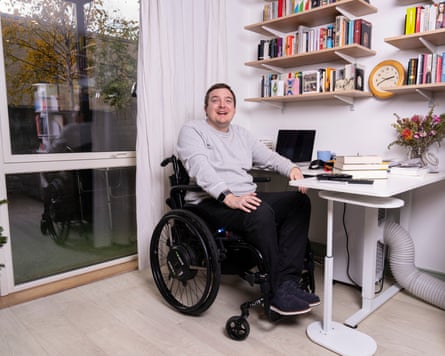
It took a while for my new chair to be set up, but when I was in it the lead asked: “Do you feel comfortable?” Now, this is a tricky question. You see, I don’t feel anything below my collarbones. It is just a dead zone. Although I can roughly work out when my hips aren’t straight, or my bum is too far forwards, this is a deductive process that I was taught to do in spinal rehab. Strictly speaking, I rely on a trained professional to look at me and determine whether my posture is correct, or whether things need adjusting. And this really matters. Postural mispositioning, if uncorrected, leads to pressure ulcers, scoliosis (twisting of the spine) and a host of musculoskeletal deformities.
Still, these guys were the professionals, right? The new chair certainly felt weird. But new wheelchairs normally do. I figured I’d just have to get used to it. After all, if things weren’t set up correctly, how was I to know? Surely, they would tell me.
Once the chair was apparently set up to the clinical lead’s satisfaction, it was time to head home. Unfortunately, the heavens had opened and I didn’t fancy the 15-minute slog back to the bus stop in the tipping rain. Annoyingly, no taxis were accepting my booking on the various apps I was trying. I asked the desk staff if they could call me a wheelchair-accessible taxi. They said they didn’t have any numbers. I tried the apps a little longer. In the end, I just got wet.
Sitting on the bus home, it increasingly felt like something was wrong with the chair. My legs were jutting out at a weird angle, bashing into things when I moved. Breathing felt much harder than it normally did, my diaphragm struggling even more than usual to make up for my emaciated intercostal muscles. Still, I told myself, I’d just have to keep trying. I used to be an athlete; I used to know how to train. Different context, same principle. You have to tolerate the suffering until it becomes easy.
A few days later, my private physiotherapist came round to do my weekly rehab session. She took one look and ordered me out of the chair – with strict instructions not to sit in it again until an engineer had been out to make it safe. At present, she said, I was running the risk of getting pressure sores and muscle damage. She hoisted me on to my bed, and spent most of our session writing down the measurements required to adjust the wheelchair to fit my body.
If I hadn’t had her, who knows how long I would have spent in a chair that could have landed me back in hospital? It was becoming apparent that – just like everywhere else – in the world of wheelchairs, having a bit of money makes life a hell of a lot easier.
In many ways, I am lucky. I was able to keep my job teaching at a university, including a generous year of paid sick leave after the accident. I also had climbing insurance, which meant I got a lump sum payment through the British Mountaineering Council. This wasn’t megabucks, but it helped pay for things such as home adaptations to make my new flat accessible. Also, friends and family clubbed together to raise extra money through GoFundMe, enabling me to buy a high-spec private wheelchair that the NHS would never have agreed to pay for.
I still need the NHS one provided by AJM. Kind of like shoes, one needs different wheelchairs for different purposes – especially when they break down (which they do). But because I was lucky to have a bit of money behind me, I was able to get by without using the AJM chair until it was properly set up. Without it, and without my private physio, I might not have had the issues fixed before finding myself back in hospital. Obviously, that wouldn’t have been great for me. But also, not great for taxpayers, given that the going rate for a hospital bed is now about £900 per day.
Meanwhile, AJM recently reported that its turnover in the financial year to April 2024 increased significantly, to £36.2m (up 29% from 2023). Profit, after tax, was £5.8m.
In last year’s strategic report, AJM listed “reliance on NHS contracts” as a risk to its financial sustainability. I struggle hard to take such a statement at face value. Because how much of a risk is it, really? As the political commentator Sam Freedman has pointed out in his book Failed State, a great deal of public service provision in the UK is going wrong because it has been farmed out under the mantra of privatisation, even in cases where privatisation makes no economic sense. Wheelchair services very much fall under this rubric.
To see why, consider where privatisation does make sense. Take, for example, contracting a private company to do the cleaning at NHS hospitals. It is straightforwardly the case that a private company can do this more efficiently, and therefore more cheaply, than keeping the operation in-house as part of the sprawling NHS behemoth. But more than that, if a contracted company starts failing to do the cleaning properly, it is easy for the NHS to get an alternative company in, virtually the next day, to do exactly the same job. Competition, here, works. Rival firms have to offer generally competitive prices and services to the NHS, because if they don’t, the NHS can easily go elsewhere. Here is a case where privatisation is good for the taxpayer, and in turn, good for the NHS.
Compare this with wheelchair services. Suppose NHS managers somehow became aware of, and dissatisfied with, the performance of AJM in Waltham Forest. It is not like they can just suddenly bring in an alternative wheelchair provider. This is not simply because the NHS is locked into a contract with AJM that would probably prove very costly, even just in legal fees, to get out of. It is also because of the immense difficulty of replacing one wheelchair provider with another.

Just think of the immense disruption involved in handing over the confidential details of thousands of disabled people to a different company, while also overseeing a complete change in stock provisions of expensive and complex medical equipment, much of which is now scattered around the local community. AJM may describe reliance on NHS contracts as a “risk”, but to an outside observer it looks more like the safest bet imaginable. Hence, indeed, why a company that employed under 350 people could post nearly £6m in profit last year.
The result is a strange situation. Insofar as there really is privatisation, it consists of people like me, with enough money in the bank, bypassing local wheelchair services to ensure they get the medical equipment they need. After all, if I want to go through the NHS, I must use AJM, simply because of where I live. AJM have the contract for Waltham Forest wheelchair service provision, so if like me you’re registered with a GP in this borough, they are the only option (unless you want to pay entirely out of your own pocket, which of course most people can’t afford). Patients find themselves at the mercy of whichever business their local council has employed.
The result is an inevitable doom loop. Because when private companies effectively enjoy state-backed local monopolies, and when they are subject to no meaningful competition, they lack any incentives to improve the services they offer, or to provide value for money.
This is a situation that no straight-thinking person should be OK with. Well, unless you’re LivingBridge, the private equity firm that owns AJM, I suppose. Last year, it posted £13.4m in operating profit. (“As a national provider, AJM offers excellent value to our NHS partners through our significant procurement economies of scale,” a spokesperson for AJM told the Guardian. “Our NHS contracts are all fixed budget, with clear and measurable KPIs focused on achieving positive outcomes for patients. AJM contracts are all awarded as a result of competitive tendering, following an NHS procurement process which determines both quality and value for money. Our performance is consistently above the national average.”)
A few weeks after AJM finally sent out an engineer to resize my chair, I got a call from the clinical lead. He said that he needed a barcode number from the chair I’d gone home with, which he’d forgotten to note down. Could I please get out of the chair, crouch down on the floor and read out the number off the bottom?
I wish I could say I kept my cool. But I was never very good at that, even before my accident. Instead, I raised my voice. I used words I shouldn’t have. Do I regret it? Not really. Because by that point, I knew I wasn’t an outlier.
Take a look at the publicly viewable Google reviews page for AJM Waltham Forest. One comment describes an elderly woman being made to wait more than 19 weeks for a wheelchair. Another is written by a frustrated father whose daughter’s wheelchair is so unsafe that her day centre refuses to take her out in it. The most recent begins: “AVOID AVOID AVOID!!!”
It is presumably for reasons like these that the parliamentary ombudsman wrote to AJM in May 2024, raising concerns after a rise in complaints reported by wheelchair users. In October 2025, the government was forced to acknowledge these complaints – though, rather uselessly, it then advised those with concerns to contact “the relevant integrated care boards”.
What amuses me about the Google reviews is not their content, but the fact that under most of them someone from AJM has offered a reply. It’s the usual mealy mouthed corporate stuff: “Thank you for taking the time to leave a review”; “We are sorry about your experience”; “We always want to find ways to improve our service”.
The reason it amuses me is because after the clinical lead called me up and asked me to get out of my wheelchair, I sent a formal written complaint to AJM Waltham Forest. I never received any reply – not even an acknowledgment of receipt.
I later escalated this to the AJM head office, and got the predictable polite fobbing off. (“You have our assurance that [we] have undertaken an internal investigation and managed the matter through the appropriate AJM Healthcare conduct policy and procedure. In accordance with those, staff disciplinary outcomes remain confidential.”) Still, at least they bothered to reply.
AJM also sent a short statement in response to the claims in this article. It began: “While we cannot comment on individual cases, we are actively supporting those affected to prevent any further delays or miscommunication.” It continued: “We are proud to exceed NHS averages, with 97.4% of 12,830 Friends and Family Test responses rating our service as good or very good. We also recognise the crucial role wheelchair services play in people’s independence, which is why every case matters and we remain focused on continually improving our performance and communication.”
As you’ve probably guessed, by this point I try to have as little to do with AJM as possible. I mostly use the privately bought wheelchair that my friends helped me afford, and rely on the excellent small business Beyond Mobility for help with engineering and maintenance. Still, there’s one thing that continues to bug me.
As a quadriplegic, I am at constant risk of developing pressure ulcers. This is more than just an inconvenience. When pressure ulcers go bad, at best they leave a person bedridden for weeks. If the skin breaks down, a sufferer can end up back in hospital needing surgery, followed by months of inpatient recovery. In the worst cases, the surgery doesn’t work and infection from the ulcer penetrates underlying bones, eventually killing the patient. This is what ultimately saw off the actor Christopher Reeve.
To try to prevent this, the NHS has prescribed me a special pressure-relieving wheelchair cushion. Due to being utterly paranoid about developing pressure ulcers, I long ago bought one for myself. (A cool £650, since you asked. Yes, for a cushion.) Still, it would be very handy to have a spare. Not least because I sometimes shit myself (the delights of spinal cord injury), and I can’t use the privately bought one when the cover is in the wash.
When AJM finally came through with my NHS wheelchair, the cushion I was sent wasn’t right. I asked if the correct make and model could be provided. OK, I was told. That was in October 2024.
I called up every so often, to check on its status, and kept being told it was “on order”. Until May this year, when the chap on the phone denied any knowledge, or record, of me ever having ordered any such cushion. After a few days of tense calls, I was once again assured that the right cushion was “on order”.
It is now December 2025. I called up again the other day. The pressure-relieving cushion, the one to make sure that I don’t end up back in hospital, costing the NHS yet more money, or potentially even dead?
Still on order.
An earlier version of this article appeared in Dispatch.

The best stories take time. From politics to philosophy, personal stories to true crime, discover a selection of the Guardian’s finest longform journalism, in one beautiful edition. In the new Guardian Long Read Magazine, you’ll find pieces on how MrBeast became the world’s biggest YouTube star, how Emmanuel Macron deals with Donald Trump, and shocking revelations at the British Museum. Order your copy today at the Guardian bookshop.