3 months ago
145
3 months ago
145
“A lot of the times it feels like you’re being suffocated. Lots of things change about you, the condition of your skin, you start to turn grey, both in terms of the hue of your skin but also you notice more grey hairs, everything manifests physically,” says Teuta Hoxha, 29, awaiting trial at HMP Peterborough. “There are days where it feels very, very heavy on the mind and on the shoulders. But from my end, and I think for my comrades, we remain strong mentally and determined.”
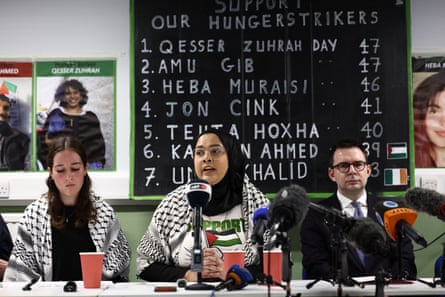
On Saturday, Hoxha will be on day 42 of her hunger strike with other Palestine Action-linked prisoners, amid increasing fears for their health. Most of the group are being held on remand over alleged criminal damage, aggravated burglary and violent disorder at a factory for the Israeli arms manufacturer Elbit systems in Filton, near Bristol. Many have been taken to hospital, some on multiple occasions; the justice secretary, David Lammy, has refused to meet with their representatives.
All will have spent more than a year in prison – significantly more than the standard pre-trial custody limit of six months – before being tried. Their demands include immediate bail, as well as ending the ban on Palestine Action, which they say has led to them being treated as terrorists in jail, despite their alleged offences pre-dating proscription. They also ask for an end to restrictions on their communications, which they link to the proscription decision.
Asked questions by the Guardian through an intermediary, Hoxha acknowledges the potential consequences of what she is doing. “You get to the stage where you’re constantly reminded of the big and irreversible changes that happen with prolonged starvation. It is something that plays on the mind,” she says.
She cites the possibility of blindness, organ failure and brain damage: “Basically everything that brings you autonomy and has given us the ability to go on hunger strike, we’re at risk of losing that.”
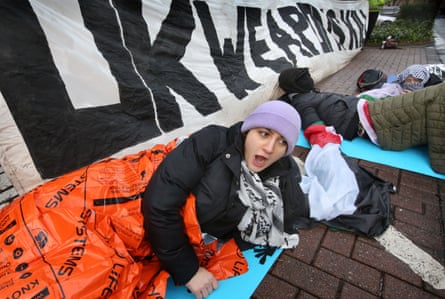
Some symptoms come and go, like chest pains, she says. “But then there’s the symptoms which are constant – dizziness, headaches, shortness of breath, and when you stand you have to sit back down again because you start blacking out.”
She says prison officers tell her “you need to be healthy to fight your case”. But she asks: “What is health without freedom, especially with what they’ve labelled us as?”
The first two prisoners began the rolling hunger strike – believed to be the biggest coordinated hunger strikes in the UK since those by IRA prisoners in 1981 – on 2 November, to coincide with the Balfour declaration, in which the British government pledged to establish a Jewish homeland in Palestine. The pair are Qesser Zuhrah, 20, and Amu Gib, 30, who are being held at Bronzefield prison, in Surrey. They were joined the following day by Heba Muraisi, 31, who is at HMP New Hall.
Kamran Ahmed, 28, at Pentonville prison, London, is on day 41 of his hunger strike, and Lewie Chiaramello, 22, who is refusing food every other day, because he has diabetes, is on day 16. Umar Khalid, 22, who has muscular dystrophy, and Jon Cink, at Bronzefield, stopped their hunger strike this week after 13 days and 41 days respectively, Cink after being hospitalised.
As time has passed concerns about their health have mounted, with the Labour MP John McDonnell saying he and colleagues had used “every parliamentary device we possibly can” to get Lammy to resolve the situation, but to no avail.
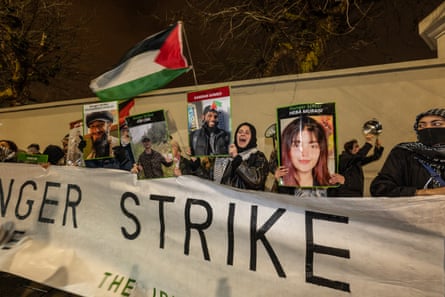
Dr Ian Miller, a senior lecturer in history at Ulster University, said that hunger strikes were relatively common, having been used by the suffragettes, Irish Republicans and Guantánamo prisoners as well as individual inmates – although the latter rarely get publicity and so tend to be ineffective and quickly abandoned. Hoxha had refused food on her own for four weeks earlier this year.
“Going back to the suffragettes, the government always said ‘Oh, it’s blackmail, and we don’t care if you die’ so they always presented it as suicide,” said Miller. “Of course, the difference with suicide is [there is] usually an intent to die.
“The government has often portrayed hunger strikers as irrational, as fanatics, whereas when you look at the perspective of the hunger strikers themselves and their families they do believe they’re fighting for a very righteous cause and that they’re using their bodies as a last resort because they can’t change much in prison.
“They can be effective,” he said. But, he noted bleakly, “I think it’s usually when someone dies – [IRA hunger striker] Bobby Sands is an example – that the public really becomes sympathetic to them.”
At a press conference on Thursday, Dr James Smith, an emergency physician and lecturer at University College London, who is in contact with some of the hunger strikers and their families, described some of the medical realities they now face. “After approximately three weeks, the body has exhausted fat stores and begins to break down muscle and organ tissue in order to generate enough energy simply to maintain essential bodily functions,” he said. “Thereafter, there is a risk that grows with every passing day of sudden, severe and unpredictable bodily dysfunction.
“The heart muscle begins to break, the kidneys are unable to filter effectively, the muscles that aid breathing are compromised, The ability to mount an immune response to infections is severely diminished, the brain is at high risk of irreversible damage … On this trajectory, put simply, the hunger strikers are dying.”
Smith, one of hundreds of health professionals who have written to Lammy and the health secretary, Wes Streeting, believes that the prisoners’ care needs “must now be managed with regular specialist inputs if not continuous monitoring in a hospital environment” and said they were “alarmed by accounts of substandard monitoring and treatment within the prison system”.
He cited the case of Zuhrah, who on Wednesday afternoon was taken to hospital after protesters gathered overnight on Tuesday accusing prison staff of refusing to allow an ambulance in despite her being in severe pain from approximately 5pm on Tuesday. Zuhrah’s designated next of kin, her friend Ella Moulsdale, 21, fears “she can’t survive another [hospitalisation]”.
Ahmed’s sister, Shahmina Alam, 33, said at Thursday’s press conference: “His heart is slowing down, so what are we waiting for, for it to stop?”
Both Sodexo, which runs Peterborough and Bronzefield, and the Ministry of Justice have consistently said that prisoners refusing food receive regular medical assessment and support from clinicians, in accordance with the relevant policies. In the House of Commons on Thursday, the prisons minister, Lord Timpson, said the government was experienced in dealing with hunger strikers “with prisons working alongside our NHS partners every day, making sure our systems are robust and working – and they are”.
Official Prison Service guidance says: “Staff must make every effort to try and find out why the prisoner is refusing food and/or fluids and address the reasons for their refusal.” Department of Health guidance for detainees refusing food says they “should be told of the consequences of their actions and provided with information on how their body may respond and how they may feel”.
John Podmore, a former governor of Belmarsh and Brixton prisons in London, said that clinical staff on site would decide whether they should be taken to hospital. “It’s not nice for the staff, it’s not nice for the prisoner, it’s not nice for the doctors and nurses in the hospital,” he said.

“If I were governor of Bronzefield and these ladies were on remand and their health was seriously deteriorating, I’d be contacting the court and say ‘Look, these women need to be bailed’.”
Ian Acheson, who worked as a prison officer, governor and senior Home Office official, said whether the court would be approached would be centrally mandated. He said: “Nobody wins in this. Individuals cannot use blackmail to compel democratically elected government …[but] in this case humanitarian grounds trump a kind of bloody-minded decision to keep these people remanded in custody.”
At Thursday’s press conference, Hoxha’s 17-year-old sister, Rahma, said: “I feel as if the state has taken away a piece of me and shattered my life … I can’t imagine life without her but the government is forcing us to now she’s instructed her doctors on what to do if she collapses.”
From her cell, Hoxha says: “I hold faith and hope, and those are the most important feelings to have in these moments. If they do not make any concessions, then they need to prepare for a scandal on their hands and prepare to answer the question: ‘Why did you let prisoners die?’”