3 months ago
109
3 months ago
109
When Bright Ansah, a nursing officer in Accra, goes searching for colleagues who have failed to show up for a shift at the overstretched hospital where he works, he knows where to look. “When you see ‘In God we trust’ on their WhatsApp status, that’s when you know they’re already in the US,” he says.
The motto of the US has been co-opted by Ghanaian medical professionals who are leaving the west African nation in droves. Many believe their faith has finally been rewarded when, after years of planning, they reach the promised land of the well-equipped, well-resourced hospitals of the US.
Since the Covid pandemic wreaked havoc on global healthcare systems, the number of nurses, midwives and doctors to have left Ghana has risen exponentially. It is estimated that at least 6,000 nurses left in 2024, driven by factors such as low wages, unpaid salaries and worsening infrastructure. While the US is a huge draw, nurses are also migrating to other countries including the UK, Ireland, Canada, Australia and the UAE.
Meanwhile, in May and October, Ghana’s foreign ministry signed agreements with Jamaica and Grenada to send hundreds of nurses to the Caribbean islands, expanding on a 2019 agreement with Barbados. In July, the health minister announced that more than 13 countries had expressed interest in establishing similar recruitment arrangements.
The government’s justification for the schemes is that Ghana has a surplus of nurses, with tens of thousands unemployed.
But Ghana is also one of 55 countries on the WHO support and safeguard list, which identifies nations facing the most pressing workforce challenges related to universal health coverage. And those working on the frontline of healthcare feel they are on the precipice of a crisis.
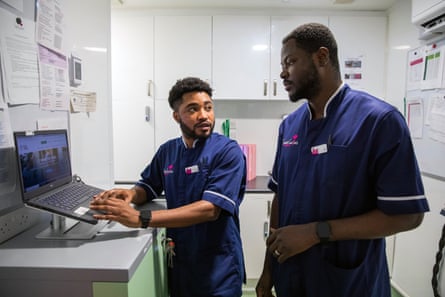
“It’s a timebomb,” says Ansah. “In Ghana, you have a population of 35 million, and the nurse-to-patient ratio is so wide that the nurses are overburdened; they are burnt out. Yet the government wants to export its most experienced nurses to a place like Grenada, which has a population of 125,000.
“I agree that most of our nurses want to go,” he says, “but we don’t have to intentionally push them out.”
Nursing has long been considered a desirable profession in Ghana, offering job security in a country where steady employment is in short supply. It has also become increasingly attractive for other reasons. An established route to migration, it has seen an increase in new entrants as people seek to move, although the schemes are open only to experienced medics.
Three nurses who have chosen different paths explain why they decided to stay, go, or wait and see what happens.
Staying: Bright Ansah, 36, nursing officer
“I’m personally excited to stay because I still feel there’s a lot I can do for my country,” says Ansah, who receives messages daily from former colleagues, now abroad, showing off their state-of-the-art equipment and comfortable lifestyles.
While he understands the frustrations that led them to leave their jobs, families and country, he remains stoic about his decision to stay. “I believe I can help save lives. If we all leave, who will look after our mothers and fathers when they need medical care?” he asks.
Although he calls the average monthly salary of 3,000 Ghanaian cedis (£197) “demoralising” and concedes that some nurses have resorted to selling medications to patients as a means of survival, he has managed to make things work by taking an entrepreneurial approach to his career.
With a PhD in public health, he combines teaching at a university with nursing, hoping to equip the next generation with the skills and mindset necessary to stay. He has also established a healthcare firm providing consultancy services.
“We need a multisector stakeholder approach. We shouldn’t just be interested in scoring political points but in addressing the problems. Why are they leaving? What can we do to retain them as much as we can? Even those who are emigrating are interested in returning to contribute to nation-building. These are things that we need to look at.
“I’ve had a couple of colleagues who vowed to be in the country, whatever happens, but when the pressure exceeded what they could bear, they all left. We have to do better.”
Leaving: Nana Yaa Mills, 39, ICU nursing officer
Nana Yaa Mills, a mother of three, is happily taking her family and leaving Ghana for good, but her mother and sister are dreading having to say goodbye. “They’re so sad,” says Mills. “They say, ‘But you’re here every time we call. Now you’re going, who are we going to call?’ I tell them, ‘You can still call me. I’m leaving, but life goes on.’”
For Mills, that life is now in the US. Though she has spent the past 12 years nursing patients in various hospitals in Accra, she has had enough of the stress and chaos, and she is not alone. Of the 15 nurses she started with in 2017 at the hospital where she worked, only three remain in Ghana. “The majority have gone to the US,” she says. “Three are in the UK, and one is in Ireland.”
The move has been a long time coming. In 2022, Mills travelled to South Africa to take the NCLEX, a standardised exam required to work as a nurse in the US and Canada.
The offer of a job came earlier this year but Mills believes she can still make a difference.
“The authorities only respect you once you go,” she says of her hospital managers. “We diaspora nurses have big plans to use our influence to make things better. We are organising ourselves; we want to make a change.”
Mills is part of a group of more than 1,000 nurses that began as a learning platform on WhatsApp but has since evolved into a support forum for those wanting to migrate. Many feel they have been forced into leaving and there is genuine bitterness and anger towards the system and patients.
“The same people we are advocating for don’t do that for us. When we go on strike, they are the same people who insult us. So everyone is on their own now.”
Though hostility towards immigrants is high in the US, Mills is not concerned. “I’m just happy. Even here we face it. Relatives of patients will just come and insult you, so it’s normal. Racism is everywhere. We just have to develop tough skin.”
Biding her time: Afua Tetteh, 23, rotation nurse
“Sometimes they don’t understand how they’ve taken you through school with the expectation that, when you finish, some of the burden will come off, but you’re still dependent on them for food, transportation and rent,” Afua Tetteh says of her parents. “And you’re working. So it just doesn’t make sense to them.”
Tetteh is part of a cohort of nurses who took to the streets in October to protest over months of unpaid wages, although she did not participate herself, despite her own grievances.
She had to wait for nine months after graduation before being allocated a hospital placement. Five months later, she has only just been paid, but not in full, despite going to work every day, travelling 13 miles each way on public transport, and returning home late after her shifts.
Tetteh’s aunt, who is also a nurse, has been instrumental in helping her adapt and stay the course. One of the biggest problems caused by the flight of experienced nurses is that new recruits such as Tetteh have no one to look to for advice and support. They are having to learn processes and procedures on the job that would normally be performed by senior staff.
“There are about 30 patients on the ward and only two nurses, plus two of us service personnel and maybe one or two students. It’s extremely stressful.
“I’m lucky I have my aunt, so if I have any difficulties I just pick up the phone and call her. When you see the nurses, you realise how tired they are of the entire job. I really don’t want that to be my portion working in this country.”
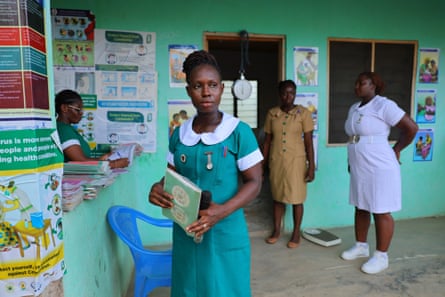
Age and inexperience prevent Tetteh from leaving Ghana in the short term, so she is facing her immediate future pragmatically. Asked whether she has considered a career change she says that, although it has crossed her mind and some of her peers have abandoned nursing for less stressful jobs, she hopes to stick with it.
“Life goes how God wants it to go,” she says, “but, hopefully, in five years’ time I should have been able to leave the country or maybe have a side-business so I can get my life together and know where I’m headed. Right now, things look very unclear for someone who is starting out.”
* All names have been changed to protect identities