3 months ago
119
3 months ago
119
It was the autumn of 2011 and Dr Matt Goodwin was documenting the potential reach of the racist far-right in Tameside, a borough in east Manchester that is part of the parliamentary constituency of Gorton and Denton.
The borough council had spotted the work the young academic had been doing on the rise of the British National party – the subject of his pioneering PhD – and requested that he dig deeper into the local dangers of what Goodwin was describing as a “new British fascism” emerging in disaffected parts of northern England.
Regarded by colleagues as ambitious to a fault, he was certainly not one to turn down such interesting work. Having built strong contacts within the Conservative party, he had already been assisting the hereditary peer James Bethell, and Tim Montgomerie, previously chief of staff to Iain Duncan Smith as Tory leader and the founder of the influential ConservativeHome website, on a campaign with the strapline “there is nothing British about the BNP”.
Goodwin’s co-authored report to Tameside council identified the areas “most ‘at risk’ of far-right extremism and the factors that have driven this support”. The paper argued that it was largely white neighbourhoods close to areas of high immigration where fears might be fruitfully played upon by the extremists.
“The underlying logic is that citizens turn to the far right as part of an instrumental attempt to ‘defend’ their neighbourhood from threatening groups nearby, and to maintain its characteristics and demographic composition,” the paper advised, according to a copy seen by the Guardian.
Fifteen years later, Goodwin’s attentions have been drawn back to Tameside. He may even wish to dust off his old findings after being announced on Tuesday as the Reform candidate in Gorton and Denton’s upcoming byelection.
It is Goodwin though, according to his political opponents, who is the extremist at the gate now. “Trump is right – Europe is facing ‘civilisational erasure,’” screamed a recent post on Goodwin’s Substack. “Having spent much time recently in Paris, Brussels, and London, I for one can say these are not the cities I once knew – they are becoming something else entirely.”
In a recent podcast Goodwin told his interviewer: “2063 is the year in which white Britons become a minority in the country. If a child is born today by the time they turn 25 they will likely be a minority among their peers … I think it matters for lots of reasons: one is more diverse societies are also less trusting societies.”
Few of those who knew Goodwin in the infancy of his academic career would have predicted his metamorphosis from ambitious centre-right academic to being a seeming proponent of ethno-nationalism. A Reform source said he was simply highlighting the consequences of a “policy of mass uncontrolled immigration which nobody voted for”. But were there straws in the wind for this rightward shift?
He could be “great fun to be around” but “loved to be the centre of attention … any group of people that gives him the time of day, he gets very excited by,” said one contemporary at the University of Manchester where Goodwin landed his first post-doctoral role – and where his nickname was Two Jacks after he excitedly blurted out the contents of his poker hand during a night out with colleagues in a casino.
His PhD on the BNP, completed while at the University of Bath, was described by one contemporary as “really quite a brave project – he basically went deep with all the activists who are the kind of people who, if they take against you, you can end up in hospital”.
One of those Goodwin interviewed, for what would become a book on the far-right party, was Eddy Butler, a senior party figure who spearheaded its “Rights for Whites” campaign.
Butler published a review he had written of Goodwin’s New British Fascism: Rise of the British National Party on his blog in 2011. “I suspect he has an element of empathy with the aims if not the means by which organised nationalism has gone about realising these aims,” Butler opined of Goodwin. “Perhaps the hours of interviews he has undertaken has had a Stockholm syndrome effect”.
These comments were dismissed by a Reform source, who said: “We could just as easily point to what radical extremist activists have said about the Green party or the Labour party in recent years.”
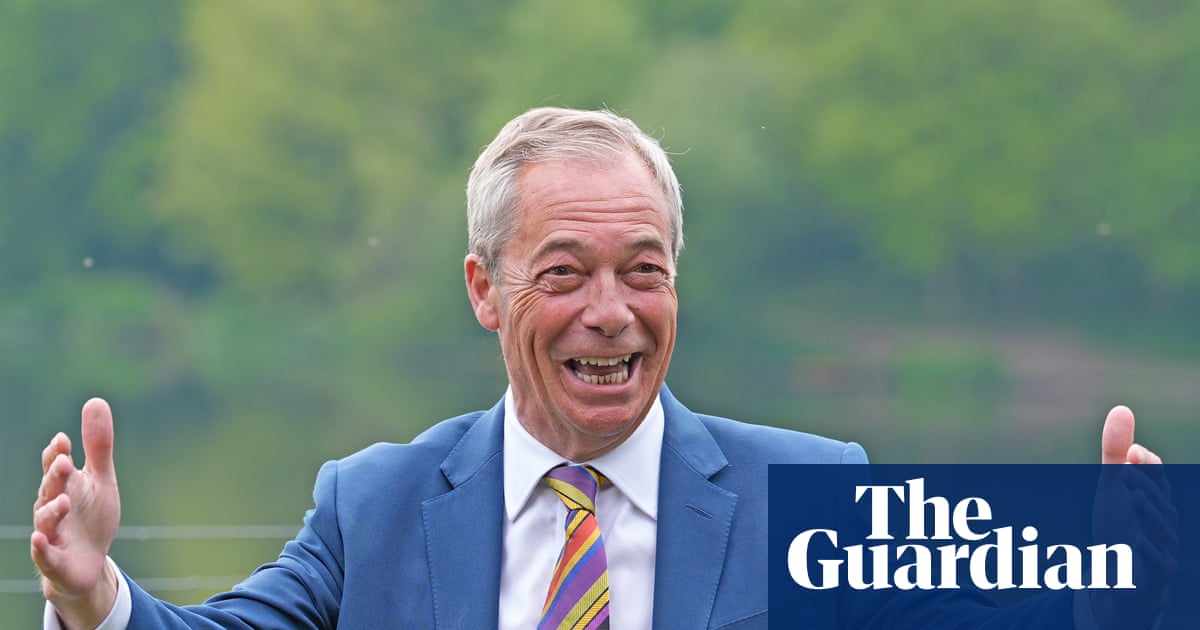
But did Goodwin have a talent for winning the trust of his interviewees or was he vulnerable to ideological capture? Certainly he managed to tease out fresh information from Nigel Farage for a second book he co-authored with Robert Ford, a friend from Manchester, entitled Revolt on the Right.
The then Ukip leader revealed to Goodwin that his party’s executive committee had held a vote in 2008 on whether to form a pact with the BNP for European elections, leading to the first of a number of front page headlines for the authors.
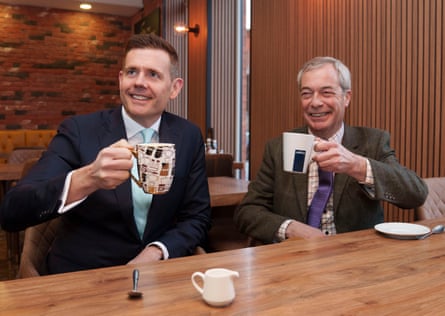
It was a dizzying time of acclaim, and at the book’s launch event at Chatham House, Goodwin arranged for Farage to join him on stage. Ford was told just two hours before the event that he would not be able to sit with them, which a Goodwin ally said was because Ford was not affiliated to the institute, describing any criticism from former colleagues as being motivated by jealousy at Goodwin’s “impact and influence on the national debate”.
A certain ruthlessness then, perhaps, but if Goodwin was at this stage showing any signs that he was leaning towards the politics of Farage or something more extreme, it bypassed senior Conservatives.
Among those who gave him their time were Ameet Gill, David Cameron’s director of strategy, who brought Goodwin into Downing Street for a tour and talks and Sayeeda Warsi, who was co-chair of the Conservative party from 2010 to 2012 and who invited Goodwin to join her government working group on anti-Muslim hatred.
Lady Warsi said she had no inkling that Goodwin, who at that time complained of the “worrying levels of public hostility” to Muslims, could end up a decade later taking selfies with Donald Trump confidant Steve Bannon and writing that “millions of British Muslims – millions of our fellow citizens – hold views that are fundamentally opposed to British values and ways of life”.
Warsi said: “Matt talked passionately and deeply about his concerns about the rise of the far right; as passionately as he now talks about Muslims, he talked then about Islamophobes. That is as honest as I can be really.”
Goodwin quit Warsi’s advisory group in 2015 claiming that the work on tackling Islamophobia was not going quickly enough although he had also complained that a request for a “paltry sum” of £5,000 to pay for researchers had been rejected.
A hard worker but also obsessive, Goodwin, 44, was said by former friends and colleagues to have a track record of taking criticism and rejection badly, as evidenced by a string of broken relationships he has left behind him.
He fell out with Ford after criticism of Goodwin’s generous forecasts for Ukip’s future electoral success led to wider concerns in academia by 2020 that Goodwin was transforming into an activist.
Montgomerie, who has also recently joined Reform, tweeted in 2024 that “there really is something sulphurous about Matt Goodwin. Incendiary views. Suspect opinion polls. Massive self-obsession. British public life would be so much better without him.” Montgomerie has since retracted his comments, the Guardian understands.
Jonathan Portes, a former government economist, was a fellow along with Goodwin at the UK in a Changing Europe thinktank but their relationship also fell apart after a row on social media.
“Recently we did a public debate on immigration, it was me and [the immigration policy specialist] Zoe Gardner debating [the former Tory cabinet minister and new Reform member] Nadhim Zahawi and Matt,” he said. “I chatted with Nadhim but I didn’t chat with Matt before or after. We are not at the point where we talk to each other. He went from being a Reform sympathiser to very explicit racism.”
Goodwin has said those who have falsely accused him of racism are simply smearing him for his audacity in opening a debate. A Reform source claimed Portes was a “deeply biased leftwing activist masquerading as an academic”.
Goodwin himself moved out of academia in the summer of 2024 when he took voluntary severance as a professor at the University of Kent. He is now a GB News presenter with a Substack that boasts 90,000 subscribers.
He wrote a book on higher education last year, titled Bad Education, which claimed British universities had been captured by “woke” ideas. Colleagues wonder whether the book might have at least been partly motivated by his failure to land the plum roles he is said to have coveted at Oxford and elsewhere. The suggestion was rejected by a person close to Goodwin as “nonsense”.
“Matt has always talked about the dangers of hate and public intolerance in society,” a Reform spokesperson said. “Throughout his academic career he has pointed to working class areas being left behind by globalisation, mass immigration and an unresponsive political class in Westminster.
A former friend of Goodwin responded: “I think ego is the best explanation of his journey. It’s vanity, he is very brittle and insecure. The one thing I can’t answer is how much of this is performative and how much sincere. But at a certain point it doesn’t matter when you are telling hateful people, hateful things”.
On Friday afternoon, the far-right agitator Tommy Robinson, a former BNP member, tweeted: “Vote Matt.”