2 months ago
94
2 months ago
94
When the artist Charmaine Watkiss was a child, she frequently visited G Baldwin’s, a herbalist who sold natural remedies and essential oils in London’s Elephant and Castle, to pick up medicinal herbs and sarsaparilla for her mother. “They’ve had an apothecary for over 100 years,” she says. “It’s a place Black women used as a resource in the 1970s and 80s. You’d say: ‘I’ve got this ailment’ and they’d recommend something.”
Watkiss’s mother was part of the Windrush generation who migrated from the Caribbean to the UK, and these memories sparked a new area of research for the artist before her first gallery show in 2021, The Seed Keepers, which explored the botanical links connecting the Caribbean, the UK and the African continent in the context of the transatlantic slave trade. “While in my studio, I thought: all this knowledge must have travelled with the enslaved.” Thus began Watkiss’s large-scale illustrated portraits depicting women of African descent alongside medicinal plants. Evoking historical botanical illustrations, the artist traces how the enslaved relied on herbal knowledge for survival.
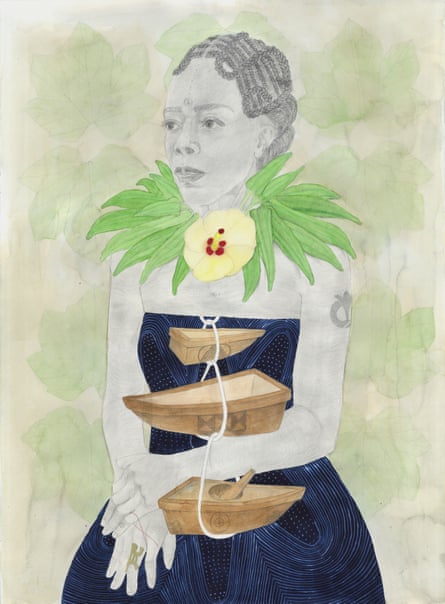
Watkiss is talking ahead of an exhibition of newly commissioned works at the Royal Albert Memorial Museum in Exeter, where she was invited to create new work that engages directly with the institution’s holdings. She immediately noticed an absence. “I needed to respond to the West Africa display as the story of the diaspora was missing,” she says. “I needed to speak to the people who were taken away from the continent – my ancestors – and speak about the diaspora through material.”
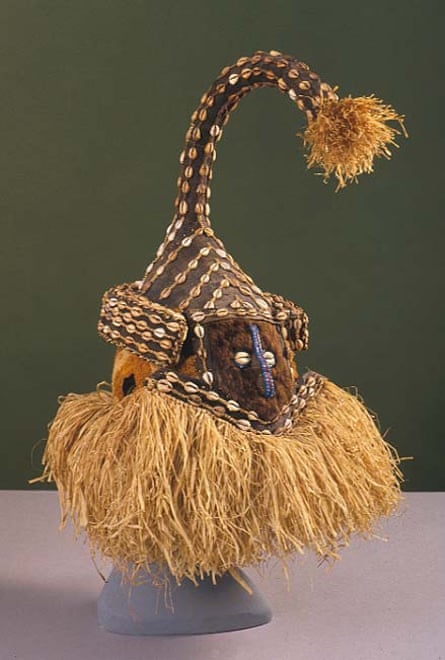
Watkiss used the opportunity to do something different: her usual way of producing work involves drawing on paper, but after encountering RAMM’s collections of masks, she turned to sculpture. The artist was particularly drawn to the mukenga helmet masks designed to cover the wearer’s face, originating from the Kuba kingdom in the Democratic Republic of the Congo, and traditionally made with materials such as cowrie shells and glass beads. “My mask will be in the cabinet with all the other African masks,” she says. “Interestingly, they’ve got some masks on loan from the British Museum too, so there is a dialogue.” Her RAMM commission also includes a new watercolour which incorporates some of the museum’s holdings, such as a nkisi figure, traditionally used for purposes including healing and protection. “With sculpture, I work intuitively. With drawing, it’s research – then the drawing takes over,” she says.
Watkiss’s journey to becoming an artist wasn’t straightforward. She worked as a footwear designer in the late 1980s but faced discrimination from those she worked alongside in the industry. She later turned her attention to studying film, and one tutor told her: “Black people made no contribution to western civilisation.” She wrote her dissertation to prove him wrong. Later, in 2015, she devised a five-year plan: “I wrote that within five years I wanted to become an artist. I had no idea how it would happen.” She embarked on a foundation course at City Lit in London before starting an MA in illustration at Wimbledon School of Art. In January 2020, Watkiss shut down her old work website and took a giant leap of faith. She credits this decision in part to also practising reiki. “When you heal someone, you align all their energy to an intention. I used myself to test that idea, and it worked. It’s a process of hurling yourself into the unknown and trusting you’re not going to die when you jump.”
This isn’t the first time Watkiss has responded to historic museum collections and narratives: she has held research fellowship stints at the Sloane Lab in partnership with the Natural History Museum and the British Museum. “I wanted to find out what Hans Sloane and his contemporaries knew about healing plants, as many specimens were collected by enslaved Africans,” she says. A work commissioned last year is currently on view at London’s National Portrait Gallery, placed alongside a portrait of physicist and collector Sloane. He was an owner of enslaved people in Jamaica and gained substantial profits from his wife’s sugar plantations – his collection formed the foundation of the British Museum, and he owned the land on which Sloane Street and Sloane Square in London now stand. Watkiss reimagines a woman Sloane wrote about in an 18th-century volume as a “queen in her own country” who helped to cure a growth on Sloane’s foot.
I ask Watkiss about the difficulties of working with legacies of race and the enslaved within western museological collections. “It’s a hard, complicated history,” she says. “That trauma is generational – it’s in our DNA. Growing up in western culture, being viewed a certain way – it’s another layer.” In her response to Sloane’s portrait, Watkiss replaces him at the centre of the story with the woman once relegated to the margins: the healer is depicted seated on a throne, rich with symbolism including the sankofa bird, an Akan symbol of looking back to move forward.