3 months ago
157
3 months ago
157
More than half of Reform UK members believe non-white British citizens born abroad should be deported or encouraged to leave, according to the first publicly available poll of those in Nigel Farage’s party.
The findings come as the Reform leader attempts to court centre-ground voters while facing pressure from his right flank, including a hardline new party launched by Rupert Lowe, who left Reform after falling out with Farage.
According to the research published by the anti-racism group, Hope Not Hate (HnH), 54% of Reform members thought non-white British citizens born abroad should be forcibly removed or encouraged to leave, while one in five (22%) also supported it for non-white citizens whose parents were born in the UK.
Survation, a respected polling company, surveyed 629 Reform members between 29 January and 16 February. Reform said in December that it had about 270,000 paid-up members.
The findings were described by HnH, which publishes its annual “State of Hate” report on Wednesday, as evidence of tensions in Farage’s party.

Its chief executive, Nick Lowles, said: “With a dilution of Reform’s policies to win more moderate voters, or if they were to form a government, you could see a number of their members becoming quite disillusioned.”
There was considerable support among Farage’s own members for two of his rivals on the right: Lowe and the activist Tommy Robinson. Two-thirds had a positive view of Lowe, who recently launched Restore Britain and advocates mass deportations.
HnH, which has been monitoring the far right for decades, said it was sounding an alarm on the rise of a more explicitly racial nationalism, which defines English identity by “blood and ancestry”.
“Its spread is dangerous because of the proposed solutions that follow, most notably ‘remigration’. This concept repackages older ideas of ethnic cleansing and forced repatriation in softer, more bureaucratic language,” the report states.
It warned that extreme racial nationalist views of who is British or English were breaking into the mainstream with the backing of Reform UK and media cheerleaders.
HnH drew a link between racially charged views on identity pushed by far-right activists during a backlash to Black Lives Matter and recent interventions by Reform UK figures such as Matthew Goodwin and Suella Braverman.
Goodwin, who lost the Gorton and Denton byelection last week, refused to disown his claim that UK-born people from minority ethnic backgrounds were not necessarily British.
The former academic had said: “It takes more than a piece of paper to make somebody ‘British’.”
After the podcaster Konstantin Kisin claimed last year that Southampton-born Rishi Sunak was not English – sparking an online debate which emboldened the far right – Braverman wrote in the Telegraph that she was a proud British Asian but not English.
The UK’s far right was now “bigger, bolder and more confrontational”, according to HnH. It said Restore Britain was also creating a realignment on the far right after attracting support from activists across its spectrum, but it was still a fragile coalition.
HnH said the most important new development last year was the “unite the kingdom” rally in London led by Robinson, whose real name is Stephen Yaxley-Lennon. More than 150,000 people took to the streets in the largest far-right protest in British history.
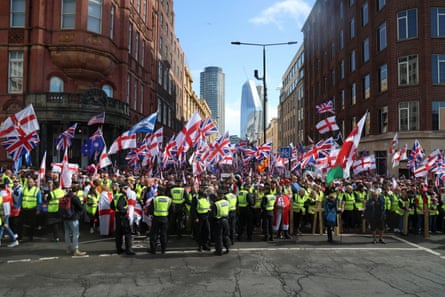
A quarter of the British population identify positively with Robinson’s movement, according to other polling for HnH by Focaldata using a nationally representative group of 8,185 people.
Another rally is being planned by Robinson, who has drawn the support of the billionaire owner of X and Tesla, Elon Musk.
Robinson is now in the US, where he was this week feted by rightwing figures including a political appointee at the state department in Washington and a congressman.
The wave of anti-migrant protests that reignited in Epping in July last year outside a hotel housing asylum seekers was also highlighted in the HnH report, which tracked 251 such demonstrations throughout 2025.
“One worrying feature is that these anti-migrant protests have persisted through the winter months in key areas, with some attracting several thousand people. As we head towards the hot summer months, we will very likely see a surge in activity once again,” it said.