2 months ago
103
2 months ago
103
In December 2020 Henry Nicholls was a fixture in the New Zealand team, batting at No 5, but he was under pressure. In nine Tests since the end of their series against Bangladesh in early 2019 he averaged only 20.33. But they stuck with him and in his next game, against West Indies in Wellington, he scored 174 and was named player of the match.
“In another time he may not have been offered that opportunity,” said one of the commentators covering the match on domestic television. “There’s many cases where guys haven’t had a sustained period to be able to find form, but a mark of this New Zealand side is their selection consistency, and they’re being rewarded.”
The commentator was Brendon McCullum, whose time as head coach of England’s Test side has been marked by a sometimes remarkable loyalty to out-of-form batters. Perhaps Nicholls had more of an influence on this game than the scoreboard suggests – and given he scored an 11th Test century, and was involved in crucial second‑innings partnerships with Rachin Ravindra and Daryl Mitchell, the scoreboard suggests his influence was considerable.
Nicholls was eventually dropped at the end of 2023, after two matches in Bangladesh in which he averaged 6.25. He went back to Canterbury and got to work. In the following season’s Plunkett Shield, New Zealand’s domestic first‑class competition, he averaged 116; in 2025-26 he averaged 96.66. When Kane Williamson made his unexpected decision to retire mid‑series, the 34-year-old Nicholls was back, as New Zealand’s selectors opted for experience and first‑class form. For this, Nicholls again rewarded them.
There is an obvious contrast here with England, who gave no thought to experience when they picked a side for this game. It is hard at its conclusion to argue the result was positive either for the team or for the players they chose.
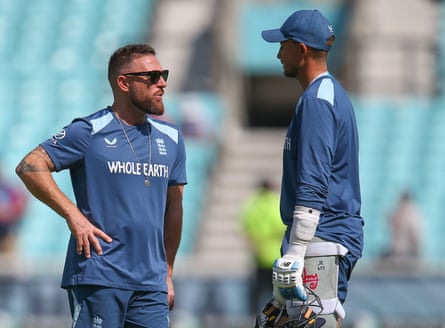
The decision to stick with Rob Key as the England and Wales Cricket Board’s managing director of men’s cricket, with McCullum as head coach, and with Ben Stokes as captain despite the manifold failures exposed during the Ashes series last winter meant that a groundswell of opinion demanding rebirth and renewal had gone unanswered at the top of the team hierarchy.
So, when a combination of disciplinary matters, paternity leave and injury forced them to replace four members of the side that won at Lord’s two weeks ago, and the decision not to pick a specialist spinner did for another, they sought to satisfy that urge. Three people made their debuts, two played for only the second time. The result, as Joe Root tacitly admitted after New Zealand had sealed a convincing victory, was all but inevitable.
Root said England had been “pushed into a little bit of a corner with the scenario that we found ourselves in”, and that “it would be unfair on them to say because of their lack of experience they weren’t the right selections”. But he also said that one of his team’s main challenges had been coping with “a number of guys at the front of their careers [who] have to learn very quickly and understand the rhythm and the requirements of Test match cricket”.
“One thing you’ve got take into account, the majority of the time, when you make your debut, you’re the sole debutant and you’ve got an experienced or a very settled group around you that have been operating in a certain way,” he said.
“I think it can be very difficult, and a big ask of young players in particular, to all come together and not have that sort of continuity around you. With that in mind I thought all of them did very well.”
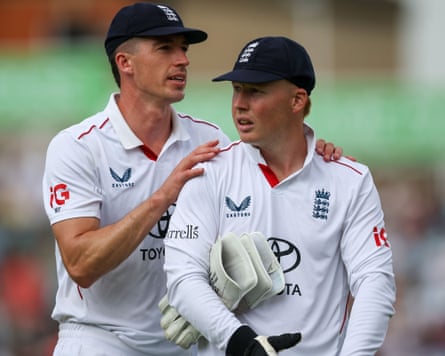
There were options, had England followed the path New Zealand chose with the selection of Nicholls. But it often feels like there is nothing in English cricket as toxic as a former Test batter, and given the current need for novelty perhaps now more than ever. For example, for this game many called for the return of Dan Lawrence, a player who, since an inglorious attempt to crowbar him into the side as opener for the series against Sri Lanka in 2024, has returned to Surrey and produced the finest form of his career – for all that he scored 8 and 0 against Glamorgan this week. He may not be the future – though there are numerous examples of players who had exceptional Test careers having debuted at or after Lawrence’s current age of 28 – but his experience, particularly on his home ground, could have been invaluable. Instead, England picked the 22-year-old James Rew, whose memories of his debut will be bittersweet.
Before the game McCullum enthused about his “super exciting” array of young talent. Nobody was using that phrase to describe Nicholls’s return, at least not then, but in the end there is nothing as exciting as success.