2 months ago
49
2 months ago
49
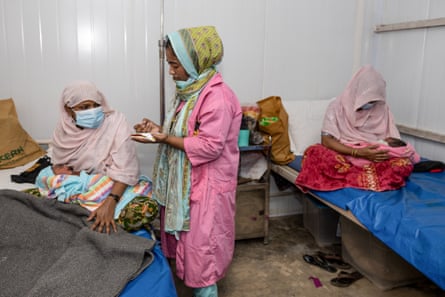
The light of a single lightbulb powered by a backup generator lasts just long enough for Noor and Sowkat to see the faces of their newborn babies for the first time. The two children were born on the same night on a crumbling foam mattress, its corners ripped to shreds by the thousands of women who have gone into labour here in Camp 22’s makeshift delivery room.
The newborns have just become the youngest residents of the world’s largest refugee camp, in Cox’s Bazar, Bangladesh, which is struggling to operate in the face of a 63% deficit in humanitarian aid funding.
In the cramped, windowless room next door, Rajuma, 30, waits nervously for the results of a prenatal test as machines beep in and out of action around her. Rajuma is eight months pregnant and knows that once her baby is born she will need to skip meals in order to feed her family; there has been a series of ration cuts this year.
Noor, 23, Sowkat, 24, and Rajuma are Rohingya, a Muslim minority group from the north-west of Buddhist-majority Myanmar, Bangladesh’s neighbour. Rohingya have faced persecution from Myanmar’s military for decades, but this peaked in 2017. After a particularly brutal crackdown, described by UN investigators as a “textbook example of ethnic cleansing”, about 750,000 Rohingya crossed into Bangladesh and settled into a sprawling network of 33 refugee camps in Cox’s Bazar.
But despite an almost complete lack of opportunity in Bangladesh, which does not recognise them as refugees, the number of Rohingya making the dangerous journey to Cox’s Bazar is rising. Close to 200,000 have left the violence in Myanmar for the camps since early 2024, after conflicts intensified between local militias and the army.
For the more than 1.1 million refugees now living in Cox’s Bazar, recent drastic cuts to humanitarian funding have been a painful reminder that their survival in Bangladesh is completely dependent on aid.
In the immediate aftermath of the USAID cuts, 48 health facilities were forced to close or drastically reduce their services, a spokesperson at the International Rescue Committee (IRC) says.
Abdullah Wahed, 25, says the reduction in health services almost cost his three-year-old son his life when a tumour started growing on his wrist earlier this year.
“We couldn’t get the support we needed from the health centre,” Wahed says. “We had to borrow 100,000 Bangladeshi taka (£620) to pay a private hospital three hours away to cut it out.”
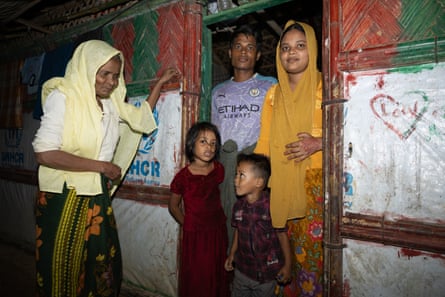
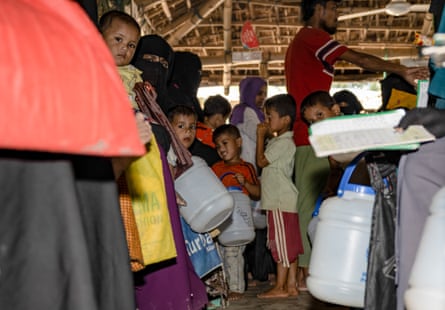
Inside the Unicef nutrition facility in Camp 15, there is almost no space left to stand. Desperate women queue with empty plastic buckets branded with aid organisation logos, while emaciated children are weighed, measured, and fed on a conveyor belt-like system that resembles a human factory floor.
About 300 children are seen for malnutrition here every day. Doctors say this September saw an 11% increase in admissions for children under five with acute malnutrition, compared with the same period last year.
“Come mid-year 2026, we will likely run out of money to continue to provide life-saving support for children,” says Dr Owen Nkhoma. “Without effective funding to treat and prevent, you’ll soon be reporting on children dying here.”
Monsur weighed 1kg (2lb 2oz) when he was born in April, when temperatures inside the tarpaulin-wrapped bamboo shelters of the camps commonly exceeded 40C (104F) during the day.
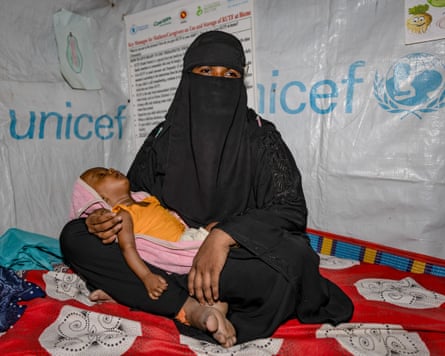
Seven months later, slumped in his mother’s arms in the facility that keeps him alive, Monsur’s eyelids are heavy, and his dry lips curl upwards, seemingly eager but unable to feed.
His mother, Romida cannot produce enough milk to nourish her boy, whose life depends on treatments such as ready-to-use therapeutic food and Vitamin A supplements. But despite these interventions, the tiny circumference of his stick-like upper arms shows he is still suffering from severe acute malnutrition.
Rohingya refugees are subject to a strict set of rules enforced by the Bangladeshi government, which has been pushing to repatriate the Rohingya since larger waves of people began arriving in the 1970s.
Shelters in Cox’s Bazar must be built in a way that allows them to be dismantled quickly, and Rohingya people cannot legally work, earn money or participate in formal education in the camps.
after newsletter promotion
This summer, an urgent appeal was launched to secure an extra $85m (£64m) to meet the needs of recent arrivals.
Funding cuts mean the newest refugees – 76% of whom are women and children – are not provided with shelter or non-food items.
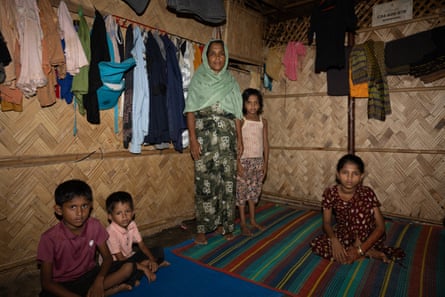
Instead, women like Rahima, 41, who arrived in Cox’s Bazar in June 2025, rely on other refugees for sleeping space on their floors and basics such as soap to keep their children clean.
It took Rahima and her seven children eight days to reach the Bangladesh border when they fled their home in Buthidaung, just before much of it was burned to ashes in 2024.
“They tortured us first,” she says from Camp 4, inside a shelter with barely enough space for her children to lie down. “Then they my took husband and forced our eldest son to join their army.”
It has been six months since Rahima has heard from either of them.
“Rohingya refugees in Bangladesh don’t rely on aid by choice,” says Davide Zappa, head of EU Humanitarian Aid in Bangladesh. “Less humanitarian aid funding today only multiplies the emergencies of tomorrow.”
Standing at the edge of a “funding cliff”, few options remain for Rohingya refugees as fighting continues in Myanmar.
In 1977, the Myanmar army launched Operation Dragon King to seek out Rohingyas living in Rakhine State. Mass killings and horrific violence drove about 200,000 people across the Bangladesh border.
Two years later, more than 10,000 Rohingya who refused to return to Myanmar starved to death in the first camps built in southern Bangladesh.
Today, there is little hope of a safe return to Myanmar. As aid dwindles, the Rohingya face the very real prospect that their deaths will once again be overlooked.