1 week ago
17
1 week ago
17
When David Hill and Robert Adamson captured the lives of a small Scottish community in the 1840s, were they creating the first ever social documentary series? A fascinating new book makes the case
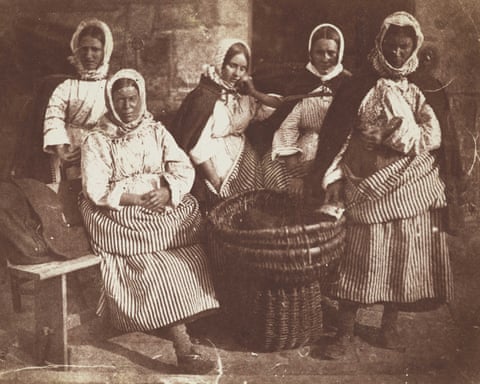
‘They helped the city survive’ … fishwives returned from market. Photograph: Sam Drake/David Octavius Hill and Robert AdamsonWed 10 Jun 2026 08.00 CEST
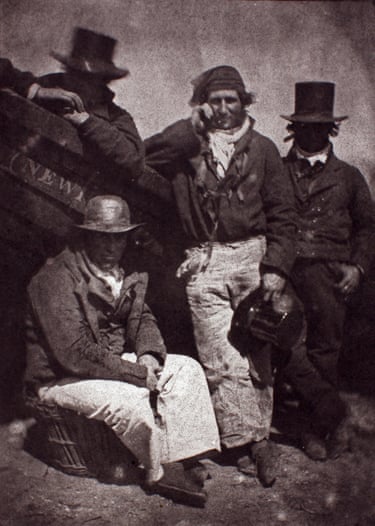
Newhaven fishers, modern print from failed negative, c1843-6
A new book brings together work by pioneering Scottish photographers David Octavius Hill and Robert Adamson, created between 1843-47 with collaborator Jessie Mann. In this image we see the men of Newhaven, at that time a village and harbour outside Edinburgh. They were impressively good sailors, fishing from small open boats, 25-30ft long. They were also responsible for saving lives. Hill & Adamson’s Fisherwomen and Men of the Firth of Forth by Sara Stevenson is available from Studies In Photography. All text: Sara StevensonPhotograph: National Galleries of Scotland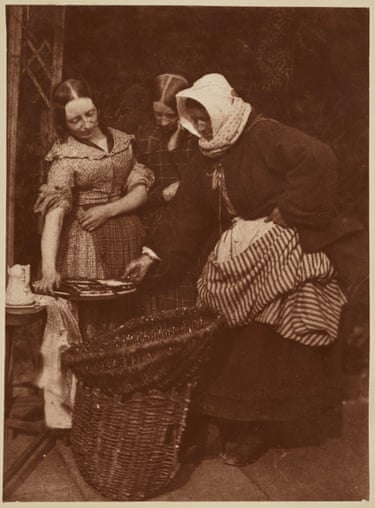
Barbara Johnstone Flucker at the door of Rock House, carbon print by Jessie Bertram from the original negative, c1843-6
Robert Adamson set up as a professional photographer at Rock House on Calton Hill, Edinburgh, in March 1843. This photograph of Mrs Flucker is one of the few of the series which was taken at the Edinburgh studio. Presumably she supplied fish to the household, and may well have introduced Hill and Adamson to the Newhaven villagersPhotograph: National Galleries of Scotland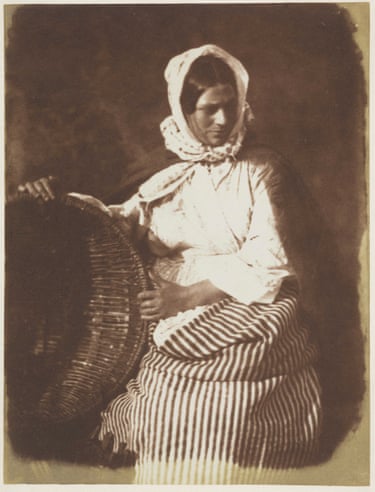
Elizabeth Johnston Hall: ‘It’s no’ fish ye’re buying, it’s men’s lives’, calotype print, c1843-6
This picture was greatly admired by the philosopher Walter Benjamin in the 1930s, and has been influential in modern discussions of the nature of photography itself. Benjamin was much moved by the sitter, wanting to know her name, and this underlines the human individuality of the Newhaven calotypes. The image’s coherence and strength reflects the nature of the woman herself. The time the picture took to make, of sometimes minutes, helps show us a breathing figure, a sense of lifePhotograph: Sam Drake/National Galleries of Scotland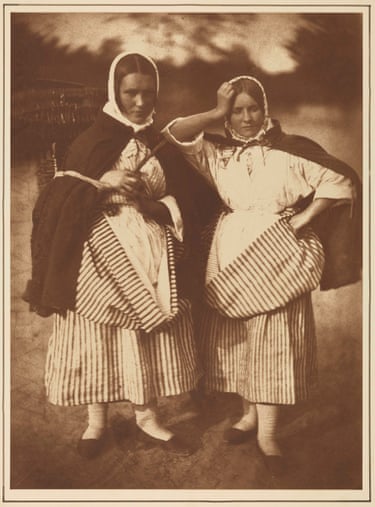
Sisters, calotype print, c1843-6
The women of Newhaven were confident and independent. They could rely on the mutual support of other women, friends and family to strengthen the social bond – in good times and bad, sharing the load in times of difficulty and grief. They had excellent singing voices and filled the streets with song. When the suffragette movement gathered strength at the end of the century, they were natural and articulate defenders of women’s right to votePhotograph: Graeme Yule/National Galleries of Scotland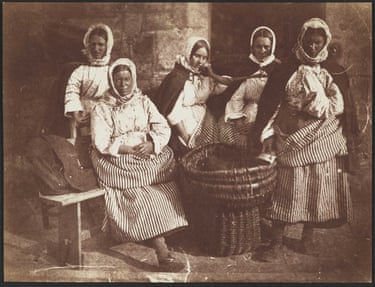
Fishwives returned from Market, group including Mrs Grace Ramsay, calotype print, c1843-6
The fishwives of Newhaven were celebrated for their beauty, confidence and distinctive costumes. They brought great loads of fish in creels on their backs up to the heights of the city of Edinburgh to sell them directly. At a time of economic depression, high mortality, endemic illness and a devastating potato famine in the Scottish Highlands, the direct provision of fresh fish was a great boon to the cityPhotograph: Sam Drake/National Galleries of Scotland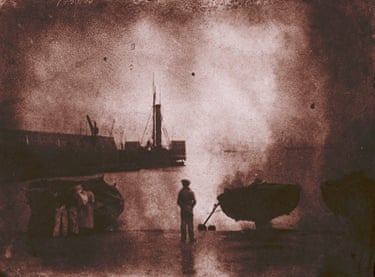
Newhaven harbour with the paddle steamer, Stirling, moored by the pier, modern print from the original negative, c1843-6
One of the problems with early photography was taking pictures of land without the much brighter sky overdeveloping and blanking out the image. Hill and Adamson worked with light bounced from the water. This picture, taken at full-tide, possibly after rain, has become too dark to see the details, but the reflection of a man looking out, and the boat perched on the line of the quay, add to the shape of the paddle steamer to make it a satisfactory imagePhotograph: Negative in Glasgow University Library, Special Collections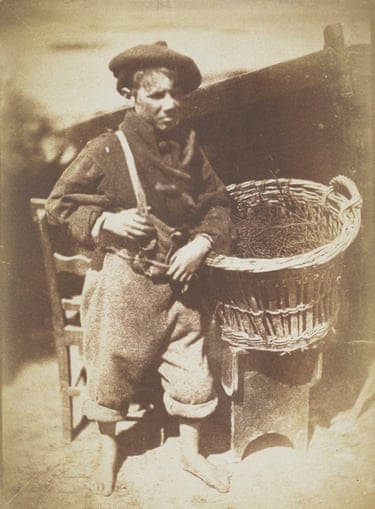
His Faither’s Breeks, calotype print, c1843-7
The picture is the only calotype of a child standing alone. The title echoes the song: ‘The soldier boy to the wars has gone / his faither’s breeks he has girded on …’ The boy’s father had died and he inherited his trousers, and perhaps nothing else. There was no welfare state, and in other circumstances he would have been destitute. But he is backed by a fishing boat and is physically supported by the creel. The community has embraced him and his future profession lies ahead of himPhotograph: National Galleries of Scotland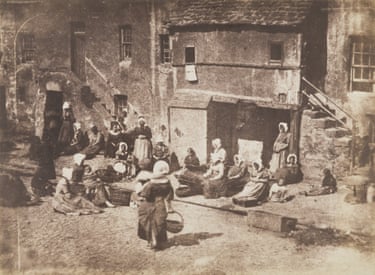
The Fishergate, St Andrews, calotype print, c1846
In Fishergate, the fishers were only able to work sporadically, and when they came back, they turned to ‘gluttony and drunkenness for one week, and in the next, if the weather is unfavourable, they are on the verge of starvation.’ In the mid-1840s, Hill, Adamson and Miss Mann went to photograph the area, with the intention of illustrating social improvement there. The central figure crossing the road, with good shadow, would have required a particular hour of day when the sea mist did not roll into the streetPhotograph: National Galleries of Scotland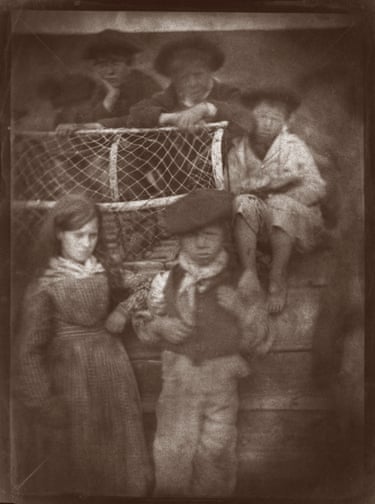
Newhaven children on an upturned boat with a lobster pot, modern print from calotype negative
The fishing series of 120-130 photographs was designed in response to the whole community, including children and infants in arms. This image has failed in the photographers’ terms, but shows an intelligent construction, using a lobster pot and a boat, materials with which the children were familiarPhotograph: National Galleries of Scotland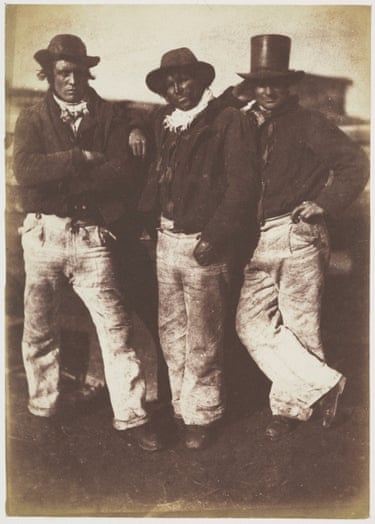
Fishermen Ashore, Alexander Rutherford, William Ramsay and John Liston, calotype print
One of the essential tenets of the book is that these photographs constitute the first social documentary series. In effect, the photographers invented the idea while working in Newhaven. The two important drives behind this series at the time were an aesthetic interest, presenting meaningful images, and the admiration of a society living and working successfully in extraordinarily difficult circumstancesPhotograph: Sam Drake/National Galleries of Scotland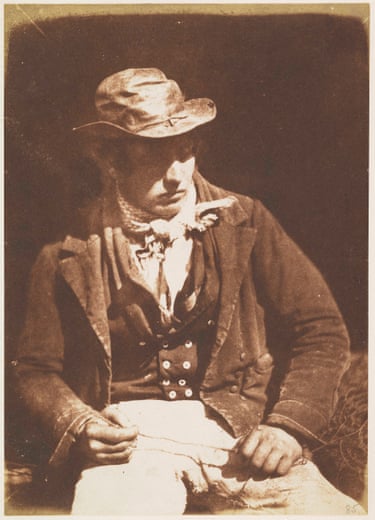
Willie Liston ‘redding the line’, calotype print, c1843-6
Fishing required two kinds of line, for inshore and further out to catch such fish as cod and halibut. The lines had from 500 to 3,000 hooks, which required cleaning and replacing the bait each time they were used. This work was shared by the men and the women. Liston shows the extended concentration required, and this calotype is balanced by another picture of the same man simply thinking. He was presumably an introspective manPhotograph: Sam Drake/National Galleries of Scotland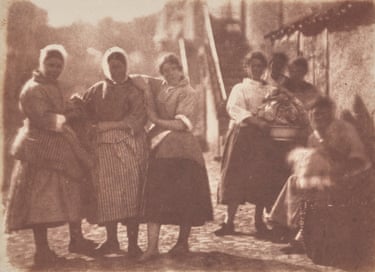
A lane in Newhaven, calotype print, c1843-6
This photograph is an extraordinary rendition of light – taken against the sun and surrounding the women with halos. Hill, himself a good singer, evidently saw this as a lyrical photograph, evoking the women’s singing voices. This calotype belonged to the marine painter Clarkson Stanfield, who wrote that he would rather have it than the best Rembrandts he had seenPhotograph: The Clarkson Stanfield Collection, Harry Ransom Research Center, University of Texas.Explore more on these topics