3 months ago
158
3 months ago
158
Paris est mythique. There was nothing understated, no obvious shades of faux humilité about the headline in L’Équipe after Paris Saint-Germain had been re-enthroned as Champions League winners on Saturday night. Mythical. Storied. Ultimate. Yeah. But are they, though?
In fairness it would be disappointingly un-Parisian not to consider your champion team the champions of all champions in the moment of victory. Give the people what they want. Play the hits. Nobody needs a polite Parisian waiter. Nobody wants to see an unstylish Parisian estate agent who has taken absolutely no care of his hair, or a Parisian bistro that doesn’t think it’s the VIP boarding lounge for the last arc leaving planet Earth. Hmm. Maybe there’s somewhere else more dismissive around the corner.
In this case the Parisian exceptionalism is entirely justified. The PSG of Luis Enrique, Vitinha and Nasser al-Khelaifi has evolved into a sensationally good, beautifully watchable team. The way they beat Arsenal only adds to this. Mikel Arteta’s tactics worked in Budapest. PSG played below their level, and looked visibly drained at times from fiddling away around that solid red defensive structure.
But they still found a way to guts it out, to win on the fine details. We got cork-popping football-of-the-gods in the 5-0 win over Inter in Munich last year. This was a different kind of champion quality.
Plus, history tells us retaining the European Cup is very hard to do. Albeit, that degree of historic difficulty does rest on the assumption you’re simultaneously straining to win a domestic league, stretched on all fronts across eight gruelling months.
Which is very obviously not the case here. Before we start doling out mythic status it is worth acknowledging the true nature of this feat. Essentially PSG have managed to win nine key games from February to May two years in a row, with a team, a schedule and an ever-giving ownership entirely geared to that spring mini-season.
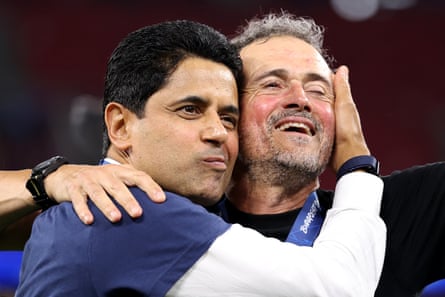
Another L’Équipe headline seemed to capture it better. “L’Europe a les champions qu’elle merite.” Now you’re talking. These are the champions European football deserves: beautiful, high‑craft, complex and also deceptive. This is elite performance for an overclass world, and a model that has successfully subverted the more established route to the very top.
Ideally a European champion team, in the form first devised by L’Équipe itself 70 years ago, is supposed to express the strengths of its domestic league, to emerge from that crucible ready to show the rest of Europe why this system, right now, is the best.
Instead the domestic league has been bypassed. The current PSG express nothing about Ligue 1 and everything about their own ambition and power. Nuno Mendes and Marquinhos have both played more minutes in the Champions League this season than in Ligue 1. Ousmane Dembélé started 11 of 34 Ligue 1 games and is basically a midweek player after Christmas, peaking for those dates. Does this really deserve a Ballon d’Or? How about half a Ballon d’Or?
Here we have a football team recast as a luxury good, the kind of overclass product that can only be found behind the velvet rope in some elite private airport suite. Given the sole challenge here is to win the Champions League; given the will of the Qatari state, the clear and actionable plan, the domestic matches that are essentially tune‑ups, we should probably temper our feelings of awe when this does indeed happen.
This is of course unfair on PSG. Most obviously it overlooks the achievements of Luis Enrique in creating PSG 2.0, a model of drive, focus and tactical coherence that bears no comparison to the celebrity machine that preceded it. PSG then: Neymar riding a snow leopard around his personal rooftop disco dressed in a solid gold bowler hat and chinchilla fur chaps. PSG now: Vitinha diligently revolving the ball, like a submarine captain down in the engine room twirling his pumps and sprockets, conductor of a team that loves to work as much as it loves the ball.
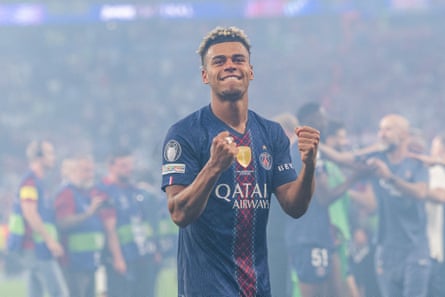
The creative leader on Saturday night was Désiré Doué, whose super-skill is his ability to spin and stop with perfect balance, like a squirrel on a branch, and who embodies a new kind of elite footballer, the details-geek, the private chef devotee, a sleep student who takes timed naps to improve his energy levels. Which is definitely a step on from turning up to training three days into a week-long cheese and Red Bull bender.
Luis Enrique has been empowered by the hierarchy and has entirely nailed the tactical architecture. This PSG play like a fusion of Pep-style possession ball and the direct attacking energy of peak Klopp Liverpool. The training methods have been innovative and data-heavy, with talk of an “immersive video simulator”, individual USB stick tactical notes, and training‑ground speakers pumping out stadium noise for Pavlovian visualisation vibes.
It has been both surprising and also entirely unsurprising that this transformation has been effected so quickly. Who knew Qatar could make its propaganda project actually work by finally listening to a very good manager?
The fact is PSG should always have been this good. There are no limits here. You don’t have to be a single-city petro-project glamour toy with an economically irrationally funding model to be successful. But it doesn’t hurt.
There is in this context something telling that PSG are seen as European football’s good guys now, the purists, the keepers of the flame, not just good but good. Most neutrals seem to have supported them in Budapest, testament to a seductive, aesthetically pleasing style of play (based around an extreme wealth of talent). And also to the performative nature of sport, the way beauty disorientates the senses, the tendency to fawn over winners, as though this also confers some kind of character‑driven authority. Paradoxically so, given this remains a soft‑power project for a carbon dictatorship, driven by the same brutal process that built the Qatar World Cup. But hey. They do play some nice stuff.
There is a further paradox here, because PSG also embody so many genuine sporting virtues. The average age of the starting XI this season is 24. Six academy players have made their professional debuts. PSG have five players in the France team. They’re also fantastically good at pumping out merch, at fluffing the “Rouge & bleu universe”, setting up hip little salons, pop‑ups and cultural events like the Ici c’est Paris la maison currently rolling out in LA and New York with its “immersive experiences combining sport, music, fashion, art and gastronomy”.
The image-making, the energy of the cultural project is as breathtaking as the Parisian midfield. And in a way PSG do express Paris perfectly. The city is also a delightful illusion. Build the suburbs far out of sight on the edge of things. Preserve the perfect centre, the myth of existing only in beauty, art and culture, a place where residents get to act out the Parisian lifestyle, where every American tourist gets to pretend to be Hemingway.
Here we have a model of beauty, a never-ending belle époque, with real-world grime and poverty just out of sight. And a place where PSG can also cosplay in victory, not just lovely, beautiful, free‑flowing but fundamentally pure. And yes, we’ll see you again in Madrid next year.