3 months ago
163
3 months ago
163
I was only able to get to live music for less than three months of this year, but among the few events that I did attend was one of the most remarkable operatic premieres I’ve heard in more than 40 years. Commissioned by the Royal Opera, and based on the movie and stage play of the same name by Thomas Vinterberg, Festen was Mark-Anthony Turnage’s fifth large-scale opera, and showed vividly how the sure dramatic instincts revealed in his earliest stage works, Greek and The Silver Tassie, have matured into an operatic language of immense power and flexibility. Not a word of Lee Hall’s libretto is wasted in revealing the dark family secrets that are exposed at a 60th birthday party, while Turnage’s wonderfully varied, unsparing score never makes a false step. The horror of the drama was remorselessly focused by Richard Jones’s production, with a cast in which every role was made horribly believable. The best British opera in half a century? Probably. Andrew Clements
Beethoven with a riot of colour and freshness
Some highlights are more predictable than others. The Australian Chamber Orchestra has now been wowing audiences for half a century, with Richard Tognetti its maverick leader for 35 years. But not even that track record could prepare me for the raw vitality of the ACO’s latest UK outing at the Barbican in March with a programme of Bach, Shostakovich and Gubaidulina. The concert began as these world-class string players were still walking on, their balance of technical control and creative freedom utterly gripping from the first contact of bow on string. A few months later, the Aldeburgh festival provided my year’s most memorable discovery, when the Gildas Quartet premiered Colin Matthews’ String Quartet No 6 alongside Bridge’s Three Idylls and Beethoven’s third “Razumovsky” quartet. It’s the latter that has stayed with me above all – such a riot of colour and intense freshness that it felt like another first performance. Flora Willson
Invigorating Janáček and spellbinding Wagner
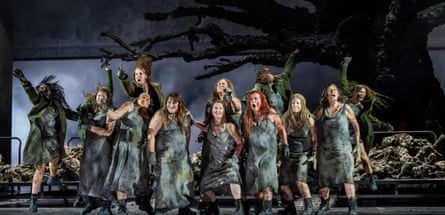
I’ve had some great evenings in the Royal Opera House this year. By the time I caught up with Festen I had heard glowing things about it from all directions, and I was not disappointed. Katie Mitchell’s production of Janáček’s The Makropulos Case was not so universally well liked, but to my eyes her reimagining of the story was invigorating: I found myself firmly rooting for the centuries-old anti-heroine, as sung by Ausrine Stundyte, and thrilling to the orchestral sound – Jakub Hrůša’s tenure as the company’s music director is off to a good start. And in May the orchestra played wonderfully for their previous boss, Antonio Pappano, when he returned for Die Walküre, the second instalment of Wagner’s Ring cycle. There are magical touches to Barrie Kosky’s staging, not least the spellbinding omnipresence of elderly Erda, the earth goddess. I can’t wait for Siegfried in March to see what will happen to her next. Erica Jeal
Honouring Palestrina and Pärt
Pictures of violinist Carolin Widmann, recently forced by airline staff to fly clutching her precious Guadaganini wrapped in a sweater on her lap, its empty case in the hold, were hardly credible. They were nevertheless a potent reminder for me of Widmann’s stunning playing – on this very instrument – of her brother Jörg’s violin concerto in the BBCNOW concert that he conducted. A truly exhilarating performance.
At St George’s, Bristol, the Tallis Scholars’ concert celebrating Palestrina’s 500th anniversary and Arvo Pärt’s 90th birthday, a model of clarity and elegant line, was one of two standout choral programmes. I Fagiolini, in the other, honoured Orazio Benevoli, wonderfully resonant and maximising the venue’s lovely acoustic.
Pianist Tamara Stefanovich’s virtuosity in contemporary and 19th-century repertoire is unquestionable, so her Royal Welsh College of Music and Drama recital of music by the Bach family – Johann Sebastian, Carl Philipp Emmanuel and Johann Christian – was unusual, and authoritative and memorable. Rian Evans
Blistering Shostakovich
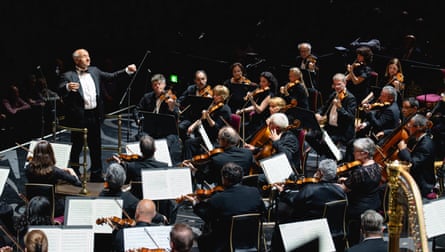
There was a real sense of freshness and innovation in the air this year. Southbank Centre’s inaugural Multitudes festival proved a stimulating mix of artistic cross-fertilisation. The London Philharmonic Orchestra collaborated with Australia’s Circa for a death-defying acrobatic take on Ravel’s Daphnis et Chloé, while Vasily Petrenko’s blistering account of Shostakovich’s Leningrad Symphony was complemented by thought-provoking imagery from art director Kirill Serebrennikov and video artist Ilya Shagalov.
On stage, Annilese Miskimmon’s searingly honest production of Jake Heggie’s Dead Man Walking was, remarkably, the work’s first full professional staging in the UK. English National Opera fielded an outstanding cast led by Christine Rice who brought enormous emotional reserves to Sister Helen Prejean, the nun at the centre of this tale of truth, love, compassion and redemption. Finally, Iván Fischer and the Budapest festival orchestra demonstrated why they are perhaps the finest orchestra on the planet playing, Beethoven and Bartók at this year’s BBC Proms. Clive Paget
Somehow, the genius for creativity in performance survives
Simon Rattle says classical music is in “a long-term fight for existence”. It certainly is. Yet despite Arts Council England’s war on excellence in the name of its curdled theory of anti-elitism, the genius for creativity in performance somehow survives. In February, Regents Opera staged a compelling Wagner Ring cycle in an east London boxing hall with reduced forces and a slashed back orchestra of 22 under Ben Woodward. In November, the no less indomitable Gothic Opera rescued Offenbach’s Die Rheinnixen, containing much music that would resurface in the Tales of Hoffmann. Both were triumphs of talent, commitment and resourcefulness. Both overcame endless practical challenges. Neither of them got a penny from ACE coffers. “We’ll do it because we’re compelled to do it,” wrote Woodward. Heroic words. Musicians across the UK continue to create marvels amid the prevailing political and societal philistinism. But they – and the universal need for live music– deserve so much better. Martin Kettle