2 months ago
47
2 months ago
47
Sri Lanka and Indonesia have deployed military personnel as they race to help victims of devastating flooding that has killed more than 1,100 people across four countries in Asia.
Millions of people have been affected by a combination of tropical cyclones and heavy monsoon rains in Sri Lanka, parts of Indonesia’s Sumatra, Thailand and Malaysia in recent days.
In Indonesia, at least 604 people have been killed and 464 remain missing, according to the national disaster agency. The death toll stands at 366 in Sri Lanka, with 366 missing, and 176 dead in Thailand. Three deaths have been reported in Malaysia.
The Indonesian president, Prabowo Subianto, said “the worst has passed, hopefully” during a visit to North Sumatra province on Monday, adding that the government was focused on delivering aid.
Three warships and two hospital ships, as well as aircraft, have been sent to carry aid and assistance to the worst-affected areas, where rescue efforts have been hampered by blocked roads, collapsed bridges and disruption to communication lines. Some areas have been cut off from response teams.
The flooding is the deadliest event in Indonesia since a 2018 earthquake and subsequent tsunami killed more than 2,000 people in Sulawesi.
It has submerged homes, inundated agricultural fields and triggered landslides across the region, though the true scale of the damage has yet to emerge. Some people clung to trees or stood on rooftops as they awaited rescue.
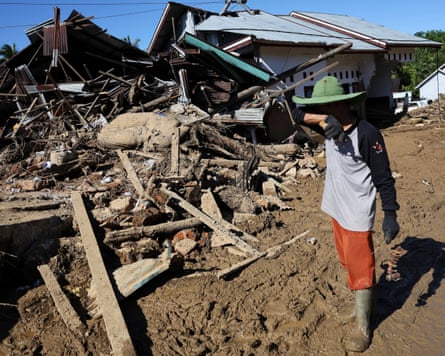
Sri Lanka has declared a state of emergency and appealed for international aid after Cyclone Ditwah, which forced the evacuation of 148,000 people to temporary shelters.
Flood waters in the capital, Colombo, peaked overnight, and with the rain stopped there were hopes that waters would begin receding. Some shops and offices began to reopen, though the full extent of the damage remained unclear.
In Ma Oya, north of the capital, Hasitha Wijewardena said he was struggling to clean up after the floods. “The water has gone down, but the house is now full of mud,” he told local reporters, appealing for military assistance.
Sri Lanka’s president, Anura Kumara Dissanayake, who declared a state of emergency to deal with the disaster, vowed to build back. “We are facing the largest and most challenging natural disaster in our history,” he said in an address to the country. “Certainly, we will build a better nation than what existed before.”
The losses and damage are the worst in Sri Lanka since the devastating 2004 Asian tsunami that killed about 31,000 people and left more than 1 million homeless.
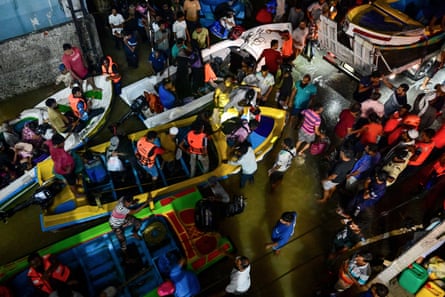
Rain had subsided across Sri Lanka but low-lying areas of the capital were flooded and authorities were bracing for a major relief operation.
Military helicopters have been deployed to airlift stranded people and deliver food, though one crashed north of Colombo on Sunday evening.
Selvi, 46, who lives in the Colombo suburb of Wennawatte, left her flooded home on Sunday carrying four bags of clothes and valuables. “My house is completely flooded. I don’t know where to go, but I hope there is some safe shelter where I can take my family,” she said.
In Thailand, the deputy prime minister, Thamanat Prompow, visited Hat Yai, one of the worst-affected areas, on Monday. He said provincial water and electricity authorities had been ordered to restore services immediately and that solar lamps were being distributed.
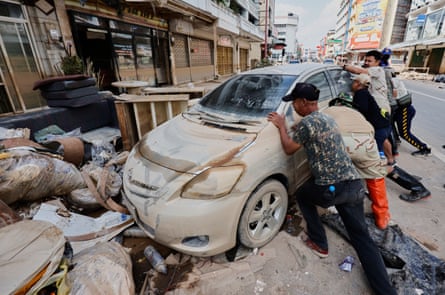
Local media reported that 80% of people in Hat Yai had returned home from evacuation centres to survey the damage, and recovery and cleanup operations were under way.
People in Hat Yai have been urged to register for 9,000 baht (£215) compensation from the government, while a interest-free loan of 100,000 baht will also be made available.
The region’s monsoon season often brings heavy rains that can cause landslides and flash floods, but recent flooding in south-east Asia has been exacerbated by a rare tropical storm formed in the Malacca strait.
As well as the destruction caused, the storm has disrupted education, forcing tens of thousands of children out of school in Indonesia and Thailand, according to the international charity Save the Children.
The charity said at least 1,000 schools had been damaged and closed in Sumatra, Indonesia. Teaching had been postponed as some schools were being used as emergency shelters, it added.
Human-caused climate breakdown has increased the occurrence of the most intense and destructive tropical cyclones, though the overall number of storms per year has not changed globally. This is because warming oceans provide more energy, producing stronger storms. Extreme rainfall from tropical cyclones has increased substantially, as warmer air holds more water vapour.