2 months ago
102
2 months ago
102
If we learned one thing at the Oval last week, it is that this England team really needs Ben Stokes. So it came as a relief when, a couple of hours after the second Test against New Zealand ended in heavy defeat, he and Gus Atkinson were exonerated by the England and Wales Cricket Board after an investigation into their celebrations following victory in the first. But the governing body found themselves in a process with no perfect outcome, and if the one they’ve ended up with is not the disaster they flirted with a week ago when Stokes was apparently considering retirement, it is still embarrassing.
Their handling of the incident was understandable, given the public drunkenness that marked the players’ trip to Noosa during the Ashes, and Harry Brook’s altercation with a nightclub bouncer in Wellington before that. There was a real lack of transparency around Brook’s incident, which was not revealed to the public until a newspaper discovered and reported it, and that led to a kneejerk reaction when the ECB thought there had been a repeat. All three incidents could have been handled better – they just keep finding different ways of getting it wrong. At least no one can accuse them of not taking this one seriously, and if it hasn’t truly established their competence it has established that all players are accountable, which will help to set a standard of acceptable behaviour.
In the end it seems there was confusion about the curfew and when it applied that extended even to the captain, who was one of the people who conceived it. That’s really humiliating, most of all for the coach, Brendon McCullum. Coaches don’t get to go on the field and lead by example. They have to get it right off the field, to nail planning and preparation, to get the right staff around the team, and to communicate with absolute clarity. The coaches I’ve worked with of international standard pride themselves in getting those things right. McCullum has admitted his rules were not communicated clearly either in person or in writing, and that reflects poorly on him.
As of course does the fact that after four years with him in charge his team’s planning, preparation, mindset and strategy were all exposed on the field in Australia, while their culture was exposed off it. Reflecting on my international career, there were times when our culture wasn’t right and times when it was, but it was never publicly exposed and scrutinised in the way it is now.
England supporters want their team to win, but know they will sometimes lose. That is part of the game and is going to be accepted. But when players – role models – behave in a way that embarrasses the country, they will find that harder to swallow. McCullum and Rob Key, the ECB’s managing director of men’s cricket, spoke at length about this before the first Test and seemed to believe a new chapter had been started, but what we’ve seen since looked a lot like the same old story.
Where great coaches operate, players know the standards that are expected and the consequences if they fail to meet them. I have written before about my first trip coaching the Lions in 2013, when Stokes and Kent’s Matt Coles were sent home after coming back to the team hotel one night in the early hours. David Parsons was the manager of that trip, and he ran a tight ship. There were consequences for poor behaviour. At the time I thought it was a brave decision, but it sent a powerful message. Everyone knew where they stood from then on, that’s for sure.
I worried that this incident could deal a fatal blow to Stokes’s credibility – if a captain wilfully breaks a curfew they themselves helped to implement, how can they be trusted or respected at all? Instead he comes back with it reinforced. He will not be blamed for misunderstanding a rule that hadn’t been properly understood by anyone, while he will get credit for the fact that, when he was in the team for the first Test, they showed so much skill and promise and togetherness, and when he was not in it they went to the other extreme. At the Oval England felt timid. Of course they had a lot of new faces, and it is not a reflection on Joe Root’s interim captaincy, but this is a group with one obvious leader and now he is back.
This is a strength for as long as Stokes is around, and a concern as soon as he is not. But he is 35, has already been in a tough job for four years, and the time will come when he is gone for good – and England are not ready for it. If Root, who like Stokes is 35 and has already done his time, doesn’t want the captaincy, who comes in then?
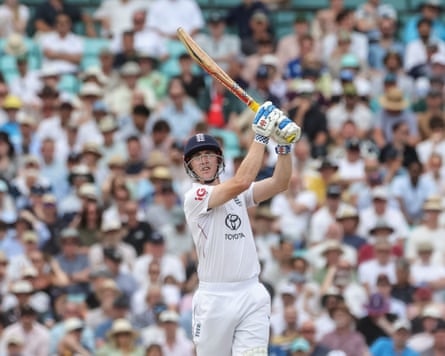
Brook has been identified as a potential leader, and people talk about his smart cricket brain, but it seems to me he has some work to do if he’s genuinely serious about taking on that kind of position. After that incident in New Zealand, and then soon afterwards celebrating an ODI century by miming Stone Cold Steve Austin’s beer smash, the optics from outside the camp are certainly not good.
Jacob Bethell was also involved both in Noosa and Wellington, but of this squad he and Jamie Smith look to me like outstanding talents who could go on to play a lot of Test matches. If Stokes and McCullum still agree on anything, it should be the need to bring along those two, as well as Brook, and to leave a strong group of leaders as a legacy. Bethell has already had a taste of captaincy with the white-ball side, which was hopefully part of a process.
Cultivate those talents, see if they have the capacity to be serious people, not just young men having fun playing a game with their mates. Just watching Stokes will have taught them all a lot about leadership – and also about the pressures, responsibilities and difficulties that come with taking on that kind of position in the hardest and most brutal format of the game.