3 months ago
111
3 months ago
111
In 2024, agents of the National Foundation for Indigenous Peoples (Funai) walked more than 60 miles through rainforest on the southern fringe of the Brazilian Amazon on a mission to monitor and help protect a group of Indigenous people who had no contact with the modern world.
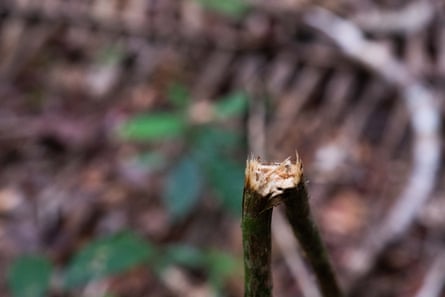
What they found was a small basket freshly woven from leaves, a child’s footprints on the bank of a creek, and tree trunks hacked open hours before to extract honey. There were huts abandoned a year before that were sinking into the forest floor, and brazil nut pods discarded around old campfires. They were all signs that the Pardo River Kawahiva people were there.
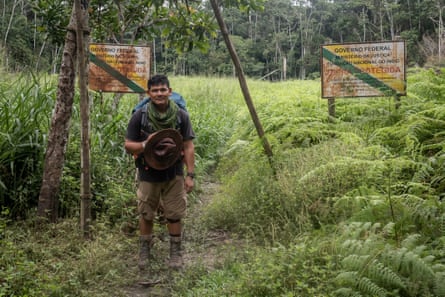
A year later, the Brazilian government continues to ignore directives by the country’s supreme court approving a plan of measures to protect the isolated Indigenous community, including accelerating the demarcation of their territory and explaining how it would reduce deforestation.
Bureaucratic delays, funding shortages and violent conflicts over land – including attacks by self-proclaimed leaders linked to loggers – have blocked the process.
Without physical boundaries, loggers and ranchers continue to encroach, leaving the Kawahiva vulnerable to genocide and cultural erasure. Advocates call the stalling a deliberate, life-threatening violation of Brazil’s constitution.
The presence of the Kawahiva people came as no surprise to Jair Candor, who led the expedition last year and who first confirmed their location in 1999. But their proposed 400,000-hectare (1m-acre) reserve still lacks full protection, as required by Brazil’s constitution, and remains the largest unprotected forest with uncontacted Indigenous people in Brazil.
Just outside the reserve’s boundaries, the forest has been burned and cattle graze on recently cleared land. Fences and gates are being erected, and roads are stretching farther and farther into the forest.
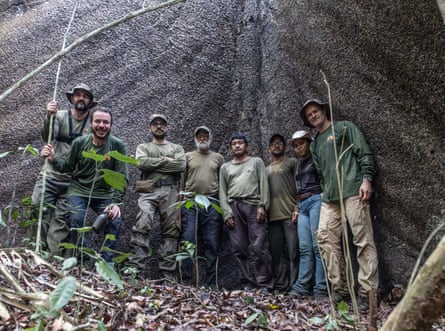
In an interview after the expedition, Janete Carvalho, director of territorial protection at Funai, the federal agency responsible for Indigenous lands, vowed to resolve the situation.
“We are doing everything in our power to make sure that Kawahiva is demarcated in 2025,” he said.
In November, Brazil hosted Cop30 and was scheduled to announce new environmental achievements, including those related to Indigenous territories. But the climate conference came and went without a word about the Pardo River Kawahiva.
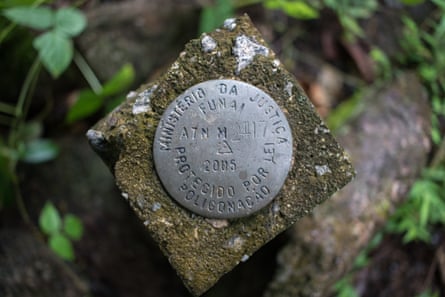
Physical demarcation of the 200-mile (320km) perimeter of the Kawahiva’s territory involves placing concrete markers and signs along the boundary, and is a decisive step in convincing loggers and cattle farmers that the government is serious about its protection. But the demarcation remains stalled.
Money has been one of the major stumbling blocks as the demarcation was to be funded by compensation received for the environmental impact of a highway in Mato Grosso state, which encompasses the territory. When that did not happen, Funai sought other sources of funding.
It has now turned to the Institute of Geosciences at the Federal University of Minas Gerais (UFMG). “It’s a technical partnership that we’ve already had success with in other demarcations of Indigenous lands,” says Manoel Batista do Prado, Funai’s director of Indigenous land demarcation. “The fieldwork is scheduled to begin in early 2026.”
The UFMG institute confirmed that it was in “advanced talks” with Funai, but did not say when or how it would present a plan for the demarcation work.
The subtext to all this bureaucratic wheel-spinning is what Funai calls the “conflictual situation in the region”, which will require an armed police presence during the work.
In 2018, an armed group of residents attacked the Funai base in the Kawahiva territory. In the ensuing gun battle, one of the attackers was killed. Six years later, during the Guardian and O Globo’s 2024 expedition to the region, heavily armed members of the national force police agency were stationed there.
after newsletter promotion
Earlier this year, the Guardian and O Globo obtained an audio recording in which a man threatened Funai’s Candor. Calling himself “Chief Francisco”, and thought to be Francisco das Chagas Paulo Rodrigues, who claims to be a chief affiliated with the Arara Indigenous Association, he called on local ranchers to reclaim the land “stolen by that scoundrel Jair”.
He claimed to have conducted a six-day expedition within the Kawahiva Indigenous territory, “looking for those isolated Indians that Jair talks so much about”.
“We can’t work because of this guy, but I have faith that we’re going to get him out of there,” he said in the recording.
The self-styled chief is linked to loggers in the region and has allegedly committed several environmental crimes. He is facing charges in the federal civil and criminal court of Juína, including for the attempted murder of Candor during the armed attack on the Funai base.
Elias Bigio, an anthropologist at the Observatory of Isolated Indigenous Peoples (Opi), says: “It has been 26 years since the confirmation of isolated Indigenous people on Kawahiva land and throughout this time, land-grabbers have always sought to overturn the land declaration in court, not to mention the threats and invasions that are still happening today. And now, once again, the demarcation is delayed.”
He raises the possibility “that this is a political, not technical and legal, obstacle. So we fear that this may not happen even next year.”
After that, he says, if a right-leaning government is elected, all Indigenous land demarcation is expected to stop, as was the case during the years when Jair Bolsonaro was president. Many see 2026 as the last chance for the Kawahiva territory project to be realised.
The petition that led to the supreme court directive for the demarcation to go ahead was filed by the APIB, a national organisation of Brazil’s Indigenous people.
The court’s decision was clear: it ordered the federal government to present a firm schedule for completing the demarcation of the Kawahiva do Rio Pardo territory, recognising the “risk of genocide, food insecurity and acculturation”.
Ricardo Terena, a lawyer for Apib, describes the process as “stalled”. The supreme court has said it is awaiting compliance with the decision.
“The delay in demarcation is not only illegal,” warns Priscilla Oliveira, representative of Survival International, an organisation that campaigns for Indigenous peoples.
“It is also extremely dangerous and puts the lives of the isolated Kawahiva Indigenous people at risk.”
-
This series on uncontacted peoples is a partnership between the Guardian and the Brazilian newspaper O Globo and is supported by the Open Society Foundations, the Ford Foundation, the Pulitzer Center and the Nia Tero Foundation. Read it in Portuguese here