2 months ago
66
2 months ago
66
For a time Pokrovsk was a haven, a wartime Ukrainian boom town because of its strategic position in the east, 30 miles (48km) from the front. But that was before the summer of 2024, when a rapid Russian advance engulfed the industrial centre in a shattering conflict, a duel only now reaching its endgame.
The 18-month battle for Pokrovsk epitomises the current state of the Ukraine war: an attritional struggle in which gradual Russian advances have been made at extraordinary human cost. Though it demonstrates Russia cannot easily capture urban areas, the fight has also drained Ukraine, and consequences are emerging elsewhere.
Such has been the level of destruction that Pokrovsk is no longer even strategically significant. Its population is decimated, its industry destroyed and supply routes are re-routed; instead it has become a bloody signpost as peace negotiations restart.
“There are fairly strong military arguments for Ukraine giving up ground,” said Nick Reynolds, a land warfare analyst at the Rusi thinktank. “But politically, Ukraine recognises that giving up territory won’t necessarily stop the war. Giving up land would mean fighting the same battles on different terrain.”
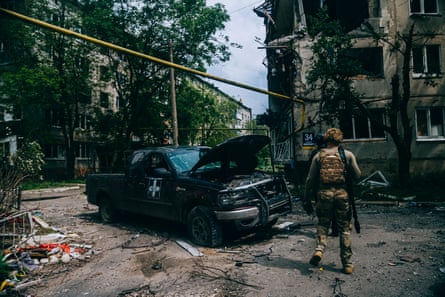
An industrial town, with a prewar population of 60,000 and five-storey communist apartment blocks in its centre, Pokrovsk was already significant before the Russian invasion. A mine 6 miles (10km) to the west was the largest supplier of coking coal, an essential raw material for the steel-making process, in post-2014 Ukraine. Producing 6m tonnes a year, it employed, with a sister mine, 10,000 people.
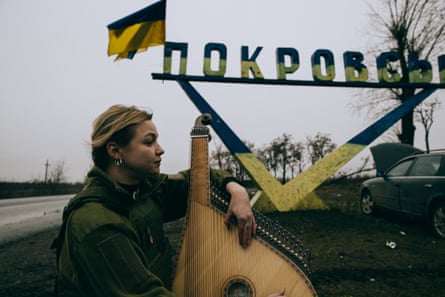
People deserted the town rapidly after Russia launched its full-scale assault in February 2022. But while the invaders swept through the south and eastern edge of Ukraine, the prewar lines held in Avdiivka 30 miles south-east. As the frontlines stabilised elsewhere, Pokrovsk’s location made it strategically important.
Its rail station became a distribution hub for the region, while its roads were the principal through connection from the central city of Dnipro to Kramatorsk and Ukraine’s fortress belt in Donetsk province, bringing troops and supplies forward, and ferrying casualties back by night.
By the summer of 2022, Pokrovsk became a lively base in the rear, even allowing for a 7pm curfew, its population at prewar levels. The Hotel Druzhba, with its soviet attitude to service, was filled with off-duty soldiers and their partners as well as humanitarian workers, military trainers and journalists.
“The city gained a boost from all the people that were arriving,” said Oleksandr Nesterenko, a public activist from Pokrovsk. An apartment that might have cost $100 a month to rent before the war “at the peak in 2023 cost anywhere from $350 to $600”, he said, with shops selling military gear springing up “seemingly every 3 metres”.
That began to change in August 2023. A few weeks before a warning had been circulated that the Russians were targeting frontline hotels. On 8 August, two Iskander missiles slammed into an apartment block near the Drubhza, landing about 40 minutes apart; the second an apparent effort to kill or maim those responding to the initial attack. Seven were killed.
For journalists, Pokrovsk became a place to pass through. Its economy had begun to change with a handful of women taking on traditionally male jobs working in the coalmines. But it was the fall of Avdiivka in February 2024 (caused partly by a suspension of military aid by the US Congress) that led to a dramatic change.

A relatively rapid Russian advance followed in the next six months, across poorly defended rear-lines, and the invaders reached within 7 miles of the south of the town by August. Civilians were told to evacuate. Library books were packed up, and shop signs were being taken down when the Guardian visited in August 2024. Gradually most residents abandoned their homes and lives.
Pokrovsk was expected to fall in weeks, but didn’t. Some pressure on the sector was relieved by Ukraine’s surprise incursion into Russia, also in summer 2024, while the defenders became more organised. Russia’s military, unable to take the town directly, began instead what turned out to be a gradual semi-encirclement – eventually outnumbering the defenders eight to one, Ukraine’s president, Volodymyr Zelenskyy, said last month.
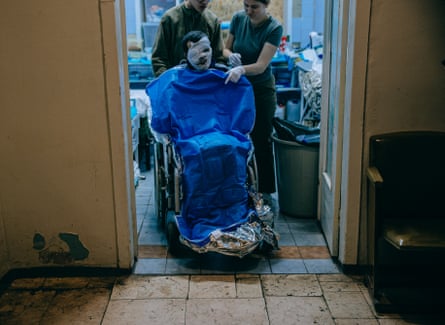
Russian forces focused heavily on locating and eliminating Ukrainian FPV (first-person view) drone crews with its Rubicon drone units, achieving an aerial dominance in the summer, and targeting the remaining supply routes covered by anti-drone netting to the north. Rotating forces and evacuating wounded, became increasingly dangerous, leaving defenders exhausted. A shortage of Ukrainian artillery weakened the defensive position further.
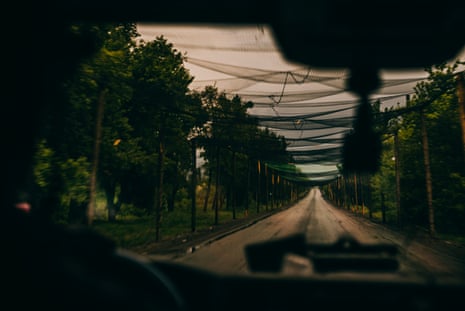
Nesterenko abandoned his apartment in Pokrovsk in the autumn of 2024, but returned, despite the growing risks, for a few months thereafter to help people in the town. His last visit was in March of this year. The least dangerous way into Pokrovsk was to walk – a car being too obvious a target for an FPV drone; the sound of explosions, he added, was constant.
“At that time there was still one shop working, a general store, and it had a Starlink internet and a generator, so you could still pay by card,” he said. “No young people were left. All the customers were 50 or older, and none of them would flinch or squat whenever an explosion was close. They were so used to it, they didn’t react in any way at all, it was so noticeable.”
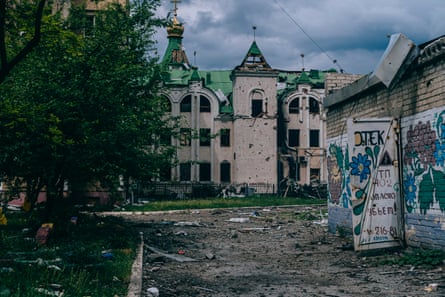
The coking-coalmine closed in January, its tunnels deliberately collapsed. Because it is not actively being maintained the mine has flooded. The last shop shut in August. About 1,200 civilians are estimated to live in Pokrovsk and 900 in nearby Myrnohrad, mostly waiting for the Russians, while Nesterenko said the city was “a complete ruin. It has no gas, no water, no electricity and no heating”.
Russian troops began to infiltrate in ones, twos and small groups, to avoid drone attack, from October, increasingly taking advantage of rainy or foggy autumn weather to hide from drones. Their aim was to seal off the town, though a dramatic Ukrainian special forces helicopter raid at the end of October unblocked an exit route.
Meanwhile the Russian infiltrators keep coming: on foot, on motorbike, even in pickup trucks. A larger but equally irregular group nicknamed the “Mad Max convoy”, appeared in a video on 10 November, emerging from under the cover of fog. Their goal was to accumulate in Pokrovsk, before finding and attacking Ukrainian positions.
In October, the Russians suffered 25,000 casualties, killed and wounded, mostly around Pokrovsk, according to Zelenskyy. In January, the figure was 15,000, according to another Ukrainian estimate. That suggests capturing the rest of Donetsk, the cities of Kramatorsk and Sloviansk, which Vladimir Putin is demanding in the latest peace negotiations, would be more bloody.
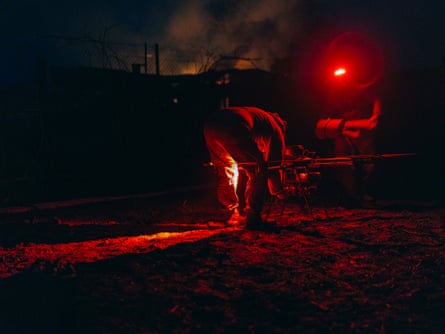
Meanwhile, perhaps because of Ukraine’s stubborn 15-month defence, problems are emerging elsewhere: its front is giving way near Huliaipole, 60 miles to the south-west, with 6 miles lost in November.
“Ukraine is in a very difficult position, though it is a large country and only losing territory slowly,” Reynolds said. “Meanwhile, even if Russia continues to advance, it is not clear to what degree its civilians will in future put up with the numbers being recruited and killed.”