2 months ago
105
2 months ago
105
In a rehearsal room perched above the labyrinthine backstage of Florence’s starkly contemporary Maggio Musicale Fiorentino theatre, Luca Guadagnino is showing the women of the chorus how to make a second-act entrance. Dressed in a slouchy cardigan and slacks, the Italian director runs forward and stops short at a line of tape indicating the rim of the stage. A little out of breath, he turns past stretching dancers to conductor Lawrence Renes and asks if he minds the sound of stamping feet. “I never mind when we hear them talk, walk, breathe,” Renes says. “It’s live theatre.”
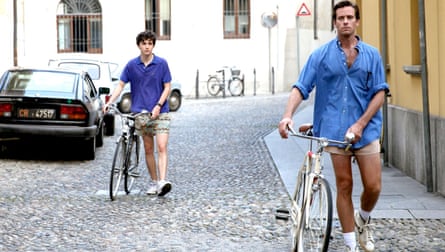
Better known for films like After the Hunt, Challengers and Call Me By Your Name, Guadagnino still sometimes punctuates stage rehearsals with instinctive cries of “Cut!” and “Action!”. But today he is directing an opera. It’s his second ever and his first in more than 15 years – and a highly controversial one to boot. The Death of Klinghoffer, a 1991 opera with music by John Adams and libretto by Alice Goodman, has sparked accusations of antisemitism whenever and wherever it has been performed. It depicts the 1985 hijacking of the cruise ship Achille Lauro by the Palestinian Liberation Front, their murder of disabled Jewish American tourist Leon Klinghoffer, and the grief and rage of his wife, Marilyn. The story is placed in a historical, even mythic, context.
This is the first new production of Klinghoffer to be conceived since the Hamas atrocities of 7 October 2023 and the Israeli bombardment of Gaza that followed. “The invisibility of victims is violent, odious and definitely fascistic,” Guadagnino says. “One of the great successes of not only autocracies but also so-called democracies has been to create a mirror where you do not see what is behind it. One of the great qualities of Klinghoffer is that it destroys that mirror and transforms the invisible, the unspeakable, the unsayable, into something you have to see, be confronted by and think about.”
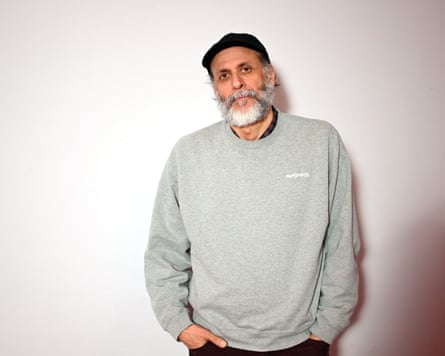
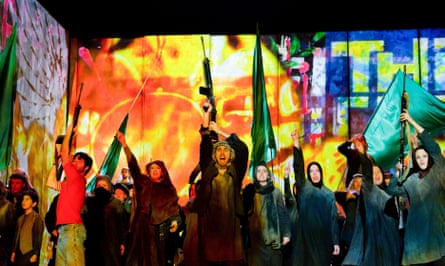
Along with Nixon in China, its predecessor by the same creative team, Klinghoffer is sometimes called a “CNN opera”. But Guadagnino rejects the characterisation, saying it’s a work of art that “elevates itself from the banality of the immediate”. The opera is constructed like a Bach passion in which monologues by the ship’s captain, the Klinghoffers, other hostages, and the PLF are studded with six chorales, starting with a Chorus of the Exiled Palestinians and followed by a Chorus of the Exiled Jews.
“You start with the catastrophic destruction of humanity, and with Nakba,” says Guadagnino, using the Arabic word for “catastrophe” which also refers to the mass displacement of Palestinians during the founding of the State of Israel. “And the catastrophe that the Palestinians sing about is the catastrophe to which Marilyn Klinghoffer, at the end, is subject. The opera is a two-faced mirror. There is always duality. The choruses are in the first person, and the Klinghoffers come to contain multitudes.”
Guadagnino got hooked on Adams’ music after being given a CD in the mid-2000s. “This music somehow preceded me within me,” he says. “I felt my unconsciousness was inhabited by it.” He built his 2009 film I Am Love – a meditation on class and eroticism in patrician Milan starring Tilda Swinton – around Adams’ music, and would listen to it while shooting scenes before convincing the composer to give him the rights.
It’s lovely to listen to but difficult to perform, due to Adams’ complex, repetitive rhythms and melismatic choral writing. Renes, an experienced conductor of Adams’ operas, is conducting his first Klinghoffer. He calls it “infinitely harder for the chorus, for the soloists, for the musicians” than other Adams works. “There is a lot of scope for interpretation,” he says. “Not in how you play the first five notes, maybe, but in how you build the architecture.”
In Florence, the Klinghoffers are being played by the French bass-baritone Laurent Naouri and the British soprano Susan Bullock, who is now focusing on new music after a career spent singing the largest dramatic soprano parts in the repertoire. Central to Guadagnino’s concept is choreography, though, which he says will “bleed out” of the chorales, accompanying them as well as selected monologues. Dance, he says, can “defy the need for clarity”. Ella Rothschild, who is choreographing this production with 12 dancers assembled for the occasion, describes the score as “never repetition for repetition’s sake, but accumulation. You feel the weight as you go in”. She has developed a vocabulary in which specific movements and gestures become extended, almost endless. “In a contrast between the movement and the text and music,” she says, “a space can open up in which people can understand in a new way.”
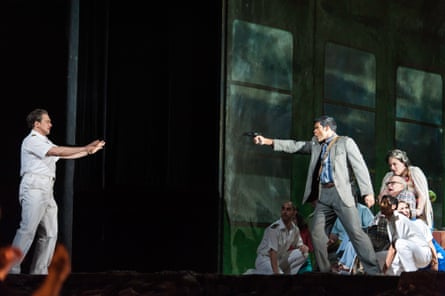
Guadagnino made his first foray into opera in 2011, with a production of Giuseppe Verdi’s Falstaff, but he seems to have been so unhappy with the result that it’s as if he has scrubbed it from his CV. Having been approached by several opera houses to direct in recent years, he is determined to get it right this time. “Every time, I proposed doing Klinghoffer,” he says. “I said I’d happily do a Traviata or Rigoletto one day – but my debut had to be Klinghoffer. Every time, it was various degrees of, ‘We don’t know what you’re talking about’ to, ‘You’re completely out of your mind’. It was the end of the conversation, just bringing it up.”
The piece has been hotly debated since its 1991 premiere. A 1992 revival at the San Francisco Opera was subject to protests, and planned performances at Glyndebourne and the Los Angeles festival were cancelled. For a 2014 revival at the Metropolitan Opera in New York, Leon Klinghoffer’s daughters Lisa and Ilsa wrote in a programme note that the piece “presents false moral equivalencies without context” and “rationalises, romanticises and legitimises the terrorist murder of our father”. That revival was met with protest from Jewish groups as well as former mayor Rudy Giuliani, and a planned simulcast was cancelled.
In 2001, in the months after 9/11, the musicologist Richard Taruskin accused the opera of “romanticising terrorists”. His criticism centred on a prologue scene – set between the two “exile” choruses but cut since the work’s premiere in 1991 – that featured the Klinghoffers’ bickering neighbours. In the scene, Taruskin wrote, “the portrayal of suffering Palestinians in the musical language of myth and ritual was immediately juxtaposed with a musically trivial portrayal of contented, materialistic American Jews”.
The scene has never been performed since the work was recorded, without it, in 1992, and will not feature in Florence. But librettist Goodman says she would have preferred it to have remained part of the work. The scene doesn’t mock its characters, she insists, but instead serves as the work’s moral centre, “positioning the human moral decency of ordinary life, of ordinary people, as opposed to the grand romantic nationalism that chews ordinary people up”. To her, she says, “romantic nationalism is the great evil of our age”.
“I think Klinghoffer is the best thing I’ve written,” she adds. “It’s about human beings. All the people who have objected to it have objected to their enemy being shown as human. One was not supposed to make the terrorists human beings.” Goodman, who was raised Jewish, converted to Christianity in adulthood, and after the furore over the piece, she found a new career as an Anglican minister. “The audience receives the opera, and by receiving it contributes to what that work is,” she says. “And in that respect it’s a bit like the work I do now. It’s an oral, formal medium.”
Taruskin argued that the opera favours the Palestinians musically, ennobling their sentiment while mocking its Jewish characters until they are ennobled by an encounter with death. “That is a false claim,” Guadagnino responds. “Who can say that with a straight face, knowing that the opera has the incredible aria where Marilyn is reminded of her husband before she knows he’s dead, or the Chorus of the Exiled Jews, which is one of the great arias?”
Carlo Fuortes, the general manager of the Maggio Musicale, says the theatre has not yet received any political pressure or been informed of protest plans. “Theatre has to take risks,” he says. “We have to do something real, something that speaks to people, not just tradition or entertainment.”
For Guadagnino, the criticism of the opera evinces “false consciousness and moral hypocrisy. Goodman is able, like every great writer, to understand human nature and the intricacies of how we perceive the Other.” The opera, he believes, is about pain, and the dignity of pain. “The attacks this opera has received,” he says, “are immoral. They are a testament to the decadence of our time, and to the constant freefall into immorality in the decades since the piece first premiered.” He pauses then adds: “I don’t know how this opera is going to be welcomed here. But so far, so good.”