3 months ago
108
3 months ago
108
After the past fortnight in which Labour’s internal bickering has once again distracted attention from government decisions that will affect real lives, it’s worth remembering how Keir Starmer briefly lifted his party’s gaze from its own navel to a higher purpose a few months ago.
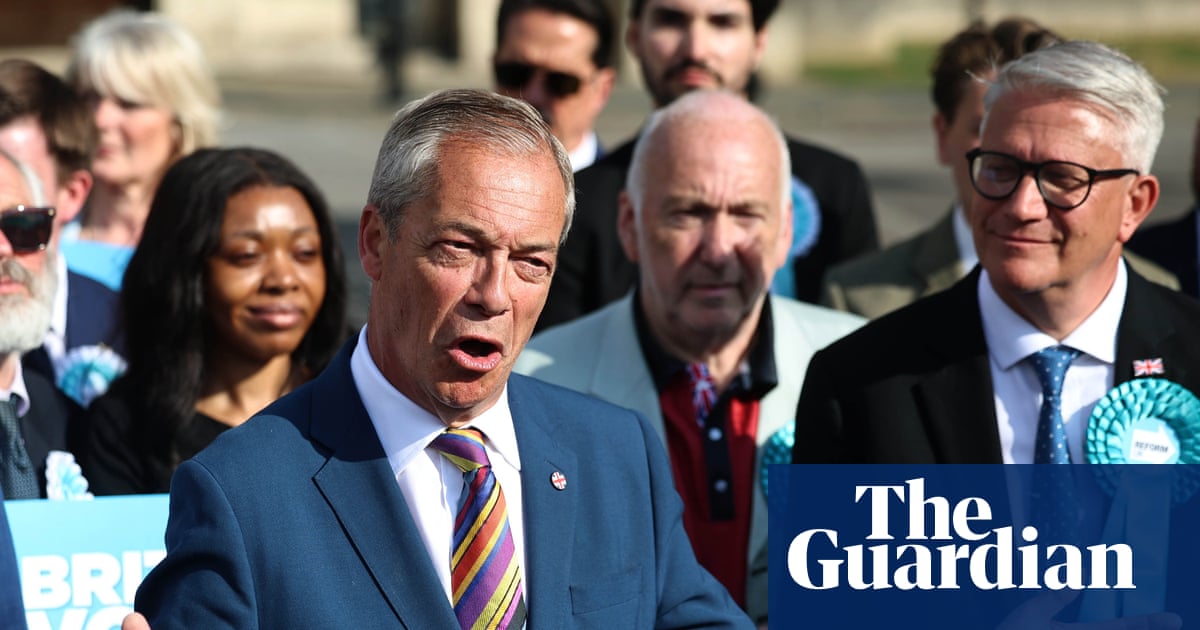
That was back in September, the previous occasion when Andy Burnham’s name was being bandied around, when the prime minister seemed to galvanise Labour’s conference by telling it “we’ve got the fight of our lives ahead of us” against Reform UK and “racist” policies that would “tear the country apart”. This would be a “different battle”, he warned, because Labour was up against opponents who represented a strain of rightwing politics alien to a Britain that had never faced “a proposition like Reform before”. He has reiterated this view several times since, not least in a pre-Christmas interview, in which Starmer said that while he could still “sleep at night” under the Conservatives, that wouldn’t be the case if Nigel Farage’s party was in power.
It is remarkable, however, that some of his own party’s staff don’t accept that the stakes are so high or the contrast so stark. Official Labour social media accounts routinely proclaim that the Tories and Reform are “basically the same”. A post last month suggested that these two parties offer only the “same people, same chaos and decline”, while an advertising campaign against Reform titled “Tories: the sequel” is reportedly being planned.
No one is suggesting that these officials have deliberately set out to undermine the prime minister and, having had the Conservatives as their main opponent for more than a century, it must be hard to resist settling back into the time-worn grooves of fighting the old enemy. This is especially true when Labour is presented with such a tempting target as that presented by the recent spate of Tory defections to Reform. Indeed, those of Nadhim Zahawi, Robert Jenrick and Suella Braverman mean there are now more former members of Liz Truss’s cabinet in Farage’s ranks than in Kemi Badenoch’s top team.
And yet a basic function of any political party is to set out a consistent line on its opponents, and senior government figures privately – if grudgingly – acknowledge that their current one looks rather incoherent. Reform can either be portrayed as an unprecedented peril to the country or as a bunch of political re-treads offering more of the same – but it can’t be both.
Polling is belatedly being commissioned to test which part of this badly mixed message works best, alongside other potential attacks that include Farage’s hostility to workers’ rights, the the conviction and jailing of former lieutenant Nathan Gill for taking bribes from an alleged asset of Vladimir’s Putin’s Russia, or Farage’s support from mega-rich Maga-ish types. Those overseeing the exercise emphasise they will be driven only by data, and become a little irritated by suggestions this is a proxy for deeper divisions. But it does touch on a bigger question about which sections of the electorate Labour is trying to reach.
For the past five years the party has focused on what it called “hero voters” – stereotypically older, working-class people who backed Brexit – who are now leaning towards Reform because they think Britain is fundamentally broken. Portraying Farage as “new” and “different” might be seen as ceding the territory of novel and radical change to him.
On the other side of the argument are those Labour MPs and ministers who fear the old strategy has opened up the party’s left flank, where implicitly “less heroic”, younger, pro-European graduate voters are switching their support to the Greens and the Liberal Democrats in England, as well as the SNP in Scotland and Plaid Cymru in Wales. Showing that Labour is a bulwark against the existential threat Reform poses to progressive values makes sense if you want to rebuild support within this left-of-centre bloc, as well as address the more immediate priority of holding on to the Gorton and Denton constituency in a crunch byelection this month.
For those with long memories, all of this is a bit reminiscent of the mid-1990s, when the Conservatives were struggling to get a grip on Tony Blair. Eventually they came up with the slogan “New Labour, New Danger”, which they notoriously illustrated with a pair of red-tinted demon eyes. Some of Labour’s strategists now say the Tories made a basic error by accepting Blair’s party was “new”, while others attribute the failure of that campaign to Labour not being really very “dangerous”. And so the argument rumbles on.
The current situation is further clouded by confused signals about what Reform is trying to achieve. Is the party really trying to be an agent of insurgent change – or does its recruitment of experienced ministers from the last government suggest it is seeking to reassure voters worried about the destruction Farage might wreak? This is why some senior Labour figures still think it’s possible to fudge their attack by saying Reform is dangerous precisely because it is filled with the “maddest and baddest” old Tories. That, however, carries the risk of helping to decontaminate the Conservative party, which, as the runner-up in more than 200 of the seats – including many of the most marginal – that Labour won at the last general election, may be under-priced at the next.
Starmer, who has never been the sort to ignore political expertise or impose his own strategy on those around him, has engaged fair-mindedly with the internal debate because he recognises there are real dilemmas about how to approach Labour’s new rival. But the biggest error would be to treat such questions as a desiccated technical process conducted in the air-conditioned atmosphere of focus groups. The reason why Starmer put some much-needed energy into his party conference four months ago was because his remarks were obviously genuine. “That was me, that was me!” he told friends when he stepped off the stage after his big speech. His party could do with an infusion of similarly authentic passion as it embarks on what the prime minister calls a battle for the “heart and soul” of the nation.
The time for hesitancy and second-guessing on how to tackle Reform, as well as much else besides, really must be over by now.
-
Tom Baldwin is the author of Keir Starmer, The Biography