1 month ago
107
1 month ago
107
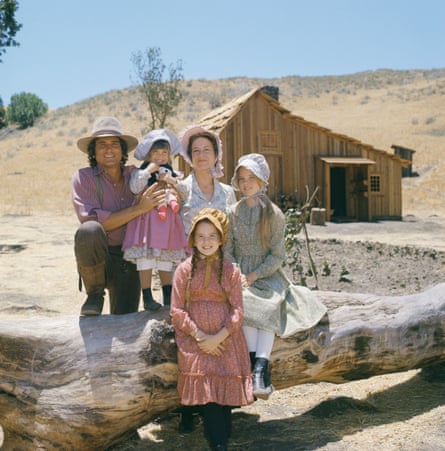
Each incarnation of Little House on the Prairie has reflected the fears, hopes and hangups of its time – from Laura Ingalls Wilder’s semi-autobiographical children’s novels, first published in the wake of the Great Depression, to the television series they inspired, which premiered amid a recession and an oil crisis in 1974.
Netflix’s reboot, premiering on 9 July, is no exception. “The stories are able to transcend generations, which speaks to its basic nature,” says Luke Bracey, who stars in the new series as Charles “Pa” Ingalls, the rugged family patriarch. “This is a family trying to get along in the world.”
Crosby Fitzgerald, who co-stars as Caroline “Ma” Ingalls, has a similar explanation for its enduring appeal. “People grew up with it with their parents and their parents, and there’s a sense of familiarity that is cozy and heartwarming to a lot of people,” she says.
The tale of survival on the American frontier has continued to resonate with audiences. The Little House books have sold more than 73m copies, while the original series has seen a resurgence in viewership in recent years and in 2024 alone reached 13bn streaming minutes, making it that year’s most streamed legacy show.
Netflix is betting big on its new adaptation, and a strange confluence of cultural trends and political circumstances could help to explain why. The original series saw an uptick in popularity during the Covid-19 pandemic, when families were navigating a new and uncertain reality, not unlike the Ingalls family did in rural Minnesota in the late 1870s. One writer described 1932’s Little House in the Big Woods (the first in the series) as feeling like “a manual for self-sufficient isolation” when she was reading the book to her son in the early days of lockdown.
You can see how the hoarding of toilet paper and masks, the emptied supermarket aisles and the suspicion with which people regarded their neighbors would have made this text all the more potent. The books and the shows may also be appealing to a rising resistance to technology and an interest in living off the land and homesteading, interests on the rise among Christian conservatives and environmentalists alike.
Cottagecore, the online subculture and aesthetic that fetishizes agrarianism, could be seen as laying the foundation for the show’s appeal too, with its fixation on gardening, handcrafts, farm animals and foraging. Another social media contagion that has possibly prepped audiences for Little House on the Prairie is the “tradwife”: avatars of domesticity and submissiveness, seen in TikToks and reels cradling babies or baking bread in gingham aprons. You could call these reactionary trends or an attempt to escape the chaotic and confusing nature of contemporary life, but either way it’s hard to not see these as conditions that helped make the resurgence of the show, and its reboot, possible.
The books themselves were born out of a reactionary trend. Rose Wilder Lane, Wilder’s daughter and a journalist, returned to the family farm following the market crash of 1929 and began to help her mother edit a memoir she was writing about her childhood on the frontier. Lane, considered a pioneer of the libertarian movement, slowly began heavy rewrites of what would become Little House in the Big Woods, transforming its real-life characters into hardened but optimistic heroes who rejected government assistance.
It was a powerful, intoxicating myth of American resilience at a time when so many were struggling and losing faith in those in power. Lane appealed to an emerging rage over Franklin D Roosevelt’s New Deal and social security programs, which struck her and other ageing pioneers as handouts and entitlements, and emphasized the power of the individual to transform his circumstances. Met with immediate success, the mother and daughter published the follow-up, Little House on the Prairie, two years later. The series soon ranked among the bestselling children’s novels of all time. Lane would later help fund a libertarian academy in Colorado, the Freedom School, which counted the Koch brothers, architects of modern conservatism, as its alums.
Conservatives have long felt some ownership over Little House on the Prairie. It’s often cited as having been among Ronald Reagan’s favorite television shows. When the reboot was announced by Netflix in January of last year, the new series was immediately dragged into the culture war. “Netflix, if you wokeify Little House on the Prairie I will make it my singular mission to absolutely ruin your project,” wrote Megyn Kelly on X at the time. Melissa Gilbert, who played Laura Ingalls Wilder in the original series, fired back, highlighting what she and many others see as the show’s more complicated legacy. “Ummm…watch the original again. TV doesn’t get too much more ‘woke’ than we did. We tackled: racism, addiction, nativism, antisemitism, misogyny, rape, spousal abuse and every other ‘woke’ topic you can think of. Thank you very much.” When I spoke to Bracey, he implored Kelly to watch the new series before making up her mind. “I had no idea about that. I have no connection to social media. But she hasn’t seen the show … watch the show.”
after newsletter promotion
While it’s not without its poorly aged moments, and while the show’s star and producer Michael Landon was a lifelong Republican, the show distinguished itself from the books by trading some of Lane’s libertarian values for an ethos that leaned heavily on honesty and collectivism, perhaps a response to the financial strife of the 70s and the sense of distrust left in the wake of Watergate. The show grappled with shockingly dark and complex issues that were relevant to the time. There’s the infamous episode, Sylvia, in which a young girl is abducted and raped by a masked man, impregnated and then shamed by the adults around her for somehow bringing it upon herself. There was the episode in which two boys inadvertently set a school for the blind on fire, leaving two dead.
Distinguishing itself from the books once again, the show took a much more humane look at the Indigenous people who were being displaced in the colonial expansion of the American frontier. In Survival, Charles Ingalls, the family patriarch, is trapped in a cabin with a federal marshal and a Native American man he is trying to banish from his own land, the three hiding out from a blizzard. Ingalls, in a move that was quite common in the show, stood up for the dispossessed. “People like you have taken everything away from that man,” Ingalls tells the marshal. “His freedom, his land, almost his life.” The real Charles Ingalls and his family illegally squatted on Osage land in Kansas before being forced out by the government in 1871, speaking to some real dissonance between reality and the fantasies of heroism and virtue that we sometimes want to see in our entertainment.
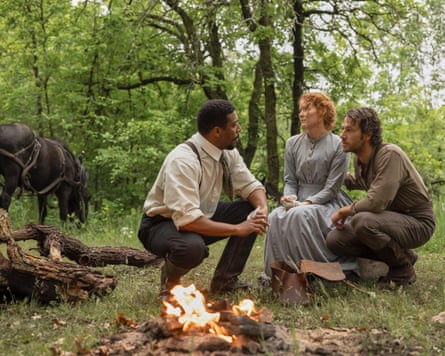
The new incarnation of Little House on the Prairie once again shows a family’s journey into the American west, but this time, showrunner Rebecca Sonnenshine (The Housemaid, The Boys), pulls more faithfully from the novels and focuses on the Ingalls family’s time on an Osage reservation in south-eastern Kansas in the late 1870s. “The accuracy of the costumes and the storylines and the set decoration, I know a lot of intense and intricate detail and research went into making that possible,” says Bracey. “Julie O’Keefe came on as the Osage consultant and made sure that was handled with the care and respect that was needed.”
While the new series possesses a more diverse cast than the original, there is still something eerily bloodless and sanitized about its portrayal of a time that was undoubtedly filled with brutality, subjugation and exploitation. Everyone is just a little too beautiful, clean and cheery.
If each interpretation of the Little House stories says something about its time, Sonnenshine’s seems to be saying something about the liberal impulse to let representation stand in for substance. Megyn Kelley probably won’t like the diversity seen on screen here, but she won’t have to wrestle with a complex or challenging portrayal of American life on the frontier.
-
Little House on the Prairie premieres on Netflix on 9 July