2 months ago
120
2 months ago
120
As we all know from history and the current news cycle, autocracy is bad. But it can also be boring. For every explosive confrontation in Minneapolis, there is a quieter, less tangible threat in the form of Kash Patel’s FBI seizing voting records from Fulton county, Georgia – a state Donald Trump lost by fewer than 12,000 votes in 2020 – or the steady implementation of 900-page manifesto by the influential rightwing thinktank the Heritage Foundation, neither of which lend themselves to blockbuster treatment. And so we have a problem: how to animate the quiet part of what’s happening in the US to reflect a dangerous but tedious reality – namely, that this thing ends not with a bang, but a combination of voter manipulation and federal electoral interference that undermines faith in the democratic process.
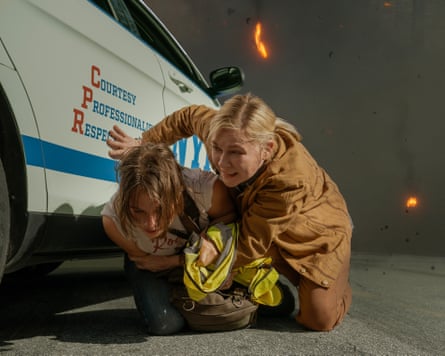
I bring this up after a week of watching popular movies that resonate in Trump’s US, most of which go heavy on the firefights and light on the details of how we arrive at them. The latest, Anniversary, which launched this week on Netflix – a streamer increasingly uninterested in the subtleties of any situation, let alone this one – depicts a US in which an evil rightwing genius in the shape of a beautiful young woman talks the country into ditching democracy via the medium of (I love this detail; the sheer optimism of it) a stirring book of essays.
Actually, I thoroughly enjoyed the first half of the film, in which Diane Lane plays a centrist mom and political scientist at Georgetown University, trying to keep her family and the discourse together. In essence, it’s a domestic drama with some autocracy for dummies around the edges. But what’s clever is its presentation of an Orwellian-style assault on democracy via language that sells plurality as hostile to “togetherness” and “unity” – very credible in today’s landscape.
The book of essays, meanwhile, is entitled The Change and is a nod, possibly, to Project 2025, the shadowy rightwing playbook published by the Heritage Foundation that is now enjoying realisation on Capitol Hill. What the film doesn’t have patience for is the finer detail of how a New York Times bestseller leads to the collapse of the electoral system, and a new order in which subversive comedians are chased across bodies of water by paramilitaries in speed boats and drones threaten citizens in their own gardens after curfew.
If I sound like a killjoy, I apologise. It’s not the job of our creative industries to act as political shills (though we do have the Melania documentary for that). But this failure, to me, seems imaginative rather than political. Consider the impact of Hulu’s adaptation of The Handmaid’s Tale, in which the full horror of Gilead hits home precisely because the show (or rather, Margaret Atwood’s source material) meticulously joins the dots about the bureaucracy of how the US got there.
With this in mind, after suffering through the second half of Anniversary, I returned to Alex Garland’s 2024 movie Civil War, which imagines a US in which three states have seceded against a strongman president in his illegal third term. I was quite critical about this movie when it came out; the supreme court was hearing arguments about the January 6 riot that week and, despite the film’s delicious touches – the on-brand randomness of Florida joining a secessionist cause for reasons wholly unrelated to the broader popular uprising – its apolitical landscape seemed to me like a dodge.
You could, I felt, sense the deep, can’t-be-arsed energy of the film’s creative team when they got to the political science part and it’s a fatigue to which we as American voters are vulnerable. It is easier, always, to pay attention only to the parts with explosions.
What does that leave us with? There is Paul Thomas Anderson’s multi-Oscar nominated One Battle After Another, a slightly different beast to the other two movies in that it shows the US in the grip of a brutal military establishment hell-bent on chasing down “illegals” – in other words, the country as it is now rather than in some future dystopia. I’ve never got on with Anderson’s movies but I loved this, particularly the perfection of Sean Penn as Colonel Steven J Lockjaw, the psychopathic rogue officer who absolutely anticipated the border patrol official Greg Bovino. By reflecting back to us the seriousness of our present situation, the film makes a future reign of terror easier to imagine.
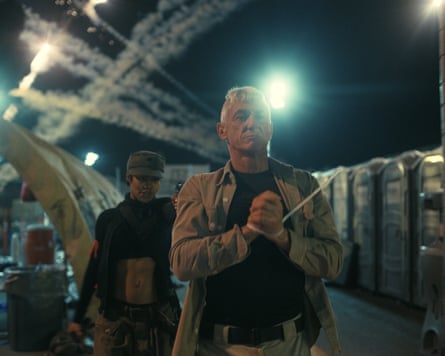
Here’s the weird thing, though. Of everything I watched this week it was Civil War, a far inferior movie to One Battle After Another, that really affected me. The movie occupies a quaint, pre-ICE symbolic order in which, even as civil war rages, the main external reference is to “Charlottesville” and a time when the biggest threat to the US was a bunch of tiki-torch-bearing dickheads, marching for fascism and armed by Bed Bath & Beyond. On first release, Civil War, so sketchy on details, made it easy to sit back and conclude “couldn’t happen here”. But the country has changed since then and, despite the film’s limitations, this time the violence on screen seemed to me suddenly, upsettingly closer.
-
Emma Brockes is a Guardian columnist