2 hours ago
3
2 hours ago
3
Every three years, Queensland Art Gallery scours the whole of Asia, Australia and the Pacific (which is probably why it takes three years) to find the best art being made across the region. The Asia Pacific Triennial is a giant, incomprehensibly enormous task.
Now, the V&A is somehow trying to sum up those three decades of art from multiple continents, dozens of island nations, countless Indigenous populations in … three rooms. Help!
It might be near-impossible to wrap your noggin around, but that doesn’t mean it hasn’t got a bunch of great art in it. The opening room is full of bark cloth paintings from Papua New Guinea, Indigenous Australian abstracts, shark sculptures from the Torres Strait and Tahitian textiles. There are so many ideas from so many cultures with so many different intentions just in this one room.
Indigenous and First Nations artists are the real beating heart of the show. Those bark cloth paintings, by Lila Warrimou and Pennyrose Sosa, are stunning, hypnotic, complex geometric compositions where every shape carries meaning: clan affiliations, tattoos, the marks of a wood grub. Tahitian artist Aline Amaru’s quilt tells the story of her husband’s dynastic lineage.
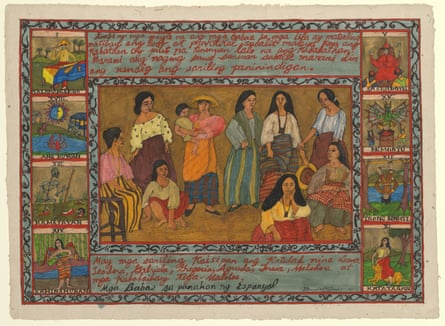
But centuries of colonialism mean that most of these works carry a heavy historical burden. Elisabet Kauage paints figures in Melanesian headdresses being transported in the bows of Captain Cook’s ship. Sri Lankan artist Pala Pothupitiye paints over historical maps from the colonial period to lay bare the injustices his country suffered at the hands of the British. Brenda V Fajardo paints Filipino women surviving and enduring under colonial rule.
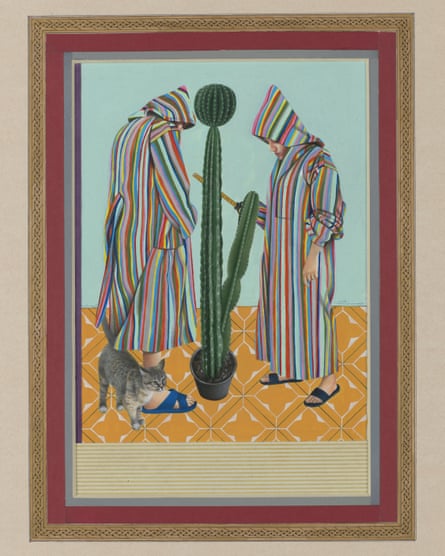
When the burden isn’t historical, it’s political. Lots of these artists worked, or still work, under tyranny. Svay Ken painted quietly through Cambodia’s Khmer Rouge regime and its murderous hatred of artists and intellectuals. Heri Dono’s grotesque cubistic take on traditional Indonesian symbolism was made under the dictatorship of President Suharto. Maryam Ayeen and Abbas Shahsavar paint a couple losing themselves in recreational drugs to deal with the pressures of life in contemporary Iran.
The show ends with works about spirituality from Mongolia and Japan. But almost everywhere you look here, art is an escape from, a rejection of, and an act of resistance against tyranny, injustice and oppression. These artists, from across a vast region, are using art to critique and satirise, or simply to express their identities and histories. It’s fascinating, and often beautiful.
There are issues with the exhibition design, however. I have no idea why you would take art this bright and colourful and present it so miserably. The whole space employs dull, grey and depressing lighting more akin to a funeral home. And whoever thought it was a good idea to have a single sound piece – a wailing, mournful piano ballad – looping loudly on an on clearlyassumed nobody would want to spend more than five minutes here.
But the real issue is that this just isn’t enough, nowhere near. This show feels like a barely cracked window into a vast world. Each segment of the show – Pakistani miniature painting, Indigenous Australian photography, Papua New Guinean textiles – could, and should, be a whole exhibition. I’m sure that as a triennial, it works brilliantly. But it’s far too huge and unwieldy a topic for a single show of this size. What story is being told with single artworks from Iran, Mongolia, Australia, Japan and on and on? There’s no cohesive thread to follow. If you’re going to do this, do it properly: go big and genuinely celebrate the incredible amount of diverse, mind-altering art from across this slice of the globe.