3 months ago
148
3 months ago
148
If Iran could manufacture destructive missiles at the speed with which it produces cutting memes, US Central Command would be coming out with its hands up by now.
One of the more bizarre and unexpected aspects of the Iran-US war is that Iran, a country by reputation dominated by conservative clerics neuralgic about western culture and media, is dominating the social media war, unleashing its gen Z tech warriors to engage western audiences with its sarcasm and ridicule of the Trump administration.
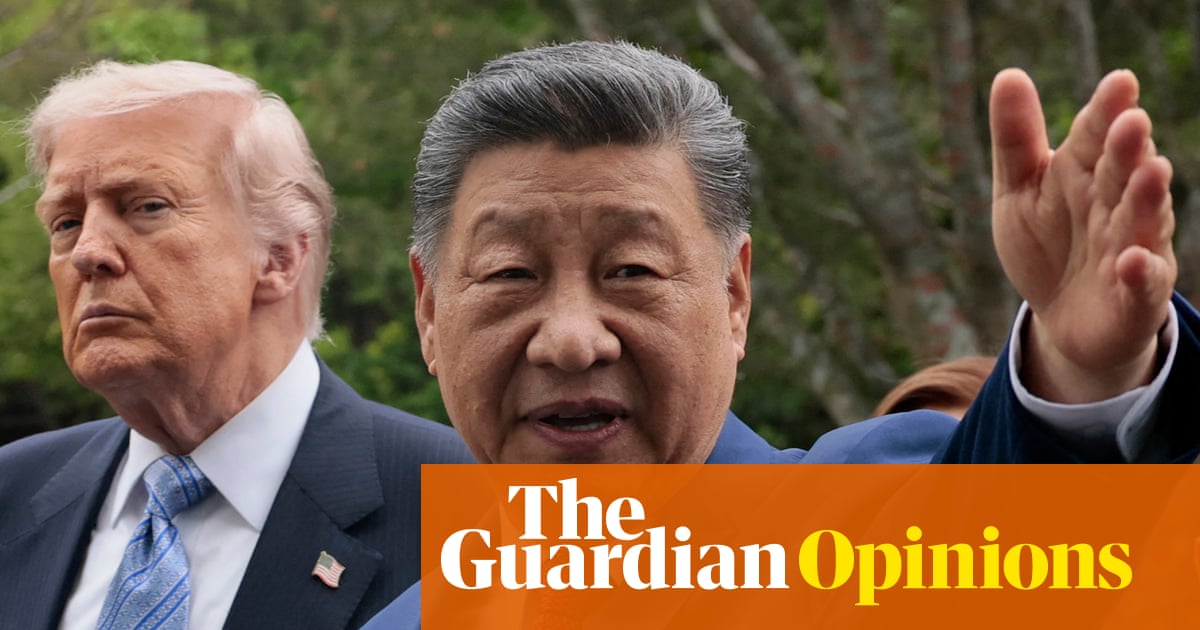
Donald Trump by contrast, now polling at Richard Nixon impeachment levels, cannot stop making mistakes, having to delete his Truth Social disastrous post likening himself to the Messiah, and allowing himself to be manoeuvred into a position where he is taking responsibility for the freezing up of global trade.
Iran’s social media performance, ranging from embassies’ social media feeds to the speaker of parliament, Mohammad Qalibaf, is all the more surprising since most Iranians are raging at more than four weeks of digital darkness, the longest government-induced internet blackout in the world.
Its once vibrant press has been reduced to reproducing army spokespeople statements, or articles culled from the western press saying Trump is suffering a strategic defeat. Some of Iran’s best newspapers have been shut down, and ordinary Iranians still complain about the unwatchable propagandist official TV news channels.
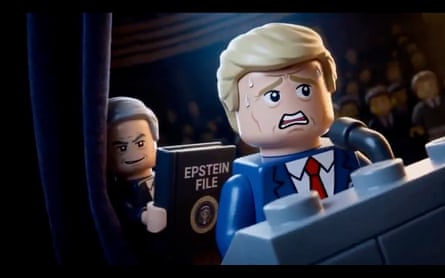
But out of this darkness comes a creativity aimed at the west. Pro-government accounts are posting AI-generated Lego animations that link the Jeffrey Epstein cases to Trump’s war, or using humour and confidence to puncture the west’s failings.
The latest example sent out by Iran’s South African embassy, one of the diplomatic network’s stellar performers, shows Donald Trump attired as a 1980s rock star with bouffant hair singing a spoof of Desireless’s Voyage Voyage, renamed Blockade, and playing the keyboards.
After 24 hours it had more than 45,000 likes. On the night Trump vowed to end Persian civilisation, the same embassy posted a clip of a dog staring quizzically at the camera as nothing happened. Such is the interest that IranWire mounted an investigation into the brains behind the Qalibaf feed, and claim to have located an old political ally based in the US. Little of the content is explicitly religious.
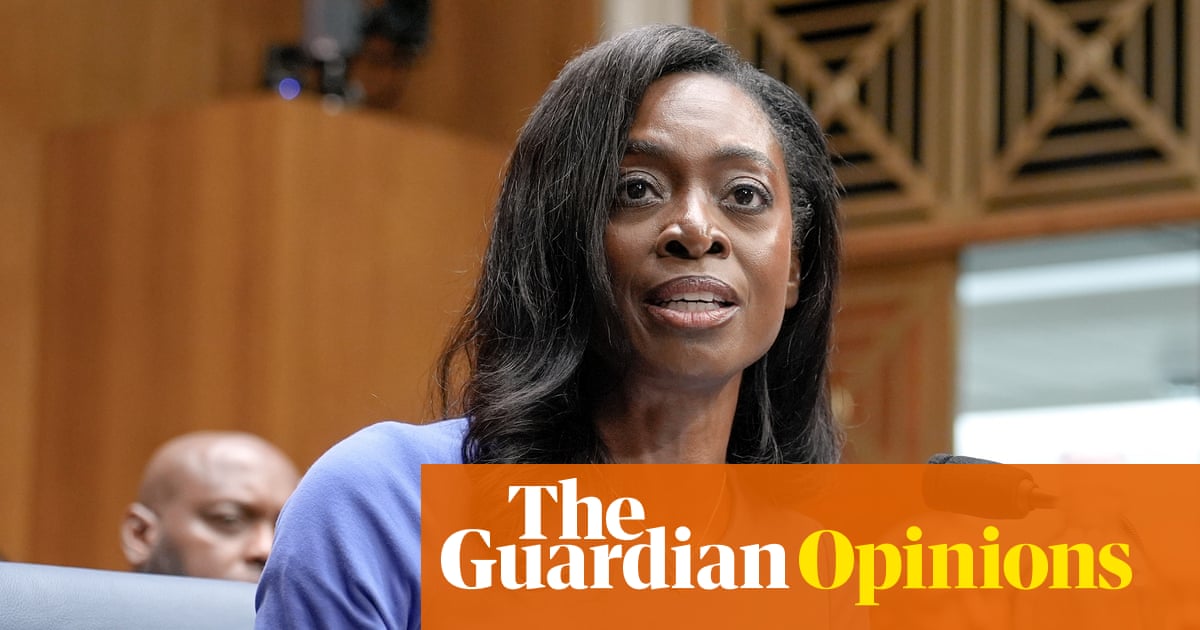
Narges Bajoghli, assistant professor of Middle East studies at the School of Advanced International Studies, John Hopkins University, describes herself as a cultural anthropologist, and as such is also a keen student of Iran’s methods of communication.
She told a Quincy Institute briefing this week Iran’s entire media apparatus had been much quicker than the land of the tech bros at getting content and messaging out. “Wars are fought in two spaces,” she explained. “They’re fought on the battleground, and then just as important a battleground is the communications war. Iran has been able to completely monopolise the communications war, especially on social media globally.”
She argued the Iranians knew they could not make any kind of dent in US mainstream media because they had been persistently portrayed as a terrorist state run by religious zealots for almost 50 years.
“Where they have really come in is hijacking the conversation and the narrative on the social media realm,” said Bajoghli.
“You have a generation of very young millennial and gen Z content creators in Iran who have been given the space and the green light to message this war to the global community, and especially those who are online and who now understand the war and understand the world in the aftermath of Gaza. And that is something that is fundamentally shifting.”
Bajoghli added: “I have over a dozen accounts that monitor social media across different political discourses and have been doing so for over a decade now on various issues, not just on Iran. I have never seen any issue in which all of my different algorithms collapse on to each other, like with this war. I have seen across the political spectrum, whether it’s the far right, whether it’s more Maga, whether it’s more moderate Republicans, whether it’s on the liberal side, all the way to the far left in the United States.”
She said she had not seen such cross-over across groups. “All of them have been sharing viral content from Iran every single day,” she said. “I have never seen this in 15 years of doing this professionally.
“Iran’s entire military apparatus has handed over the communications to this younger generation. It is no surprise to me that they are going viral and it is no surprise to me that they have paid attention enough to the discourse online that they’re able to hit upon all of the issues that make it go viral across the political spectrum.”
One reason the US may be having such a hard time putting forward its narrative is the cuts imposed by Elon Musk on the US state department. To the extent there is activity, the Pentagon projects its warrior ethos aimed at its base. Trump lives his life in caps and ever larger typefaces.
Bajoghli argued Iran is also making huge dents in Arab discourse by pushing on a debate about the meaning of sovereignty, an issue that is not academic but has very real weight.
She argued Iran is trying to persuade the Arab world that Israel has been telling the Gulf that the only country that is permitted sovereignty is Israel. As a result, the question has become “what does sovereignty even mean in the region if Israel continues to act as a military hegemon fully backed by the United States”.
Bajoghli added: “This is something that none of these countries’ political establishments can sustain for the next two decade if their own sovereignty is consistently being questioned, if they are dealing with two powers that seem to not care about the sovereignty of anybody in the region except for that of Israel.”
She said this is the “fault line that the Iranians are pushing up against right now in very robust ways across the Arab discourse”.
The Gulf leaders may be very mad at Iran moving forward, but they also can’t change their geography, and may have to contend with Iran’s argument.
It is possible the loss of so many Islamic Revolutionary Guard Corps leaders have removed some of the brakes on the creative minds pushing out the propaganda, many of whom have an acute awareness of US culture and understand they need to make films in a way that people would not think were made by the Iranian government.
One of the most successful Lego-branded themes is the suggestion Trump and Netanyahu are linked to the Epstein scandal, comparing their treatment of children to the bombing of Iranian schoolchildren from Minab. The aim is to insinuate that Trump started this war to distract from the Epstein scandal – a view already circulating in US. It may not be a message Iran invented, but it has reinforced.
Changing perceptions of a country takes a long time, and may be impossible in Iran’s case due to the brutality with which it suppresses dissent. Trump’s worldwide unpopularity does not necessarily transmute into worldwide sympathy for Iran.
But if there is a shift, as there has been about Israel’s standing in the US, Iran can claim some credit in being ready to push out these videos. Even the assassinated former supreme leader Ali Khamenei, obsessed by the influence western-based satellite channels on the nation’s liberated youth, realised social media’s importance.
At a meeting in 2024 he said: “The media is more effective than missiles, planes and drones in forcing the enemy to retreat and to influence hearts and minds. All war is a media war. Whichever actor has greater media influence will achieve their goals.” For the moment the land of the tech bros is losing.