3 months ago
170
3 months ago
170
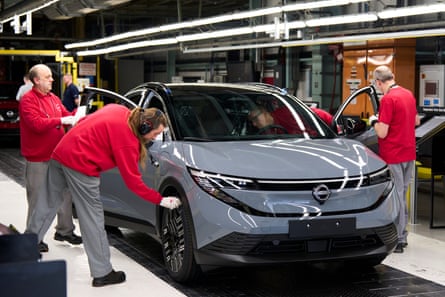
Car bodies suspended from overhead rails move through Nissan’s factory in Sunderland, with workers stepping in to fit parts at different stations. At the newly installed battery “marriage station”, lifting machines push the most crucial component up into the body. Robots fit and tighten 16 bolts in under a minute – quick enough to ensure the constant flow of vehicles around Britain’s biggest car factory.
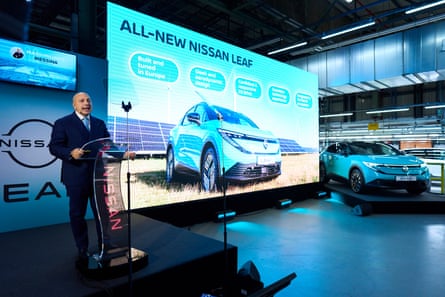
The electric cars in question are the third generation of Nissan’s Leaf, after the Japanese carmaker this week launched production following £450m of upgrades.
Beside the brightly lit final-inspection line, the industry minister Chris McDonald hailed the investment as an important part of the UK industry’s transition to electric vehicles. The Leaf remains – for now – the only electric car to be built in large volumes in Britain.
However, the launch does not come at an auspicious moment for electric cars. Carmakers around the world have delayed models, complaining that sales have not grown as fast as expected. On the same day as the Leaf’s launch, the EU announced it would water down a 2035 ban on petrol and diesel cars, proposing instead to allow 10% of European car sales to have internal combustion engines after that point.
Nissan has joined the retreat. Just two years ago it had pledged to sell only electric cars in Europe by 2030. However, Nissan’s boss in Europe, Massimiliano Messina, said in Sunderland that he was unwilling to commit to a date for the transition to be completed.
“If I might give a number, it will be wrong,” he said, when asked when Nissan would be all-electric in Europe. “I cannot give you a date by when. But I’m more confident that we talk about 2050.”
The EU, a key market for the cars from Sunderland, was the last domino to fall in a global move to slow the transition, after a global barrage of lobbying by the politically powerful car industry. The UK weakened its zero-emission vehicle (ZEV) mandate in April – and will examine further changes. Canada paused its EV sales mandate in September.
Meanwhile, Donald Trump has torn up any policy with a hint of support for electric vehicles – despite his short-lived alliance with Tesla’s boss, Elon Musk. That has cost US carmakers including Ford and General Motors billions of dollars in abandoned investments and lost sales.
European and British manufacturers will still have to switch to electric sales, but carmakers including Volkswagen have expressed relief at the EU’s changes. That will give them greater leeway to sell more hybrids, which combine a smaller battery with a polluting petrol engine. Electric-focused carmakers have strongly opposed the changes, and some in the EV industry have argued that it will just leave the way clear for manufacturers from China, the rising EV manufacturing superpower.
Part of the Sunderland investment was to make sure it could sell more hybrids if needed. The new Leaf cars are now being manufactured on the same kilometre-long line that builds hybrid Qashqai and Juke models.
“We’ve future-proofed for the transition to fully electric vehicles – when the time comes,” said Guy Reid, the engineering general manager at Sunderland, on a platform overlooking the battery conveyor belt. “When we introduce more electric vehicles, we don’t have to modify this facility again.”
Each station completes 60 jobs an hour in order to be able to make up to 600,000 cars a year. However, in 2024 the plant made only 282,000 cars, down 14% from the year before, and well below its 600,000 capacity.
The batteries themselves are manufactured next door, in a new plant built by the Chinese-owned company Automotive Energy Supply Corporation (AESC). As the new Leaf was launched, high-precision robotic arms were stamped and trimmed battery cells to be assembled into packs, although only one out of four lines was operational as it waited for demand from Nissan to increase.
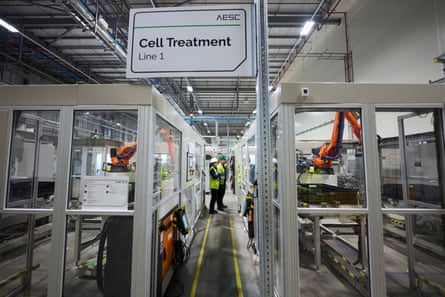
AESC has also had to scale back its ambitions for Sunderland. Its new battery factory is capable of making 15.8 gigawatt hours (GWh) of batteries a year, enough for about 300,000 electric cars, but well short of initial plans for 38GWh.
Nissan’s change in direction is not just following the global automotive mood. It is in the middle of a third turnaround plan after years of leadership turmoil. The company’s former chief executive Carlos Ghosn tried to make an alliance of France’s Renault, Nissan and Japan’s Mitsubishi into the world’s biggest carmaker. However, he was arrested in 2018. He dramatically fled house arrest, leaving behind years of leadership chaos at Nissan, and an abandonment of world-spanning ambitions.
Nevertheless, in 2023 Makoto Uchida, one of Ghosn’s successors, had enough confidence to pledge only electric sales in Europe by 2030. He said: “Nissan will make the switch to full electric by 2030 in Europe – we believe it is the right thing to do for our business, our customers and for the planet.”
Sunderland was a key part of that plan. Nissan also said that year it was considering three electric models: a new Leaf hatchback, plus replacements for the Juke and Qashqai crossover SUVs (although the latter has yet to be confirmed).
Securing the new electric models in Sunderland was seen as a huge priority for the previous Conservative government – partly to avoid a rerun of 2016, when the plant became a symbol of the potential economic harms of Brexit. The government secretly agreed to give state aid worth £61m.
Brexit is no longer the main concern of the car industry, but carmakers are still able to win significant support. State aid disclosures show that the UK government in 2022 gave Nissan £101m towards the plant in direct grants for a “new all-electric vehicle”, one of the largest subsidies given to a manufacturer since the UK’s departure from the EU. Nissan said it had invested £450m itself in upgrading the plant.
The government said the grant was justified because it “secures a strategically important internationally mobile investment”. Carmakers often play different governments off against each other when seeking support for factories.
The support may have helped Sunderland avoid the axe when Uchida was forced out earlier this year. In May, Nissan’s current chief executive, Ivan Espinosa, announced the closure of seven factories, with the loss of 20,000 jobs – but spared the UK.
Yet Nissan still faces questions over whether it can fill the plant again. One suggestion aired by Espinosa was to build cars for Dongfeng, a Chinese manufacturer and partner in a joint venture with Nissan in Wuhan.
Messina said Nissan was still looking at “opportunities”, but added that there was “nothing concrete”. He insisted the company’s main focus would be on winning back market share with new models, starting with the Leaf.
“For the time being, we are looking at ourselves because we want to make sure we secure our own footprint with our vehicles,” he said.