6 hours ago
7
6 hours ago
7
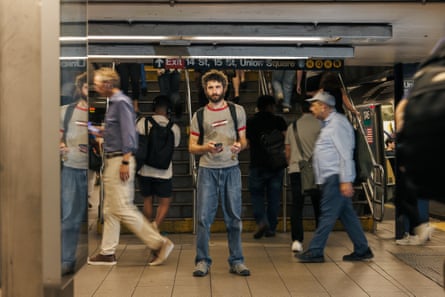
On a recent August day in the subterranean furnace of New York City’s subway, one bearded, curly haired man was studying his phone for different reasons than the other wilting passengers – to track the soaring temperatures and ponder how underground train stations can cool down in an era of climate crisis.
Jack Klein, a 31-year-old construction site manager, has in the past two years taken it upon himself to become a sort of guerrilla subway heat operative, sticking teardrop-shaped thermometers to steel beams in seven of the hottest Manhattan stations and posting social media videos of the hades-like summer temperatures that commuters have to endure.
“This line must be cursed,” Klein said on the 4/5 line platform at 14th Street-Union Square, one of the city’s most blistering stations, as he dangled another of the monitors and saw the digits climb to 99F (37C), a good 10F (5.5C) hotter than aboveground.
The heat index, which combines the temperature with New York’s clinging humidity, rose to 116F (46C), well above the level at which heatstroke can set in. “It’s been worse – I’ve seen it get to 120F [48C],” said Klein, as two nearby police officers shifted uneasily in their heavy bulletproof vests. “But this is definitely uncomfortable.”
Shortly afterwards it did indeed get worse. The monitor’s temperature reading, which displays on Klein’s phone, climbed to 101F (38C) with the “real feel” heat index hitting a delirious 132F (55C).
“It’s just too hot, it’s terrible, too much,” said one Italian tourist, named Leo, on the platform. Another passenger, a woman fanning herself, likened the heat to an oven. “I just want to get outta here,” she said. The heat’s biggest impact is upon subway staff – such as maintenance workers and cleaners – who have to toil for hours in these temperatures, a situation that their union describes as dangerous.
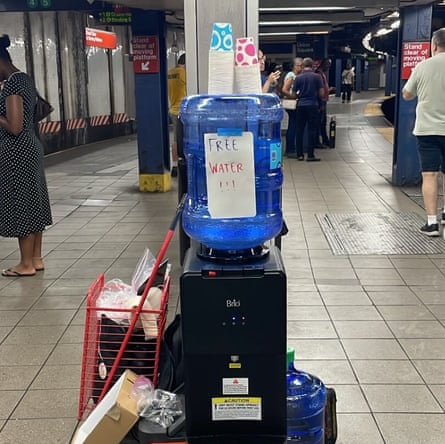
Most of Klein’s in situ magnetized thermometers have disappeared, either removed or fallen, but he has now switched to helping relieve the heat by heaving down large dispensers of water to platforms and agitating for better seating and proper fans.
“I mean, what the hell is that even doing?” Klein grumbled about a dust-clogged overhead fan in the 14th Street-Union Square station that blasted even hotter air at commuters already beleaguered by a sensory assault of heat, smell and the clanging din of passing trains in this dingy, cramped warren.
Living in New York often demands a certain gruff stoicism, and older commuters have taken to reminding Klein, originally from Ohio, that the subway has always been hot and the trains themselves weren’t fully air-conditioned until 1993. “A lot of people just say ‘suck it up’,” he said. “I get that. But I still see this as a public health issue.”
Rising global temperatures – July was the hottest month ever recorded in the US – from the burning of fossil fuels are ratcheting up pressure on cities around the world to deal with stifling heat on public transport. Some, like London, which still does not air-condition all its underground trains, and New York have to grapple with infrastructure built more than a century ago in what was, effectively, a different climatic era.
“The problem is getting worse, people are suffering more and more,” said Giorgia Chinazzo, an environmental engineer at Northwestern University whose research has found widespread underground passenger distress at rising heat.
“The underground is overheating more than aboveground, which is creating these extreme temperatures,” she said. “This summer is a clear sign that we are facing a climate crisis and our built environment isn’t designed for it. In older systems like in London and New York, the metro systems just can’t deal with this.”
Underground stations act as a sort of hot box, soaking up heat in concrete and steel and slowly releasing it. As they brake, trains give off heat and air pollution and, in a sort of steamy irony, further broil passengers by dumping out the hot exhaust from the air conditioning designed to cool carriages. Tightly packed crowds of commuters – each person gives off about 100 watts in heat – adds to the stew, with temperatures sometimes 20F (11C) higher than aboveground.
New York’s subway was designed with a piston system, whereby incoming trains push out hot air via vents, which is replaced by cooler air from above, although this crude ventilation isn’t enough to deal with extreme heat. Yet the vents, along with stairwells and other open spaces, mean stations are also still too leaky to be air-conditioned, unlike the trains.
“The subway isn’t a submarine, it’s not an enclosed environment,” said Janno Lieber, chief executive of the Metropolitan Transportation Authority (MTA), which runs the subway. “Bringing down the temperature is a complex problem in a system where the stations are 100 years old. We know this is no fun for New Yorkers. It’s brutal underground in the summertime and every year is getting hotter because of climate change.”
So New York has devised a new plan to combat the heat in its stations by looking to a solution even further underground. A new city and state government study will explore if it’s viable to capture station heat and push it deeper underground, then use this trapped heat in the winter to warm up surrounding buildings.
This system, called a thermal energy network, would run chilled liquid through pipes behind walls and under flooring to pull heat away from the platforms and, as the liquid warms, funnel it into storage boreholes drilled up to 600ft underground.
The study will focus on the Brooklyn Bridge-City Hall and Chambers Street subway station complex – which Lieber said is one of the “sweatiest” stations, with an average temperature of 96F (35C) in summer – where this underground thermal battery will soak up and then release the heat in the colder months to warm up municipal buildings including city hall and two courthouses.
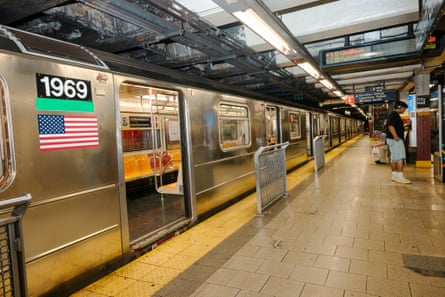
This would knock down platform temperatures by a couple of degrees, or the “difference between total misery and merely sweltering”, as Lieber put it.
“What we could see is a first-of-its-kind approach that could lead the nation,” said Zohran Mamdani, New York City’s mayor, at a media event at the crumbling Chambers Street station, which is due for an revamp (the mayor likened it to a “chamber of horrors” and a background in the Street Fighter II video game).
“We would be making these stations cool again, and we’d be making what is old new again,” said Mamdani, who has vowed to revitalize New York’s creaking transit system and tackle the climate crisis. “That means lower energy costs, a more resilient subway system and a cleaner energy future for New York City.”
Transferring heat in this way isn’t a new idea – the ancient Romans and the Persians, who cooled spaces enough to keep ice in the desert, mastered the flow of hot and cold air long before the advent of electricity. In New York, the city’s vast St Patrick’s cathedral and its botanic garden both use heating from geothermal techniques like this, and the MTA is already starting several schemes elsewhere in its system to draw away and bury heat.
Experts say this means that there is a feasible path to cooling down overheated stations, in some cases also heating nearby buildings, in cities like New York and beyond if the political will and funding is there.
“Extracting the heat and moving it away is a rational approach,” said Alessandro Rotta Loria, an engineer who worked with Chinazzo on her research. “You can deploy this universally, in New York City, London, Rome, wherever you are. The only issue is space restraints and the expertise and willingness to install it.”
Even if New York does opt to build this system, though, it will take billions of dollars and many years to refit the largest subway system in North America, which spans 472 stations, 283 of them located underground. And this will just be a fraction of the hundreds of billions that will be required around the world each year to keep pace with an overheating planet.
The 4 million people who ride New York’s subway on a typical day will in the meantime have to deal with rising heat – already the US’s largest natural, or increasingly unnatural, killer – with some interim measures, perhaps free water in stations, as is normally available in airports, or altered summer clothing and shift requirements by employers. The MTA did not respond to questions as to whether it will introduce, for example, free water, as Klein has done in an impromptu way himself.
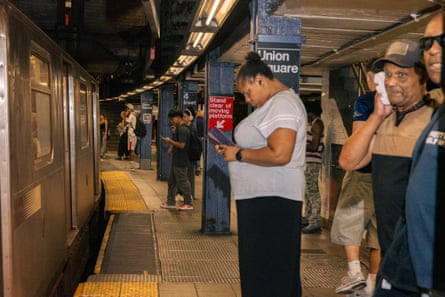
“Our stations do not just get hot, they turn into underground saunas,” Mamdani acknowledged last week, a motif recently depicted on a recent cover of the New Yorker and soon to be taken up literally by Klein, who is planning to erect an actual wooden sauna on the platform of the 14th Street-Union Square station as a piece of art commentary.
“It’s almost done and it looks pretty solid. We will see how people react,” Klein said of the sauna. “I think not being from here perhaps it’s like I recognize that [the heat] is actually not normal. I didn’t grow up as a kid riding this so I have a different, outsider perspective. It really is like a sauna.”
More frequent trains, to whisk passengers away from the platform, will also help. After a lengthy period in a sweltering station, as a sense of dizziness sets in, stepping into the cool air of a subway car comes as a relieving summer joy.
-
The Guardian receives support for visual climate coverage from the Outrider Foundation. The Guardian’s coverage is editorially independent