3 months ago
110
3 months ago
110
Look at a satellite photograph of Britain taken on a clear night and the only things visible are the glowing street lights of towns and cities. If you cast your eyes to the centre of northern England, the distinctive, cupped-hand-shaped boundary of the Peak District national park is clearly outlined as an island of darkness washed by an ocean of light from the industrial conurbations of the north and Midlands.
It was established in April 1951 as the first national park in Britain. And that view from space gives the clearest indication possible of why this site was chosen – it put a national park where it was most needed in the country. It has been estimated that about a third of the population of England and Wales lives less than an hour away from the Peak District.
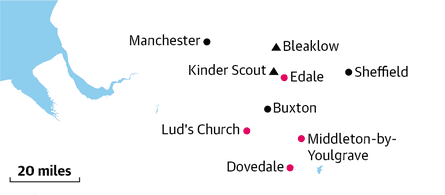
And the teeming populations of those surrounding industrial cities – Manchester, Sheffield, Derby, Leeds, Nottingham and even Stoke-on-Trent and Birmingham – are where the vast majority of the more than 13 million annual visitors come from, regarding it as their back yard and playground, making it one of the busiest national parks in the world.
The inviting hills of the Peak District were close enough to be visible to the workers toiling in the cotton mills and steel foundries of Manchester and Sheffield. In the words of the late Manchester journalist and broadcaster Brian Redhead, they represented the “Great Escape”. It’s still not unusual to see a well-equipped walker kitted out in Gore-Tex, breeches and boots striding out along Piccadilly in Manchester or Fargate in Sheffield, heading for a day out in the Peak.
When Sir Arthur Hobhouse first proposed the Peak District as a national park in his seminal 1947 report, he stated: “Beyond its intrinsic qualities, the Peak has a unique value as a national park, surrounded as it is on all sides by industrial towns and cities … There is no other area which has evoked more strenuous public effort to safeguard its beauty … Its very proximity to the industrial towns renders it as vulnerable as it is valuable.”
The Peak District national park is split between two distinct geographical regions: the glorious limestone dales, such as Dovedale and Lathkill Dale, are in the White Peak; while the contrasting gritstone moorlands, in places such as Mam Tor and Bleaklow (whose very names give a clue to the uncompromising nature of their terrain), are in the Dark Peak.
I’ve always been a Dark Peak man myself, preferring that unique, away-from-it-all, top-of-the-world feeling of freedom you get in places such as the peaty expanses of Kinder Scout or Stanage Edge to the gentler, more subtle joys of the White Peak dales. It must be said that not everyone shares that view. The fell wanderer Alfred Wainwright couldn’t wait to escape Bleaklow’s peaty bogs, and actually had to be rescued from one by a passing ranger when researching his 1968 Pennine Way Companion. “Nobody loves Bleaklow,” he stated unequivocally. “All who get on it are glad to get off.” In the same year, the nature writer John Hillaby was equally scathing in his book Journey Through Britain, describing Kinder Scout’s boggy summit as looking as if it was “entirely covered in the droppings of dinosaurs”.
But Kinder Scout, the highest point in the Peak, is as much a spirit as a mountain – and it just tips the scales as one by topping the magic 2,000ft (610-metre) mark. Few people have actually reached the 2,087ft summit, as it lies in the middle of an extensive peat bog and was marked by a solitary stick when I last visited.
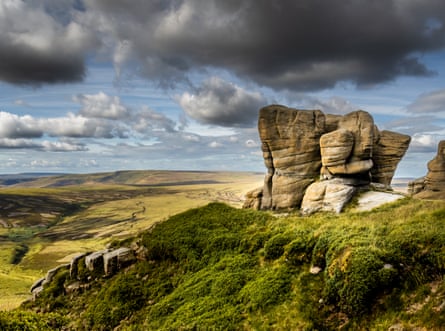
Of course, Kinder occupies a special place in rambling folklore as the scene of the celebrated 1932 Mass Trespass, after which five “ramblers from Manchester way” (as Ewan MacColl dubbed them in his song) were imprisoned merely for exercising their unjustly stolen right to roam.
Another of my Dark Peak favourites is the atmospheric tottering towers of Alport Castles on the southern slopes of Bleaklow. This is said to be Britain’s largest landslip, and I have fond memories of watching spellbound as a family of nesting peregrine falcons swooped and dived above the walls of gritstone, which glowed gold in the late afternoon sun as their piercing “kek-kek-kek” calls rang out.
Lud’s Church, hidden away in the birches and beeches of Back Forest in the far west of the park, is another favourite landslip. This one is wreathed in Arthurian legend because it’s widely acknowledged as the location of the Green Chapel in the denouement of the anonymous early medieval alliterative poem Sir Gawain and the Green Knight. I’ll never forget my first visit to this mysterious 18-metre-deep chasm, when I nearly bumped into an escaped red-necked wallaby and was the first to spot the unmistakable profile of the helmeted, lantern-jawed Green Knight in the natural rock wall of the Chapel. Everyone sees the knight now, but the wallabies are long gone.
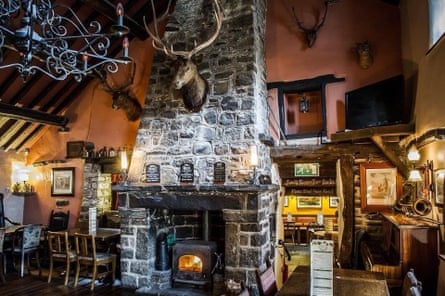
My favourite pub in the Dark Peak has to be The Old Nags Head at Edale, a traditional, stone-floored pub in the centre of the village. It is popular with walkers and famous as the starting point of the 268-mile (431km) Pennine Way, envisioned in 1935 by rambler Tom Stephenson and finally opened in 1965.
The most famous of the lovely limestone dales is Dovedale, whose gin-clear waters were first described by Izaak Walton in his Compleat Angler (1653) as the “princess of rivers”. But Dovedale is probably best avoided in summer when it can resemble Blackpool on a bank holiday, and queues form to cross the famous, now restored, stepping stones.
Far better to stroll through the sylvan delights of Lathkill Dale, below Over Haddon, along the River Lathkill, described by Walton as “by many degrees, the purest, and most transparent stream I ever yet saw, either at home or abroad”. But be warned, the Lathkill shares the habit of many of the Peak’s limestone rivers of disappearing underground for much of the year, only to reappear in quite spectacular fashion after heavy rain.
After a walk, I always enjoy a pint at the Church Inn at Chelmorton. “Chelly” (as it is known locally) is one of the highest villages in the Peak, and the Church Inn stands at the top of the village opposite the parish church, which has a golden locust as its weathervane in recognition of its dedication to John the Baptist and his time in the wilderness.
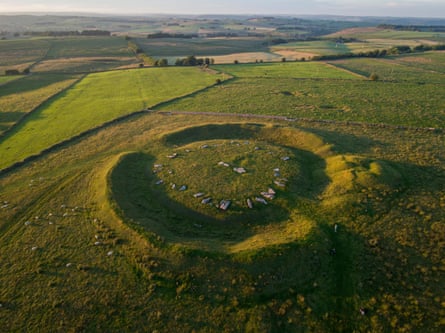
The White Peak is also the best place to appreciate the incredible richness of the Peak’s prehistoric past. It’s humbling to walk up to the now-prostrate, clockface-like Neolithic stone circle of Arbor Low, near Middleton-by-Youlgrave, and hear the silver, spiralling song of the skylark just as the builders of this atmospheric monument must have done 5,000 years ago. Or to visit the nearby haunted ruins of Magpie Mine near Sheldon, the best-preserved lead mine in the Peak, which was worked almost continuously for 300 years.
As the first British national park, the Peak District has always been a pioneer in the way it manages its ever-increasing tide of visitors. This has included groundbreaking traffic management schemes in places such as the Upper Derwent and Goyt valleys, and the conversion of former railway tracks into popular walking and cycling routes such as the Tissington and High Peak Trail and the Manifold Way.
But like all the British national parks, the Peak has suffered crippling cuts in its government grant over the past decade. A massive 50% cut in real terms, resulting in a 10% decrease in staff last year alone, prompted the establishment of a charitable Peak District Foundation to raise income. A visitor tax of 10p a head has also been mooted, something which would undoubtedly make those trespassers of 90 years ago turn in their graves.
The Peak District national park proved to be a vital and easily accessible lifeline for the frustrated, locked-down folk of the surrounding towns and cities during the recent Covid pandemic. It’s a proud role it has served for the 75 years of its existence, and long may it continue to do so.
Roly Smith is the former head of information services for the Peak District national park, which earned him the epithet “Mr Peak District” in the local media. He is the author of 99 books, including 111 Places in the Peak District That You Shouldn’t Miss (Emons) and Fifty Odd Corners of Britain (Conway), both of which will be published this year