2 months ago
88
2 months ago
88
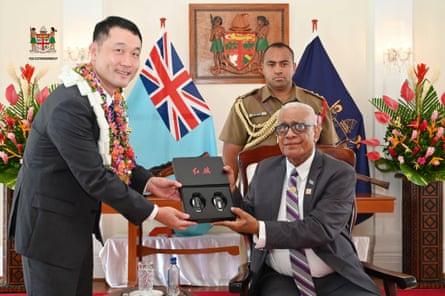
At a ceremony in January, a shiny black luxury sedan rolled into the leafy, rain-soaked ground of Fiji’s state house. It was a gift from China to the Pacific nation’s president, Ratu Naiqama Lalabalavu, who thanked Beijing for the “beautiful limousine”.
The vehicle given was a Hongqi or “Red Flag” car, the same brand used by China’s leader, Xi Jinping, during military parades.
It is an example of China’s “prestige diplomacy”, says Yun Sun, director of the China Program at the US-based Stimson Center. “This is more symbolic than substantive,” Sun says. “It’s part of China’s aid program that aims to build good personal relationships with leaders.”
Across the Pacific, countries have long used vehicles – from ambulances and police trucks to school buses – as a diplomatic tool. But as strategic competition in the region intensifies, these donations have become visible markers of rival efforts to court Pacific governments and solidify partnerships.
In a region where geographic isolation and high import costs drive up the price of new vehicles, foreign-donated cars – often delivered at the donor’s expense – are highly prized by Pacific governments.
Australia, the US, New Zealand and Japan are among the other nations that have donated vehicles in the Pacific. China has given luxury cars, alongside more practical fleets, to countries in the region. As early as 2013, China donated luxury vehicles to Fiji’s leaders, and regularly delivers cars to host nations during the Pacific Islands Forum, the region’s main leaders’ gathering.
Over the past decade, China has been steadily expanding its diplomatic, economic and political footprint across the Pacific, courting governments with infrastructure projects, development aid and high-profile gifts. One objective is to persuade Pacific nations to cut ties with Taiwan and publicly back Beijing’s One China principle, Beijing’s claim that Taiwan is part of its territory. Seven years ago, Taiwan counted six allies in the Pacific region. Now, with Nauru severing its Taiwan ties in 2024, only three remain – Tuvalu, the Marshall Islands and Palau.
Fiji’s president and China’s embassy in Fiji did not respond to requests for comment about the latest gift. But in a speech given as the car was handed over in February, Lalabalavu reaffirmed Fiji’s commitment to the “One China policy”.
Blake Johnson, Pacific affairs expert and senior analyst at the Development Intelligence Lab, says the link between gifts and political messaging is often clear.
“That reiteration of support for the One China policy is a common phrase that comes along with most kinds of ceremonies where [Pacific leaders] receive gifts or thank China for the aid and support,” Johnson says.
“Gift-giving in the region is always a two-way street.”
Vehicles ‘reinforce relationships’
China’s growing presence has unsettled traditional partners in the Pacific, particularly Australia, which has long positioned itself as the primary partner – and it remains the largest foreign aid donor to the region. Over the past decade, Canberra has moved to reassert that role, expanding policing partnerships, security agreements and infrastructure assistance - including its own vehicle donations.
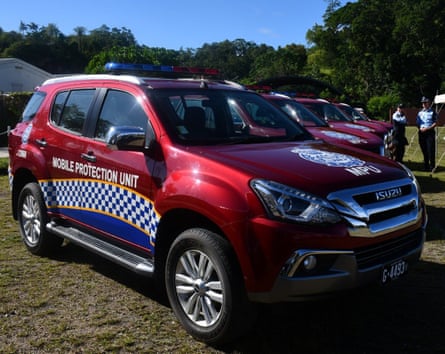
Last year, Solomon Islands’ prime minister released two public statements in quick succession, first thanking Australia for a fleet of police vehicles, then thanking China for a fleet of SUVs.
The incident highlighted a “level of one-upmanship”, Johnson says, and also Australia’s desire to maintain its relationships in the Pacific in the face of Beijing’s growing influence.
“Australia has made it quite clear it wants to be the security partner of choice in the Pacific,” he says. “When Australia is working so closely with forces across the Pacific, it is easier to have vehicles and equipment that match.”
China and Australia are not the only players, though. In January, the United States donated two ambulances to Palau. Japan, Korea and New Zealand have all supplied fleets to Pacific governments.
For donor nations, the appeal is clear. Johnson describes these vehicles as “moving billboards” – rubbish trucks in Honiara emblazoned with “China Aid”, government cars in Vanuatu bearing stickers noting their donation from Korea, or a glimmering black presidential car with the red Hongqi symbol.
“Vehicles are good bang-for-buck for foreign partners,” Johnson says. “They drive around every day, reinforcing that relationship again and again.”
Johnson says most Pacific island countries need support and “vehicles can be useful regardless of where they come from.”
“A free limo here and there is pretty hard to turn away,” he says.