9 hours ago
13
9 hours ago
13
I awoke one morning in the summer of 2023 to discover that, while I’d slept, my son Joel had been texting my wife and me a series of unnerving messages about a perilous situation he had found himself in, in Connecticut.
From what I could tell, as I frantically tried to piece together the night’s events, one of Joel’s friends had been invited to a party being held by a stranger she’d met that week on Tinder. So Joel and two others went along for the ride. But when they arrived, they found the man’s home so bizarre that Joel did something he’d never done before – he sent me the coordinates of his location and a photograph, just in case.
The photograph was of a vast medieval castle with a drawbridge, gargoyles and many – I couldn’t shake the sense that there were too many – spires, towers and turrets, reaching like skeletal fingers to the looming clouds above.
“I honestly have no clue what is going on,” read Joel’s second text. “This is very weird.” Then: “You drive down a road in the middle of a forest and then there’s this gate and it’s just a huge, massive castle.”
It was a few days later and Joel and his friends were sitting in my office, recounting for me the disquieting events that had occurred that night. It began with an invitation to one of Joel’s female friends: “Castle party Saturday! 3:00pm to whenever. Dress code: Formal. Tell your friends. 18+ to come, 21+ to drink.”
It was a three-hour drive from New York City to the pleasant town of Woodstock, Connecticut (160 miles from the more famous Woodstock, New York, of festival fame). Then their GPS took them out of town, on to a winding forest road, and finally to a set of imposing iron gates. They stared at the menacing castle that loomed beyond, urgently discussed turning around, but then the gates swung open and they found themselves entering.
Standing on the drawbridge were a man, a woman and a large black dog. The man was the castle’s owner, Chris Mark. He was in his early 60s.
“He had sharp blue eyes,” Joel’s friend Delaney said, “but glazed over.”
“And he had a cut above one of his eyes,” said Joel.
The dog was called Cerberus, named after the multi‑headed hound that guards the gates of Hades. The woman was blond and much younger.

Mark beckoned them inside. They crossed the drawbridge and entered the grand banqueting hall to discover … there was no party. The room was completely empty, all except for a small number of equally bewildered young people standing around awkwardly.
“I’m sorry, but where’s the party?” someone asked.
“Oh no,” Mark replied. “I’ve invited you here for a different reason.” The room fell silent.
“Which is?” someone asked.
“I’d like you all to take part in my reality show,” Mark replied.
“What’s the name of your reality show?” Joel asked.
“101 Princesses,” he replied.
“What’s the core concept?” Joel asked.
“I’m the lord,” Mark replied. “I’m looking for my queen and I’ve got 101 princesses to choose from.”
He turned to Joel’s female friends. “Are you ready to get into your princess costumes? Come downstairs to my costume room.”
Which they did.
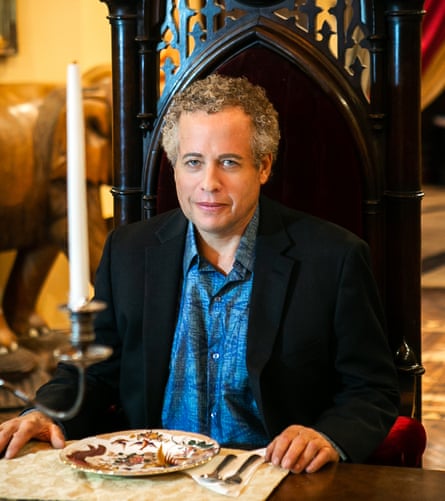
I found this part of their story especially melancholy, that these young people were prepared to follow him to the bowels of his castle to dress as princesses.
Mark’s costume room was located near his hot tub grotto room, which doubled as his botanical gardens. Whirlpool baths nestled among subterranean plants illuminated by purple lamps. In the next room was his pole-dancing nightclub. There were mannequins and, one of Joel’s female friends said, “a whole collection of extravagant princess attire, racks of medieval gowns and a glass display case of tiaras. He told me to choose a dress and pick a tiara to match.”
Mark seemed far more interested in the young women than in Joel and his male friend Cement, but he gave them tuxedos to change into all the same.
After the women re-emerged, wearing princess outfits and tiaras, a videographer appeared. They were assured that while 101 Princesses hadn’t yet been set up with a network, it would end up on Netflix. Then filming began. Mark walked in and a woman who apparently lived at the castle curtseyed and said: “Yes, my lord?”
Yet Mark seemed increasingly on edge, irritated that Joel and his friends were observing rather than participating in 101 Princesses.
(It isn’t entirely clear what participating would have entailed. But they were told it was “a collaborative project” and the makers would be open to ideas. Joel later surmised that along with dance skits and other castle-themed vignettes, the princesses would have been encouraged to make out with each other on camera, while Joel and Cement would have appeared in scenes in which they were rejected by the princesses in favour of Mark.)
Finally, seemingly exasperated by their lack of interest, Mark sent his videographer to inform them that: “Chris wants everyone to leave. Everyone has to leave now.” And that was the end of their story. I stood up to thank them for telling it to me, then I let out a scream.
In terms of them finding themselves in unsettling situations with older men, Joel and his friends were, I have to admit, somewhat out of the frying pan and into the fire. Six days earlier, I had been in surgery, having a foot of my colon removed due to diverticulitis. I was still in pain, which was causing me to let out sudden, unexpected shrieks.
I’d been recuperating partly by sitting on park benches, staring out at nothing, trying to think up ideas for stories. But after about 10 minutes, I’d invariably find myself overwhelmed by a dreadful thought: I’m just a man sitting on a bench. It’s a terrible feeling, that sense of purposelessness, which is why I spent the following days not sensibly convalescing but instead learning whatever I could about Mark and his castle.
The castle, although you’d never know it from the photographs, is newly built. Construction began in 2003 and was completed in 2010. Mark’s money was inherited. His great-grandfather Clayton had been a gilded age steel tycoon – the owner of the Clayton Mark & Company.
Back during construction, when rumours were circulating around Woodstock that a wealthy scion was building an ostentatious castle on the edge of town, journalists managed to unearth fragments of strange stories about the place. Like how it had been claimed during Mark’s 2010 divorce hearing that one of the couple’s pet camels had starved to death due to neglect. Mark blamed his estranged wife; she blamed him – but given that camels can last for several months without food, that sounded like a lot of neglect.
Sixteen days after my surgery, I drove three hours to Mark’s castle. Each time my car hit a bump it tore at the still-raw scar, causing me to yell out. Still, I had no regrets. I was embarking on a story, one that had crashed into my life unannounced. It’s always nerve-racking to be driving into the unknown – and this journey did feel like it might be dangerous – but the sense of purpose I get from following strange stories like this is more powerful than any painkiller.
Mark was waiting for me on his drawbridge. He knew I was coming. I’d texted him to say I was a nonfiction writer and that “my son and his friends were invited to take part in 101 Princesses, and they told me about the extraordinary world you’ve created for yourself at the castle. I’d love to come and write about it.”
“OK,” he’d replied.

He beckoned me inside. I passed an Egyptian sarcophagus and a suit of armour, its helmet tilted forlornly towards the ground. Perhaps because of my proximity to these privately owned relics of war and death, I found myself brooding over my surgery; how while under anaesthetic I must have resembled, for a moment at least, a medieval drawing of a heretic being tortured, intestines spilling out – a drawing that wouldn’t have looked out of place inside this remarkable but disquieting castle.
Guarding this great fortress had clearly gone to Cerberus’s head, because he repeatedly lurched at me and bit my foot – too hard to be considered playful, not hard enough to be deemed an assault.
“Hey, pal,” I said tentatively. And, “Hey, buddy.” Finally, I tried to engage Mark. “Your dog does like biting my foot,” I said.
“For some reason it’s not a negative thing,” he replied. “It means he likes you or something.”
“Oh, OK,” I said.
“How do you convince people to visit the castle and take part in 101 Princesses?” I asked him.
“I go on dating apps,” he replied, “and I make some kind of relationship. Then I have them come here and I adapt them to this lifestyle.”
I asked how he “adapts them”, and he explained that some of them have never had sex with other women so he has to coax them into trying it: “I always thought it would be amazing if I had living here six, eight girls, but the only way it works is if the girls love girls. That’s how the princessing works.”
“Princessing?” I thought.
“We go out and find more girls,” Mark continued, “because they’re looking for themselves. And I just benefit from it.”
So it was fortunate, he said, that once he brings them round to the idea of sex with other women, “they actually really like it”.
I noticed several young women padding silently around in the darkness. Some looked away when they saw me glancing in their direction; others eyed me with suspicion.
I continued to pepper him with questions about his life inside the castle. Eventually, it evidently dawned on him that he was saying unwise things to a journalist, because he suddenly stood up, walked to a kitchen drawer and retrieved a document from a pile of identical documents. It was a non-disclosure agreement.
“I need you to sign,” he said.
“I don’t feel comfortable signing an NDA,” I said.
He looked sharply at me. But he relented. He put the paperwork back in the drawer. But the atmosphere had changed, and soon afterwards I thanked him for allowing me to visit and left.
I had many questions. For instance: who comes up with a word like “princessing”? Also, why was he trying to control me with an NDA? Moreover, why did he have a whole pile of NDAs? Who else was he asking to sign them, and why?
Several weeks later, I was driving Joel from upstate New York to Manhattan when Mark began sending me a series of texts – 42 of them during the three‑hour journey. I asked Joel to read them out to me. He picked up my phone, his eyes darting, and read out an increasingly disturbing sample.
“I’m meeting with my lawyers tonight,” he read. “I’ll spend whatever it takes to protect my family. I’m having the largest international investigation company learn everything about you. I want to get to know you really well.”
I flinched. The car swerved.
There were more pings. This time, as Joel looked at the texts, I saw his eyes widen in shock.
“What?” I asked.
“I’m going to be sending you some of my friends that were in prison for killing somebody,” Joel read. “Maybe you could help them write something good so they can turn their lives around … One of my good friends who got out of prison is on his way to New York today … Do not ever mention anything negative about the castle because this guy will get really upset. He thinks I’m like a god, and you don’t want to see him angry. He just got out of jail like a week ago and has been in there for, like, 15 years … To be honest, I’m even a little bit afraid of some of these people … Carlos and Brandon are on their way to New York right now.”
Joel fell silent. “Meet them,” he said.
“You want me to meet Carlos and Brandon?” I said.
“Yes,” he said. “But take security with you. Take five security guards.”
“I’m not going to take five security guards to meet Carlos and Brandon,” I said. “You want me to escalate this to gang warfare?”
Joel looked frustrated by my reluctance to hit back harder, but the truth was those last texts had brightened my mood. Libel courts surely don’t respond well to plaintiffs threatening journalists with visits from murderers – especially not when the threats were read out to the journalist by his own son, who was arguably emotionally harmed by them.
“Yes,” I thought. “This is good.”
Mark’s volley of texts continued. I was surprised by how uninhibited they were. He was saying the worst things he could think of: “Everything is a mirror. You destroy someone and someone destroys you.” But he’d intersperse these ominous messages with positive character references from friends and colleagues: “I am Shaolin kung fu grandmaster Tyrone Bullock. Chris Mark is an amazing and remarkable person with such a wonderful heart.”
after newsletter promotion
To be honest, I felt the threats were rendering the character references somewhat redundant, but on rereading the messages I was pleased to notice him dialling back the eeriness regarding Carlos and Brandon, even offering to cover my costs.
“If you take my murder friends out,” he texted, “I’ll Venmo you the money.”
The next day, I received an email out of the blue:
Hi Jon,
I am a friend and advisor to Chris Mark and handle a number of business matters for him. Somehow, someway, you really got under his skin and it’s driving him crazy … I’d love for some feedback so I can get a sense of what is happening. Thanks,
Charles Cady
Eleven days later, I sat on Cady’s terrace, overlooking his woodland and stream, five miles from Mark’s castle. He was in his late 60s, and with his kindly demeanour he reminded me of a favourite grandfather from a Frank Capra film.
“Chris and I were doing 15, 20 phone calls and texts a day about you,” he told me.
“Oh God,” I said. “He says he has two murderers on his staff?”
Cady chuckled.
“I assume those people don’t exist,” I said.
“They do exist,” he said.
But he assured me Mark was “completely harmless”, and that he only had ex-convicts on his staff to give them a second chance in life.
But I must have hit a nerve, because at the end of our two-hour conversation, Cady glanced out over his quiet, rolling land and suddenly said: “If I suspected in the least there was something creepy going on, I’d drop it like a hot potato. I have no desire to see a police car pull into the yard. I don’t have any room for that in my world.”
Before Joel and his friends were kicked out that night, they’d swapped numbers with two other young women who’d arrived under similar pretences. Now, I was on the phone to one of them. I’ll call her Ari. She filled me in on what had happened next – how they’d all piled into Mark’s Rolls-Royce to go clubbing in Boston, and how Mark kept “asking if we’d be down to film a shower scene or a hot tub scene with a bunch of women. At that point we figured maybe this wasn’t actually a Netflix show.”
“By the way,” I asked her, “did he ever happen to mention Hugh Hefner to you?”
“Yes!” she exclaimed. “He said how much he loved Playboy, and that 101 Princesses was based on the whole Playboy situation. He said Hugh Hefner was one of his idols.”
It struck me that Mark was trying to be Hugh Hefner during surely the worst period in human history to be Hugh Hefner. Unless you’re the creme de la creme of manosphere influencers, you can’t lord it over princesses in your castle like it’s the 1970s any more.
And so, despite there being nothing immediately relatable about his story, being a tale about the complexities of luring women to your castle in the post‑#MeToo age, I could see a resonance. It was a story about men out of time, men failing to adjust to a world that was moving away from them. The world had changed shape and all kinds of men were discovering there were things they’d once done that they couldn’t do any more.
Mark’s situation was, of course, bizarre and extreme. He had the resources to construct a fantasy bubble within which he could pretend his lifestyle wasn’t dated and weird and damaging, but aspirational. However, I was picturing less empowered and more sympathetic men than him – men who used to derive structure and meaning from, say, office or factory life, and were now struggling to adjust to a society that had reorganised itself without them in such a central position.
Some were instead scratching a living as YouTubers, “personal brands”, content creators with no job protections, while others were withdrawing, folding in on themselves. There’s data to prove it. By 2022, one in six US men aged between 25 and 54 wasn’t working. But within that statistic was a more startling one: two‑thirds of those men weren’t even looking for jobs. That’s 6.7 million US men, and countless more around the world, who’ve just … bowed out.
I was aghast. Why had those men opted out of society? What havoc was that purposelessness wreaking on their inner lives, and on the lives of their loved ones – partners, parents, children? And given that some of them would inevitably grow sick of a life in the shadows – of a life of male nothingness – what might happen next?
While many traditionally male sectors, such as factory work, are dying, I’ve noticed one role for men that’s flourishing: actors who can play doofuses in television ads. Modern TV commercials, certainly, are an orgy of male buffoonery, of men who can’t do anything right and have to be constantly bailed out by their exasperated wives. I’ve watched men falling off lawnmowers, driving off cliffs (1st for Women insurance), accidentally abandoning their babies on restaurant conveyer belts (Philadelphia cream cheese) and being terrible at sex (Domino’s pizza).
“Hey, honey,” says the man in the Domino’s ad, “the Domino’s lady just said we’ve got 30 minutes. Are you thinking what I’m thinking?”
His partner looks at him. “What are we going to do with the other 28 minutes?” she says.
I wondered about the actors who play the doofuses. Are there particular go-to men who invariably snag the parts? I messaged the veteran casting director Zita Zutic Konak, and she emailed back: “Hi Jon, meet Ed – a wonderful actor who we’ve cast in these types of roles previously.”
Ed has played a man in a Specsavers ad who misses his plane because everything goes wrong at the airport due to his own ineptitude and the general frustrations of modernity. He can’t scan his boarding pass. The barcode won’t work. He refuses to give up his water at security so he guzzles it down, drenching his Hawaiian shirt. He loses his hand luggage on the moving walkway. He can’t find the gate. The ad ends with his wife, who’s already through security, looking long-suffering and irritated.
“I did one for Scholl insoles where I had to gallop like a horse,” Ed said. “I’m a regular guy walking to work, but then I put on these really comfortable insoles and I start galloping like a horse down the street. I had to look quite doofusy for that.”
“Fifty years ago,” I said, “there was the Marlboro man being stoical and masculine on a horse, whereas nowadays you have to be the horse.”
“Yeah,” said Ed. He thought about it. “But when you look at those old ads, do you relate to those men on any level?”
“You’re right,” I said. “I don’t relate to the Marlboro Man at all. I relate far more to the man who can’t make it through the airport.”
As the old structures collapse – across both office and factory life – men who feel cut adrift have had no shortage of advice about how to re-anchor themselves. Some men’s health influencers advocate stoicism, while others encourage the opposite: vulnerability, that “once we finally reveal what’s under our ‘manly masks’ we can start to live authentically”.
Then there’s all those doofus men blundering around the culture. Clearly, all this reimagining of what it means to be “male” has been disorienting or irritating for some men, leaving them feeling tossed around in a sea of conflicting ideologies about what being a man actually means.
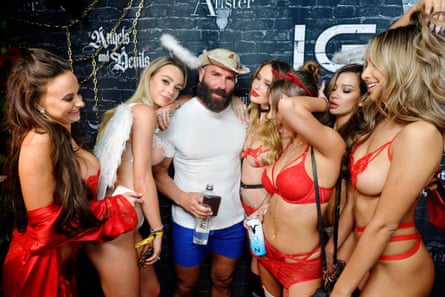
Perhaps that’s in part why yet another male archetype has emerged – the Manosphere Man.
Take influencer and virulent antisemite Dan Bilzerian, whose 28.7 million Instagram followers get to watch him sit on thrones next to lions, walk through forests with assault rifles, and dine on private yachts with near-naked women and, in his pre‑incarceration days, with Andrew Tate.
“I had sex nine times in one day. I was so proud of myself,” he told Joe Rogan in 2016, sounding a lot like Mark. And “I couldn’t fuck all the girls if I had five dicks … I’m not bragging.”
“I salute you, sir,” Rogan said at one point. “You’re living a life that doesn’t even seem real.”
Several months had passed since I’d been in contact with Mark. Finally, though, my curiosity got the better of me and I texted him: “How are things at the castle?” “Everything at the castle’s good,” he replied. He was working on new reality show proposals. He sent me one. It was called Queen to Fraud, and, per its synopsis, it would document Mark’s “battle for justice against Anya and Sasha [not their real names], two women who manipulated his wealth and engaged in deception on a massive scale. Tagline: She was supposed to be the queen. But she became the queen of fraud.”
Both Anya and Sasha had, at one time or another, lived at the castle. Mark had already told me about Anya – how she’d reported him to the police for trying to throw her into his moat, “but they looked at my surveillance videos and saw she was lying”.
I didn’t know Sasha, but the Queen to Fraud pitch document outlined his complaints against her – how he’d showered her with “endless luxuries”, but then she was disloyal to him in Bangkok. Episode three, “Betrayal in Thailand”, would recreate “the shocking moment Sasha disappears to buy drugs, leaving Christopher stranded and sick”. But by episode 10, “The Maximum Sentence”, he’d get his restitution. He’d collaborate “with law enforcement to ensure the harshest penalties” for the women’s treacheries.
I suppose that answered my question about how things were going – evidently, not well. In the short time I’d known Mark he’d gone from developing a reality show where he’d meet and woo his queen to one where he’d have her imprisoned – a similar arc, it struck me, as Henry VIII’s.
He sent me ChatGPT’s assessment of Queen to Fraud. It called it “the most compelling entertainment project ever created”.
“AI likes you a lot!” I texted him.
“That’s who I talk to most of my time,” he replied.
We continued to correspond and I met him in Fort Lauderdale, in the lobby of a beachfront hotel called Ocean Manor. He was in Florida, he said, because he was planning to build another castle and was scouting for locations. There, he outlined for me another new plan – to construct in his Connecticut castle’s grounds an orphanage called Ark of Light.
“Is Charles helping you out with this?” I asked. Mark shook his head. “I don’t know what happened to him,” he replied, looking genuinely baffled. “We talked almost every day up until a few weeks ago.”
Cady – Mark’s friend, spokesman and business adviser for 20 years – was suddenly no longer returning his calls? It had always been Cady’s job to handle Mark’s permit applications, on occasions when Mark had, for instance, tried to turn the castle into a bed and breakfast or a wedding venue. Now that the responsibility had presumably fallen to Mark, was he concerned that the town of Woodstock might not grant him a zone variance for a campus of orphaned prodigies?
He shrugged it off. “They’d look bad if they go against me,” he said.
This was Mark falling for ChatGPT’s sycophancy again. The chatbot had assured him that should Woodstock choose to “fight a billionaire humanitarian trying to help people, headlines would be brutal: Town of Woodstock opposes billionaire’s plan to feed millions.”
Mark’s devotion to ChatGPT was far from uncommon by this point. Millions were falling for its obsequiousness. It felt like a ripple from the downfall of the old structures. People fall apart, people become directionless, and the tech companies swoop in with new ways to monetise our feeling of purposelessness – our desire to be of use – by telling us we aren’t worthless. Far from it. We’re creating “the most compelling entertainment project ever”.
A breakup can be good news for a journalist, and so, after I left Florida, I messaged Cady to let him know I’d just interviewed Mark again.
“Lucky you, spending quality time with Chris,” he replied.
There was a distinct and, I thought, intriguing change in his tone. We arranged to meet. I arrived at the restaurant early. Cady was already there, looking grave, tapping his fingers on the table. I sat down. We ordered lunch. And then Cady told me the news.
Mark, he’d learned, was under investigation for a number of alleged sex-related crimes. It was at a federal level, with several agencies involved, including the Department of Homeland Security.
“My head exploded after I met with the feds,” Cady said. “I am angry and upset. And I started thinking, ‘Oh my God, what was I involved in as an unsuspecting individual?’ I feel incredibly, incredibly naive.”
At this time of writing, August 2026, the investigation into Mark is ongoing. Of course, an investigation is not evidence of criminal wrongdoing – and he has not been charged in the US. Maybe he never will be. I don’t know where Mark is. I’ve heard he’s abroad, perhaps in south‑east Asia. Maybe he’s anxious about returning to the US due to the police investigation, and the publication of my book, which tells the stories of many unravelling men, including him. But after I left Cady that day, I dug and dug and I finally feel I’ve learned the truth of what was really going on inside his castle.
I think that, like many men, Mark was trying to create a fantasy life within which he didn’t have to live or interact with other people except on his own terms. It’s a growing phenomenon – men responding to the collapse of the old structures, and a shift in power, by becoming like separatists, succumbing to uninhibited behaviour, trying to create false utopias where they can behave however they want. But it feels like the experiment is failing. As Mark is presumably learning, sometimes when you push boundaries, reality bites back.
When approached by the Guardian for comment on this article, Chris Mark said that Jon Ronson had “presented me and events involving me in a profoundly misleading manner”. In relation to 101 Princesses, Mark denied deliberately deceiving people into coming to the castle, adding that “the gathering related to a proposed creative project … that also had a genuine charitable purpose”. He added: “I strongly dispute any characterisation suggesting that I groomed, conditioned or manipulated women into sexual activity.” He denied that the text messages referencing Carlos and Brandon in any way constituted a genuine threat: “I did not intend to instruct anyone to physically harm Jon Ronson.” In reference to the allegation from his 2010 divorce hearing about mistreatment of a pet camel, he said: “I dispute any implication that I intentionally starved or neglected an animal.”