3 months ago
172
3 months ago
172
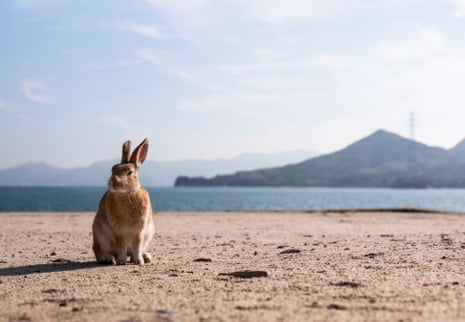
The bunny-ear designs on the window aside, there is little to indicate that the ferry has arrived on an island teeming with rabbits. Then, moments after the passengers disembark, there is activity in the undergrowth. A single rabbit scampers out, wholly untroubled by its two-legged visitors. And then another.
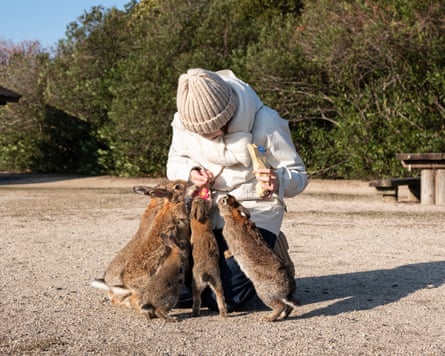
A short walk along the coast takes visitors deep into rabbit territory on Okunoshima, one of 3,000 islands in Japan’s Seto Inland Sea. Half a dozen of the animals chase away another as it attempts to join them in a communal meal of Chinese cabbage. The scene unfolds in front of smiling, camera-toting tourists barely able to believe their proximity to Okunoshima’s fabled – but troubled – furry residents.
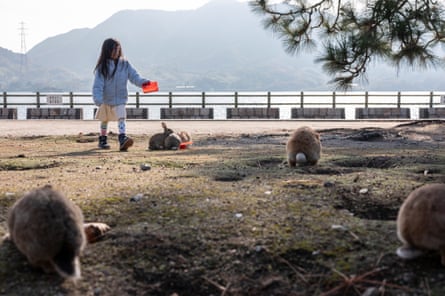
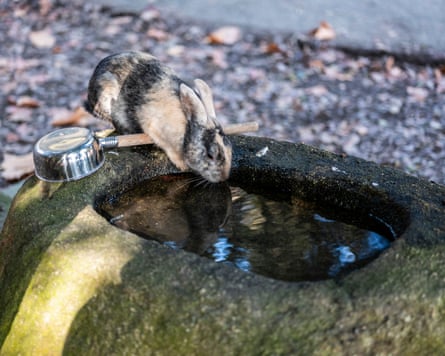
The two grey rabbits that greeted the ferry from the mainland return to bushes stripped of their leaves. Shallow bowls of water left by volunteers dot the island in places where its estimated 400-500 rabbits tend to congregate in expectation of pellets of food left by visitors in the absence of their natural diet of fallen leaves, bark, roots and grass.
-
The rabbits are dependent on visitors and volunteers for food.
For all its natural beauty and popularity as a tourist destination, Okunoshima – uninhabited except for staff working at the solitary hotel and its guests – faces an uncertain future, and so do its four-legged inhabitants.
From 1929 until the end of the second world war, the island hosted poisonous gas research and production facilities run by the Japanese imperial army. The operation was so secret that Okunoshima was not included in contemporaneous maps of Japan.
Workers in rubber uniforms, gloves, long boots and gas masks manufactured mustard gas, and smaller quantities of teargas and cyanide.
The manufacture of weapons of chemical warfare – which was not exposed until the 1980s – also marked the beginning of the island’s connection to rabbits. About 200 were used in experiments to test the efficacy of gas that Japan’s army used during the Sino-Japanese war and, later, to arm balloon bombs targeting the US.
-
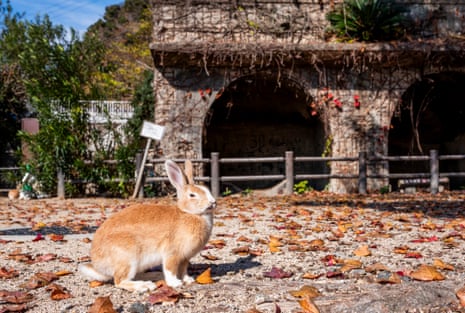
Each of the two rooms at the former poison gas storage facility above once housed a 10-tonne tank on a concrete base.
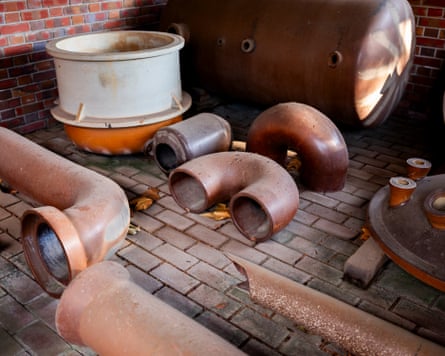
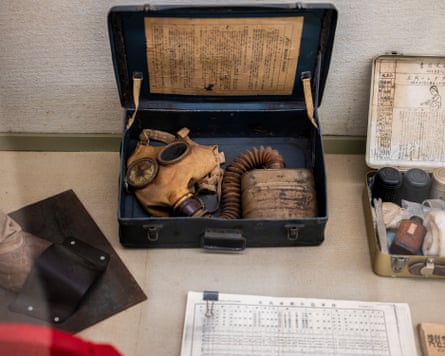
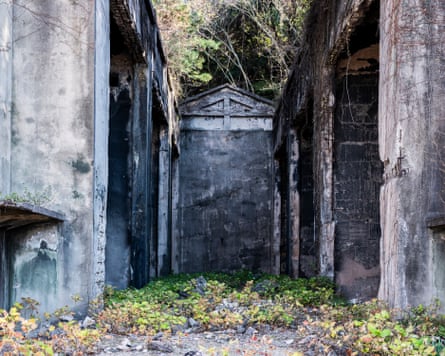
-
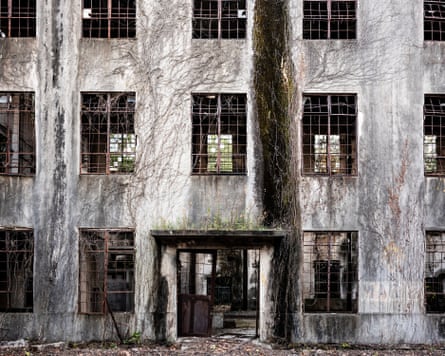
A power plant (top left) once supplied electricity to the gas factory (samples of its pipework and components, top right); a gas mask used at the factory is displayed at the island’s museum (above, left); the largest gas storage facility on the island (above, right) once held six tanks, each with a capacity of about 100 tonnes.
In the early 1970s, a nearby elementary school released a small number of rabbits on the abandoned island, hoping they would bring it back to life. In 2024, nearly 200,000 people visited Okunoshima, drawn by its eminently Instagram-friendly coastline and the promise of entering a rabbit paradise.
An interest in wartime history first brought Koji Yamamoto to Okunoshima five years ago. But it is the rabbits that keep him coming back. “This is my 30th time here,” the retiree says as he watches grey rabbits gratefully devour the pellets he has put out for them.
“There isn’t much natural vegetation, so I thought it would be a good idea to come regularly and feed them, especially during the winter when there aren’t many tourists.”
Defeated Japanese forces attempted to destroy evidence of their wartime activities, including exterminating their collection of white lab rabbits.
Experts have not ruled out a genetic link between the rabbits experimented on in wartime and those that roam Okunoshima today. The chances are, though, “very low”, says Shingo Kaneko, a professor in the faculty of symbiotic systems science at Fukushima University, who is studying the rabbits’ DNA to learn more about their lineage.
“Even if an individual rabbit survived [the wartime experiments] it would have been very difficult to continue its lineage. But I can’t say 100% no, and it’s a story that people like to believe could be true.”
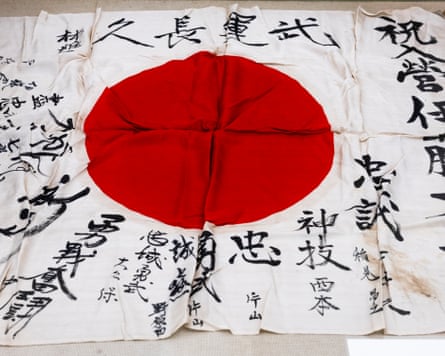
-
A hinomari yosegaki (Japanese good-luck flag) displayed at the island’s Poison Gas Museum is inscribed with ‘shuku nyūei’ (‘congratulations on your enlistment’), a phrase wishing soldiers safety and success in war, and signatures and messages from family and friends.
Kaneko’s study of hundreds of droppings revealed that the rabbits have diverse DNA characteristics, suggesting that animals have been left on the island on multiple occasions, possibly by people hoping to give unwanted pets a new home.
Unable to compete with larger animals for dwindling crops of natural food, the rabbits are now entirely dependent on visitors and volunteers for sustenance, according to Kaneko. “They depend on people for food, and that’s not good. There is not enough natural food,” he says. “The rabbits look happy enough in social media posts, but they have an increasingly precarious existence.”
Yamamoto will not leave his spot until the rabbits have eaten every last morsel. “You have to stay with them until they’ve finished, otherwise other animals come and help themselves,” he says. The predators – usually wild boar and crows – not only eat the rabbits’ feed, but have been known to attack them.
Last year, their chief tormentor was Ryu Hotta, a 25-year-old who was given a suspended prison sentence after being found guilty of abusing multiple rabbits by kicking them or inserting scissor blades in their mouths. Media reports said the carcasses of 77 rabbits were discovered on Okunoshima between November 2024 and January last year, although it was not clear how many had died as a result of abuse.
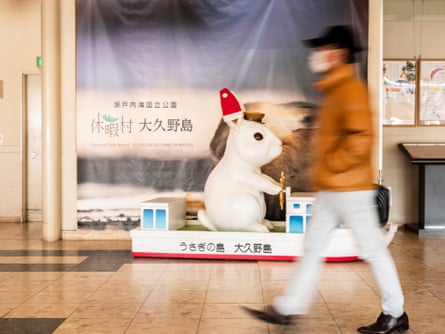
-
The lobby of Okunoshima’s only hotel.
As concern grows over the future of the rabbit population, some worry that the island’s past could be forgotten.
“About 85% of people who visit Okunoshima come to see the rabbits and give this place a miss,” says Kazuhito Takashima, who manages the Poison Gas Museum, where exhibits include uniforms worn by plant workers and photos of the disfigurements they suffered after exposure to dangerous chemicals. “Most Japanese people have no idea about the poisonous gas facilities … we didn’t learn about this kind of thing at school.”
As the tourists leave Okunoshima on the Lapina pleasure boat, they take their final photos of rabbits, whose company they will commemorate with a visit to a souvenir shop 15 minutes away across the water.
“There are lots of tourists now, but there is no guarantee that will always be the case,” says Kaneko, adding that the relative dearth of visible droppings suggests the rabbit population is falling again after increase followed the lifting of coronavirus restrictions.
“I feel very conflicted when I leave Okunoshima. It’s a place of darkness and light. Its connection with poisonous gas ended 80 years ago, but that doesn’t mean it doesn’t have problems … they are just of a different kind.”