1 month ago
79
1 month ago
79
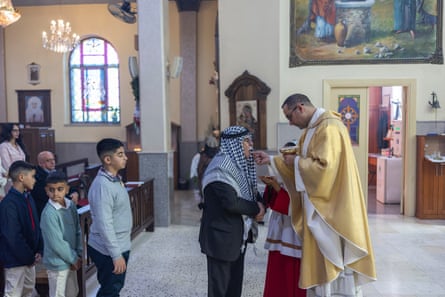
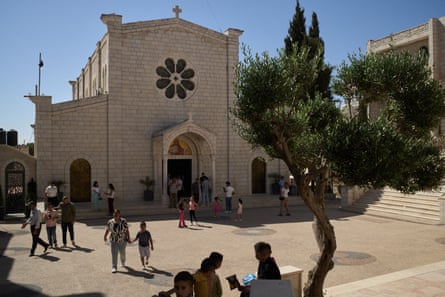
Taybeh, a small hilltop town in the heart of the West Bank is one of the oldest Christian communities in the world. After increasing attacks from Israeli settlers it now feels itself under siege and is fighting for its very existence.
The town’s ancient Greek name was Ephraim where, according to the gospels, Jesus hid with his disciples from the Jewish religious hierarchy, the Sanhedrin, before making his final fateful trip to Jerusalem.
A church was built here in the fifth century, and the entirely Christian community survived the crusaders, conquest by Salah ad-Din Yusuf ibn Ayyub or Saladin, the Ottoman empire, the British empire, and three Arab-Israeli wars, but its inhabitants say its long-term future is in question.
There are four substantial Israeli settlements around Taybeh, and countless unofficial outposts have also sprung up on the steep hills overlooking the Jordan valley. They have been set up by messianic Jews who send their young people, the “hilltop youth”, to harass and intimidate local Palestinians in the surrounding countryside.
The relentless land grabs and intimidation is a pattern repeated up and down the West Bank in a campaign the UN has called ethnic cleansing, which has been driven by hardline members of the ruling coalition, the finance minister, Bezalel Smotrich, and the national security minister, Itamar Ben-Gvir.
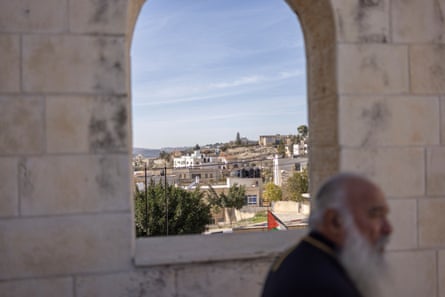
“First they kicked the Bedouin out in the last three years and put up their caravans and bring their cows and sheep. They are using the land without any permission from the owners and from ourselves,” said Father Bashar Fawadleh, the parish priest of Christ the Redeemer church.
After driving out Bedouin nomads and their flocks, Fawadleh said the settlers began to drive their cows and sheep into the olive groves and fields which have been Taybeh’s lifeblood for millennia.
“For three years now, we have been forbidden to visit our land. We are forbidden from tending the olive trees,” he said. The only times local people venture out into the countryside is when diplomats from the French and Italian consulates come to accompany them for a few days each harvest season.
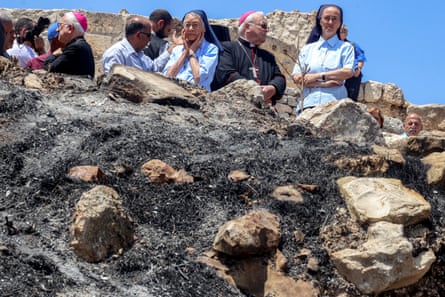
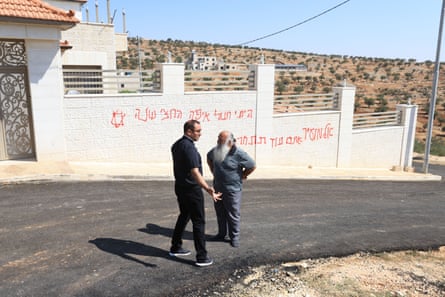
Over the past year, the pressure has been turned up further. In July last year, settlers set fire to the grounds of the fifth–century Byzantine church, St Peter’s. Since then, bands of hilltop youth have raided the town four times, setting fire to cars, slashing tires and smashing windows.
On 19 March, the parish said about 30 settlers took over a concrete factory and stone quarry on the edge of Taybeh, raised the Israeli flag and held prayers on the site, in what was seen locally as a statement of intent that the interlopers would start taking over parts of the town itself.
In February, the security cabinet approved measures allowing Israelis to buy property in the occupied West Bank, an important step towards annexation.
What sets Taybeh apart from other besieged West Bank towns is its identity as a completely Christian town with ancient roots. This brings it a modicum of protection, such as from the harvest visits by diplomats, but it also makes the community as a whole more vulnerable. Western countries generally have been more welcoming to Palestinian Christians than their Muslim neighbours, meaning it is easier for them to leave – which is what has been happening.
The church, part of the Latin Patriarchate of Jerusalem, supports small business ventures to provide jobs and builds affordable housing, but the community is still haemorrhaging. Fifteen families have left in the past two years, leaving the current population at about 1,100.
After the attack on St Peter’s church in July, the US ambassador, Mike Huckabee, visited the town to condemn what he called “an act of terror” and to appeal for prosecutions.
No prosecutions have been reported, and Huckabee has not spoken out over any of the subsequent attacks on Taybeh. A Southern Baptist minister, the ambassador is a fervent supporter of Israel’s territorial claims to the West Bank and beyond, which he argues are divinely ordained.
Huckabee’s support for Israel’s expansionist policies has attracted criticism from American Christians, including from the US right. The far-right commentator, Tucker Carlson, repeatedly challenged the ambassador over the treatment of Palestinian Christians in a combative two-hour interview in February.
Huckabee rejected claims of Israeli mistreatment as “a lie” and pointed out that the 184,000 Christian population in Israel, mostly Palestinian Israelis, had grown rapidly in recent decades.
In the West Bank however, the Christian population has shrunk from 5% of the total population in 1967 to roughly 1% today, about 45,000 people.
The fierce religious nationalism that the Israeli government has cultivated in recent years has largely been directed at Palestinian Muslims but there has been a rising tide of anti-Christian incidents. The Religious Freedom Data Center (RFDC), an Israeli-run organisation that documents such incidents in Jerusalem, recorded a 65% rise in cases of harassment, many of them involving spitting on Christians.
“We identify a connection between the national mood, the prevailing tensions, and the government’s backing which together foster a sense of superiority among Jews – a factor contributing to the rise in attacks against non-Jews,” the RFDC’s director, Yisca Harani, wrote on the organisation’s website.
Aware of sharply declining US popular support since the start of the Gaza war (a February Gallup poll showed more Americans sympathising with Palestinians than with Israelis for the first time) Israel has sought to court US evangelicals, who, like Huckabee, see Israeli expansionism as being grounded in biblical teaching. The foreign ministry hosted more than 1,000 evangelical pastors and Christian influencers on an all expenses-paid trip in November.
“Israel is the only country in the Middle East and one of the few countries in the world that stands up for Christians,” Benjamin Netanyahu told the conservative US television outlet Newsmax, on Monday.
The Haaretz newspaper argued however that the government’s support for Christian groups was conditional on “loyalty to the political agenda of Netanyahu and his far-right coalition”.
Jad Isaac, the director general of the Applied Research Institute-Jerusalem, which tracks the Israeli takeover of land and resources on the West Bank, said: “When Netanyahu says we are the only country which is taking care of the Christians, he’s a liar. He said that in Palestinian Christian communities in the West Bank “the strategy is to make life intolerable”.
On the last bit of open green hillside east of Bethlehem, a new Israeli settlement has sprung up which local Christians fear will tighten the noose around their precarious existence.
The area under threat is Beit Sahour, “house of the night watch” in Arabic, known to Christians as Shepherds’ Field, a place of pilgrimage. About 80% of its population are Christian, and the town is built around a cluster of churches of different denominations.
The only remaining open expanse is a green valley which descends steeply from the south-east corner of town. It is just possible to imagine biblical shepherds guiding their flocks through the grass patches and rocky outcrops, until the point where the view is jarred by a military watchtower, a radio antenna and a cluster of prefabricated huts on the far side of the valley.
The hilltop known as Ush Ghrab (Crow’s Nest) was the site of an abandoned military base, where the Beit Sahour’s civic leaders had hoped to build a children’s hospital and playground. Permission was repeatedly turned down by the Israeli military, and in November bulldozers appeared, flattening a space where the mobile homes suddenly materialised, housing a group of armed settlers.
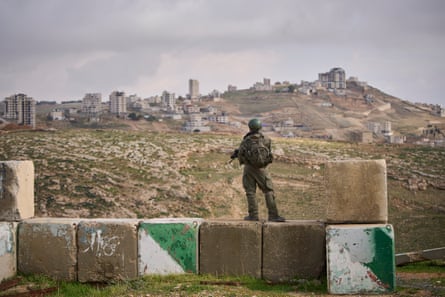
By January, this rogue outpost had been speedily legalised as the settlement of Yatziv, and Smotrich attended the opening, telling reporters: “We’re going to be here for ever.”
Since then a handful of settlers have been seen strolling along the edge of Beit Sahour, assault rifles slung around their shoulders, and local Palestinians have kept away, well aware of the record of settler and army violence across the West Bank. So far this year, according to UN figures, there were 1,828 settler attacks on 270 Palestinian communities in 2025 – an average of five per day.
Rifat Kassis, a Beit Sahour community activist and member of the town’s Lutheran congregation, fears today’s handful of huts is the seed of something far greater and more threatening, in line with a pattern that has spread across the whole West Bank.
“A settlement is not just about the house, but it’s a whole construction, because with the settlement comes roads, military roads, bypass roads and settler-only roads to connect to other settlements,” Kassis said. “This is exactly our fear as Palestinians and also as Christians, that we will become like any other village next to a settlement, with daily harassment, daily shooting, daily arrests of our kids.”
The whole Bethlehem area has been surrounded by settlements steadily infringing on the town. A hulking grey concrete wall runs through the centre, separating off an area around the Jewish shrine of Rachel’s Tomb. According to Isaac, Israel now controls 87% of historic Bethlehem.
Palestinians live increasingly enclosed lives, their right to move determined by the Israeli military. Kassis, a devout Christian, has not been allowed to visit Jerusalem just 9km away for 35 years, because of his participation in non-violent civil disobedience including a Beit Lahour tax strike in 1989.
All his children have moved abroad in search of a viable future and Kassis worries about the death of this ancient community.
“We kept our existence and presence for the past 2,000 years uninterrupted, despite all the turmoil, one empire after another, invasion after invasion and war and another war,” he said. “But since the occupation the pressure imposed on us comes from all sides … Israel has managed to create an atmosphere where there is no hope.”