2 months ago
141
2 months ago
141
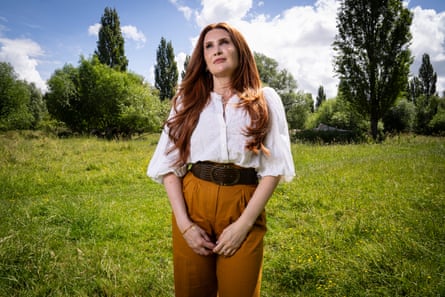
When Sarah Steele woke up on the morning of 2 December 2023, she found herself in a pool of cold water in a bathtub. She was naked and in the apartment of an American fighter pilot she had met in person for the first time the night before. She was confused. Her head hurt, and so did her neck.
This was the account Steele, a British academic, provided to prosecutors. They later accused the pilot, Capt Jacob Wulfson, of drugging and strangling Steele in his apartment in the east of England, and penetrating her vagina with his penis without her consent.
In the criminal justice system for England and Wales, Wulfson’s trial would probably have been held at the city’s crown court, and the alleged offence categorised as rape. A jury of ordinary citizens – men and women – would have heard the case. If found guilty, a judge would have decided the sentence.
However, Wulfson’s case was tried at a court martial on a US airbase, despite his alleged crime taking place while he was off duty and in an English city. The proceedings followed US military law, and the offence was not charged as rape but as sexual assault and “aggravated sexual contact”.
The judge, an air force colonel, sat before an American flag. He presided over a room of people in navy-blue uniforms. The jury – who heard the case in April this year at RAF Lakenheath, the largest US base in Britain – was a panel of eight air force officers.
All were stationed on the same base as Wulfson. All were men.
The panel’s president, equivalent to a jury foreman, was the chief of the squadron that maintains the jets flown by Wulfson. Another panel member had been acquitted of sexual offences at a court martial several years earlier.
Apart from two Guardian reporters and the British witnesses who took the stand, everyone in the courtroom was American. At one point, the NHS was misnamed. At another, there was confusion about how long it would take to get to Wales.
Unlike in the British courts, there was no dock for the accused. Wulfson sat at a table with the defence team, directly across from the airmen selected to weigh the evidence in the week-long court martial.
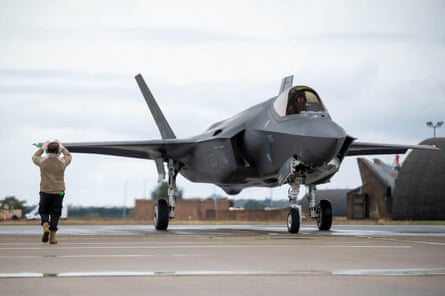
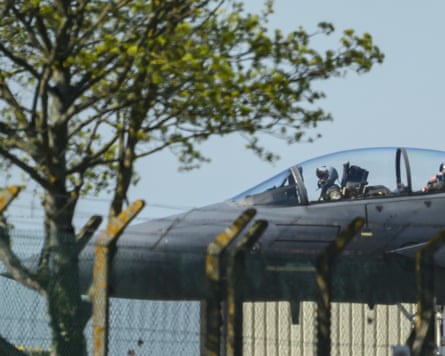
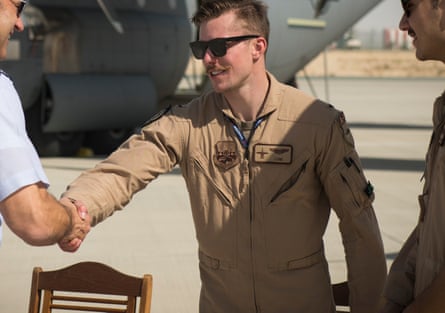
Wulfson, a decorated aviator, flew F-35s, the US military’s most advanced fighter jet. He served in Afghanistan and more recently had trained to fly carrying nuclear weapons. His elite squadron was nicknamed the “Valkyries”.
He did not give evidence in the court martial. For much of the proceedings, he was silent, exercising his right under the US constitution not to testify. As a result, he did not provide his own account of what had happened in his apartment.
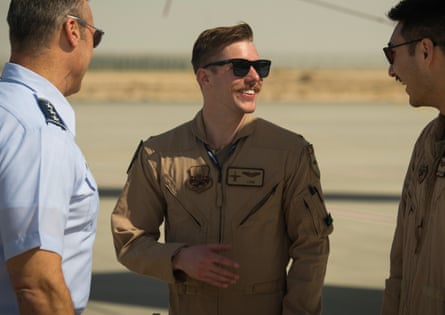
Instead, Wulfson’s defence team sought to undermine Steele’s credibility. His lawyer, an ex-army litigator who had flown in from Florida, depicted her as a financially motivated, sex-obsessed “liar”, subjecting her to the kind of theatrical and combative questioning more commonly found in US courtrooms.
Steele’s experience throws into sharp relief what can happen when the alleged perpetrator of a crime in the UK is a member of the US military.
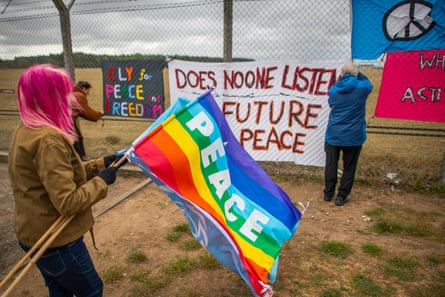
Technically, the UK authorities should have primary jurisdiction to prosecute crimes allegedly perpetrated by US service members off duty and off base. But the Wulfson case is one of several uncovered by the Guardian in which UK police and prosecutors appear to be ceding responsibility to their American military counterparts.
“The British authorities should be fighting to maintain jurisdiction,” said Rachel VanLandingham, a law professor and former US air force judge advocate involved in efforts to reform military law. “Why should they trust the American military justice system with anything related to sexual assault?”
In Wulfson’s case, the jury found him guilty of strangling Steele, but not guilty of penetrating her vagina without her consent.
If his case had been heard in the English courts, the judge would have at this point taken responsibility for sentencing Wulfson. Under national guidelines, the equivalent offence of non-fatal strangulation carries a maximum sentence of five years.
At the court martial, Wulfson could choose between the judge or jury to decide his punishment. He opted to have his fellow airmen, with little or no legal experience, decide his sentence.
The maximum sentence of imprisonment they could impose was 13 years. The prosecution requested five years. After three hours of deliberations, the men returned with a decision: Wulfson would be confined to a corrections facility for six months.
At the back of the courtroom, Steele looked exhausted. She had spent more than six hours on the stand that week. In a statement to the Guardian, she described the court martial as a “degrading” process that had placed her, rather than Wulfson, on trial.
‘His hand was on my neck’
RAF Lakenheath is in effect a small American town in west Suffolk. There are more than 6,000 active-duty personnel plus their family members stationed at the base, where the convenience stores are stocked with American candy.
The base has its own shopping mall, a drive-thru Taco Bell and a miniature Statue of Liberty. The currency used in its shops and cafes is dollars. To reach the emergency services (it has its own hospital, police force and fire service) you dial 911.

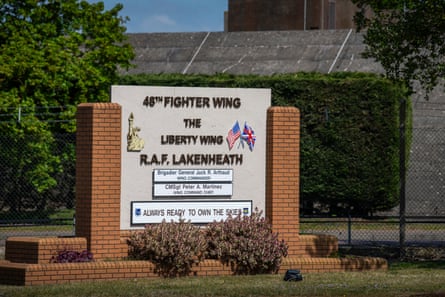
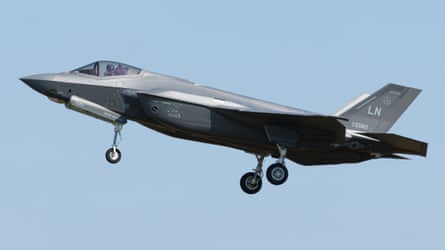
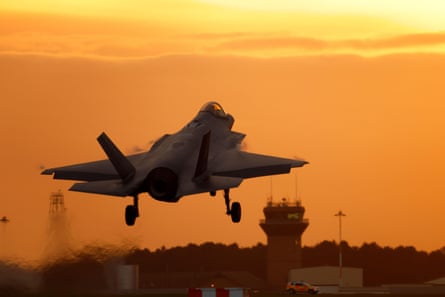
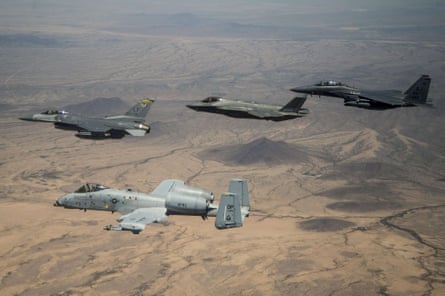
Lakenheath is home to the US air force’s 48th fighter wing. A typical morning on base involves formations of fighter jets departing for training missions. Some of its jets were recently involved in the US bombardment of Iran.
Wulfson worked at the base’s F-35 complex. After joining the Valkyries, one of Lakenheath’s two F-35 squadrons – the second is known as the Grim Reapers – his name and callsign, Lone, could be seen printed on a flap of one of the jets capable of dropping thermonuclear bombs.
Wulfson met Steele on Tinder in September 2023. They both lived in Cambridge, a 40-minute drive from the airbase. “I live on Midsummer Common,” he wrote in one of his early messages. “I’m a pilot up at Lakenheath.”
After exchanging messages on the dating app, they switched to WhatsApp, sharing details about their lives. Steele, then 39, had separated from her long-term partner earlier that year. In court, she said she had been dipping her toe back into the dating world. “I was trying to see what was next in my life.”
Weeks after they met online, Steele went into hospital for surgery to deal with complications arising from a mastectomy she had had several years earlier. From hospital, she texted with Wulfson, who was 29, as she lay recovering, joking about the strong painkillers she was taking.
They also exchanged messages sharing sexual fantasies. In conversations with friends, she referred to him as “the pilot”.
By 1 December 2023, Steele was back on her feet and slowly returning to her fitness regime. At the gym that evening, she discussed with a friend whether she should meet Wulfson in person for the first time. He had texted her earlier that day to see what she was up to.
At 10.42pm, Wulfson wrote again: “You should come here.” She asked where “here” was. “At my flat,” he replied. Back at home, Steele quickly showered and ate some slices of apple before driving over to him.
Before arriving, she texted him with what she described as “a few ground rules”. It read: “No means no when said. No hands on my neck. Ever. Condoms please.” She acknowledged that her message was “blunt”. Wulfson replied: “Yes, that’s fair.”
Security camera footage played in the court martial showed Steele arriving at his apartment building shortly after 11.30pm. Steele’s account of what happened next was laid out by the military prosecutors.
Upstairs in the kitchen, Wulfson poured her a whisky and they chatted for around half an hour. The prosecution alleged it was while Steele was in his apartment that a potent drug, etizolam, entered her system. They advanced several theories about how it was administered but could not say for certain, and Wulfson was ultimately acquitted of the drug-related charge.
From the kitchen, they moved to Wulfson’s bedroom and undressed. Steele said on the witness stand that it was at this point “things sped up really quite fast”. Asked by the prosecutor to describe what had happened, she said that once Wulfson was on top of her, he moved “very rapidly” and penetrated her without a condom – against her stated wishes.
She said she tried to protest but couldn’t. The prosecutor asked why not. “His hand was on my neck,” she replied. She said she had wanted him to slow down but she “couldn’t speak”. She described looking up at him and noticing a light fixture on the ceiling above his head.
“One of his hands was on my arm, one of his hands was on my neck,” Steele said. Asked how this felt, she said she was frightened, and that things then started going dark. “[I felt] like I was going out, disappearing down a tunnel, and then nothing.”
Prosecutors alleged that Steele had passed out in Wulfson’s bed because of the etizolam in her body and the pressure he applied to her neck. “As he was squeezing her neck he was still penetrating her,” alleged Christopher Mitchell, the air force major on the prosecution team.
Her next memory, Steele testified, was waking up in the cold water of Wulfson’s bath.
She said her body was sore. Where, the prosecutor asked. “Throat, neck, head, feet, genitals,” she said. She described feeling confused about why she was in so much pain. At that point, she said, “I was not sure of anything.”
‘Like someone had beat the shit out of her’
According to the prosecution’s case, Wulfson eventually helped Steele out of the bath and returned her to his bed. She remained there until the afternoon, drifting in and out of sleep. The nausea was acute, she said. “I had splitting pain in my foot and fire in my throat.”
Later, after Wulfson had driven Steele home (she said she was unable to drive due to an injured foot), he sent her a series of texts. “I am so sorry. I’m horrified with myself,” he wrote. “I need to spend some time thinking about who I am,” he added. “I feel so badly about what happened.”
Steele went that evening to A&E (a term that had to be explained to the American jury). She was scanned and X-rayed. A doctor who treated her testified that she had “injuries visible to the eye”, namely bruising on her face and body. The doctor did not observe bruising on her neck, though she said Steele presented symptoms associated with strangulation.
Steele left hospital the following morning and a friend took her to a sexual assault referral centre. There, Steele said, she gave a urine sample and photos were taken of her vagina as part of an intimate examination conducted by a forensic nurse.
She also had an off-the-record conversation with a UK police officer stationed at the centre. Afterwards her friend, a woman who worked for the US air force, took Steele to a nearby US base to have a similar conversation with military police.
Within 24 hours, US air force police had arrested Wulfson. A spokesperson for the federal law enforcement agency told the Guardian it “negotiated jurisdiction” with Cambridgeshire police and agreed the US “would take the lead”. Cambridgeshire police confirmed it had agreed the Americans “would take investigative primacy”.
Another friend who saw Steele around that time testified that “it looked like someone had beat the shit out of her”.
During the court martial, an alternative explanation for the injuries was presented by Wulfson’s lawyer, Tim Bilecki, a prominent defence attorney in the US court martial system who posts videos on YouTube about his courtroom victories. Steele’s injuries, he said, were the result of her own actions.

Bilecki, an imposing presence with a blond crew cut and pinstripe suit, said Steele had started “freaking out” in Wulfson’s bed because of a traumatic assault earlier in her life. He claimed she had hit the pilot and head-butted him, leading her to sustain a head injury and a concussion.
The lawyer denied that Wulfson had assaulted Steele, strangled her or drugged her. “Capt Wulfson has been falsely accused, plain and simple,” he said, adding that the pilot was “unequivocally not guilty”.
At the core of Bilecki’s case was an assault on Steele’s credibility. The approach had various lines of attack, starting with a claim that Steele had fabricated the allegations as part of an elaborate scheme to extract money from a UK government compensation scheme for crime victims.
In his opening statement, Bilecki confidently asserted: “This is a play for money,” saying his client had been “set up for money”. Steele repeatedly denied this. She said she had applied to the scheme – and had still not received a decision – to cover loss of wages arising from difficulties going back to work after the assault.
The prosecution described Bilecki’s theory as absurd. By his closing submissions, he seemed less confident in this aspect of his case. “Do I know if she’s doing this for money? I don’t know,” he said.
Another line of attack was that Steele abused prescription drugs. At one point, Bilecki seized on the texts she had sent Wulfson from hospital while recovering from breast surgery. She had joked about being on strong American painkillers.
By attempting to present Steele as a drug abuser, which she strongly denied, he suggested she had in fact taken the etizolam, a benzodiazepine-like drug banned in the UK and sometimes called “street Valium”. Bilecki suggested she may have wanted to “pop a few pills before going to meet a fighter pilot significantly younger than her”.
Show more
Bilecki said there was “zero evidence” Wulfson administered the drug. “Why would you need to drug someone who is willingly coming over to hook up with you? You wouldn’t need to, it’s absurd.”
In his efforts to paint her as a “dangerous” liar, Bilecki even raised doubts about whether Steele had had reconstructive breast surgery. He asked the jury: “Have you heard any record she had that surgery?”
Such speculative claims may not have been tolerated in English courts. Alleged victims of sexual offences are entitled to anonymity and eligible for protections that include testifying from behind a screen in order to shield them from the gaze of the defendant.
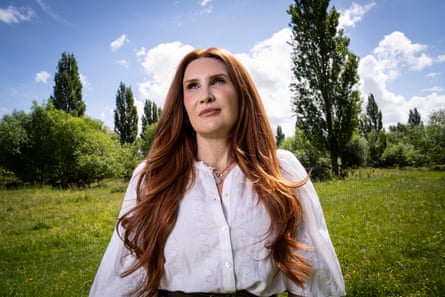
With no such measures in the court martial, Steele testified a few metres away from Wulfson.
As Steele sat facing the accused, Bilecki questioned her about texts she had sent Wulfson months before she went to his apartment, describing the ways in which she wanted to have sex. The lawyer read them out. He referred to others in which she had discussed teaching law students about BDSM. “She’s certainly not some victim in the bedroom,” he said.
On the stand, Steele mostly appeared composed, if at times nervous and occasionally exasperated with Bilecki (“That’s a stupid question,” she said at one stage). At other points, she was visibly distressed, struggling to hold back tears.
This did not stop Bilecki from making a jarring claim in closing submissions that Steele had enjoyed the court martial. “She loves the attention of all of this,” he said. As he spoke, a young woman in camouflage uniform at the back of the court gently shook her head.
A sentence handed down by peers
It took the panel almost five hours to reach a verdict. By the time the men retired to deliberate, they had heard evidence from 13 witnesses called by the prosecutors, including medical professionals, military police officers, and friends of Steele. No witnesses were called by the defence.
Among the witnesses was a US military forensic biologist. He said limited male DNA had been found on Steele’s body, but traces of Wulfson’s DNA had been on her neck and breasts (the prosecution noted she had spent hours in a bath and had showered before samples were taken). Swabs taken days after the assault did not find Steele’s DNA on Wulfson’s penis.
Due to specific requirements under US law, the intimate images and report detailing the forensic examination of Steele’s vagina shortly after the alleged assault were not admissible as evidence.
When the panel filed back into court with a decision, Wulfson stood to attention, his eyes fixed ahead on the officers tasked with deciding his future. A slip of paper recording their decision was handed to the judge. Wulfson was ordered to return to his feet for the verdict.
As well as the strangulation charge, he was found guilty of another offence: wilfully disobeying a commander’s orders to not contact Steele after the assault. He was acquitted of penetrating her without her consent and doing so knowing she had been drugged.
When Wulfson elected to be sentenced by the panel, judge Brian Thompson – a bespectacled colonel who wore a black robe over an air force uniform and sipped orange soda during breaks – instructed its members that deciding on a sentence would require “wise discretion”.
Jury sentencing is permitted in only a handful of US states. Its use in courts martial was ended in 2023 amid concerns over inconsistent decisions and the role of military personnel in dispensing justice. Wulfson’s offences occurred weeks before this came into effect, meaning the old system applied.
In making their decision, the judge said, the panel should consider factors including the impact of the offences on the victim and how to promote “good order in the armed forces”. However, in this phase of the court martial – in which new witnesses would testify – they could also consider Wulfson’s military character and combat record.
The defence called three witnesses: two senior pilots he had flown alongside and a colonel who spoke via video link from a US airbase in South Korea. Referring to Wulfson by his callsign, Lone, they described him as a diligent and unassuming wingman, and one of the air force’s top young aviators.
Stories were told of Wulfson’s missions in Afghanistan flying attack jets between 2019 and 2020. He had, for example, provided air support to special forces conducting night raids in villages, and flown sorties carrying 500lb and 2,000lb bombs.
Each witness was asked whether their assessment of Wulfson’s character was different now they knew he had been convicted of strangling a woman. No, they replied – they had seen his “true character” in combat.
As Bilecki argued against a prison sentence, he presented the panel with a folder containing a record of Wulfson’s military service. On several occasions, he noted how many people his client had killed. One mission in Afghanistan, he said, resulted in hundreds of “KIA”, a reference to enemies killed in action.
On the court martial’s final day, Wulfson broke his silence and stepped forward to address the panel. He spoke softly. He said that on the night in question he had been “highly intoxicated” and had taken things “too far”. Referring to the texts he had sent apologising to Steele after the assault, he said: “What I expressed to her remains.”
“I hope we can both move on with our lives,” he added, describing what happened as “one night, one bad decision”.
The consequences for Steele were laid bare in a victim impact statement she read to the court. She stood and addressed Wulfson. “I asked you not to do something, and you did it anyway,” she said. “That was not a misunderstanding. It was a conscious disregard for my autonomy, my safety and my voice.”
Speaking through tears, she said that when she had gone to meet Wulfson she had recently undergone surgery and had been trying to “reconnect with a sense of self and feel safe in a very different body”.
She said she was grateful for the conviction, but “the road to get to this point was long” and had required her to return to “the worst experience in my life again and again”. Steele concluded with a request for the panel: “I’d like to see justice served that will not only restore some of my own faith in humanity, but offer a layer of protection to other women.”
A US air force spokesperson said the military justice process “includes strict procedural safeguards by design to ensure proceedings are fair, transparent and thorough.” They added: “Maintaining the trust that underpins our partnership, while ensuring accountability and the fair administration of discipline, remains our priority.”
In her statement to the Guardian, Steele said: “The ordeal I went through was incredibly distressing and degrading. It felt intrusive and archaic.”
What happens next?
The building where Wulfson is serving his six-month sentence is a corrections facility at RAF Lakenheath, a short distance from the runway he used to tear down at hundreds of miles an hour in an F-35. At the time of his trial, only two others were being held there.
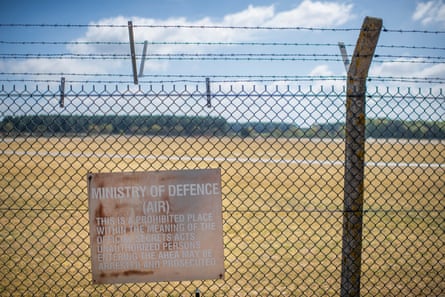
Detainees wake each day at 5am and wear camouflage uniforms rather than prison suits. They take on work around the airbase, and visitors are allowed on Sundays and US public holidays. Good behaviour can contribute to a reduction in sentence.
As well as the six-month sentence, the panel punished Wulfson with a formal reprimand and a dismissal from the air force, a penalty that can strip an officer of veteran benefits and leave a permanent record as a convicted felon.
In a statement to the Guardian, Bilecki said that prosecutors could have charged Wulfson with rape but had opted not to, and emphasised that the court found the pilot was not guilty of the sexual assault allegations.
He also played down the significance of Wulfson’s apology. “He apologised because it made sense to,” Bilecki said. “This woman had come to his home for the first time and left looking like she had been in a fight. Obviously, the night had not gone as planned.”
Wulfson’s case will now be automatically reviewed by an air force appeals court at a military base in Maryland, that can re-examine the case’s facts and evidence. He is due to leave RAF Lakenheath in mid-September, at which point he will be free to fly home to the US.
Were it not for this article, the only public record of Wulfson’s conviction would be an entry on a docket on an obscure US air force webpage. It lists the offence for which he has been convicted and the sentence received. There is no reference to any facts of the case. There is nothing to indicate the offence occurred in Cambridge, or that the victim is a British citizen.