2 months ago
117
2 months ago
117
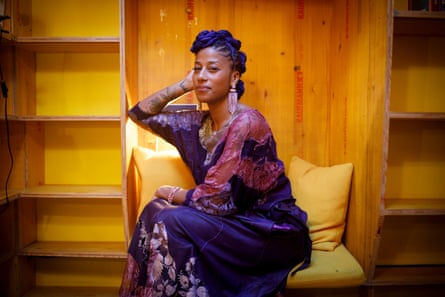
‘For many years, I’ve called myself a surrealist blues poet,” says Aja Monet in her warm, deep voice. Sitting in a London cafe, the Los Angeles-based artist looks striking, with her blue braids woven up in an intricate style. She was up late uploading the final master recordings for her new album, The Color of Rain, which she says was heavily influenced by her reading around how “surrealism was a real intentional device that artists used in response to the rise of fascism throughout history”.
High-minded and yet invested in the cut-and-thrust of our lives today, it’s a typical comment from Monet. With themes around love, resistance and the absurdity of our current times, her performance, poetry and music offers a balm for the suffering and abuse meted out by establishment power. Already in 2026, her second poetry book Florida Water was nominated for an award by the foundational US civil rights organisation the NAACP, and she performed alongside Stevie Wonder at Time magazine’s event celebrating Martin Luther King Day.
She’s gearing up for a show at Carnegie Hall in New York this spring to showcase The Color of Rain, an album born from experimental jazz that plays with rhymes and rhythms in a way that gives them a psychedelic quality. Lead single Hollyweird is a good example, portraying Los Angeles in the wake of the wildfires as a surreal apocalyptic landscape full of hypocrites and blinkered, pampered stars. “African people are surreal,” she says. “The way we move through the world is through a surrealist lens. We’ve always had to contend with the most absurd. What is more absurd than racism and sexism?”
Some of the most impactful films and TV shows made by Black American artists in the past decade, such as Get Out, Atlanta and Sorry to Bother You, fall under the umbrella of Afro-surrealism, but Monet also points to figures from the Négritude movement and the Harlem Renaissance as inspirations. “Surrealism for us is where insurgent consciousness takes shape. It’s what we’ve imagined and cultivated in face of all we’ve endured because of colonialism’s lack of political imagination.”
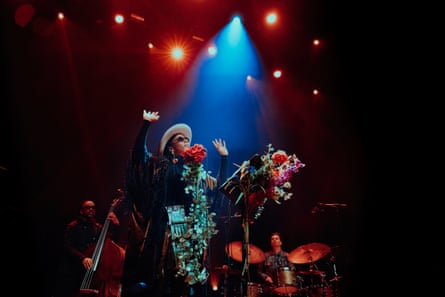
When I meet her, she is the Barbican’s artist in residence, performing a sold-out headline show as part of London jazz festival. On stage she pulls together threads from traditionally separate disciplines to create work that feels like it cannot be contained; if you’ve never really understood jazz or poetry, going to an Aja Monet show will burst your doors off.
“We talk about poetry as if it’s not integral to so many facets of our lives,” she says. “It seems like this high-art elitist thing, and it’s taught that way, in academia, for a specific reason.” What is that reason? “Division,” she replies. “It’s like spiritual warfare that we’re in. Culture is one of the biggest ways to access a sense of self-determination, new ideological frameworks, to come to understand why we’re here, what our purpose is, what we can do together.” But instead of this ideal, she sees the way that culture is controlled by institutions and algorithms as having “a tendency to produce a certain kind of person you can control or manipulate”, something baked into cultural institutions that were founded in wealthy colonial counties “to uphold their own values and ideals and to keep people in place and in the control of the hierarchies that they wanted to exist.”
Monet cites hip-hop as one example. Great art forms like this, she says, “have become like modes of entertainment. ‘How do I entertain you? How do I keep you engaged, looking at the shiny thing? How do I get you to buy something? How do I get you to’ …” Exploit yourself, or someone else? “Yes, I think that’s what capitalism has made of art.”
Monet was born to parents with Jamaican, Cuban and Puerto Rican roots but says that growing up “what mattered most was that you were a New Yorker”. Her poems often speak to the struggles of minority ethnic people and she is clear about identifying as Black. “The police didn’t stop us, pull us over and say, ‘Oh, you’re Cuban.’ They saw Black people. My uncle was locked up from the time I was a kid, so I had to understand that this system was not built for our dignity and our humanity.”
At 16 Monet left home and found herself gravitating towards the church. It was the community rather than the religiosity that really appealed to her. Grappling with issues at home and in the wider world, she found solace in words and thought that her calling might be using poetry to bring people closer to God. “Poems became a place of testimony and ministry,” she says. “How do you testify about what you see, what you want, what the conditions are that you’re living in and the things that you want to change?” She says her generation “came from Big Pimpin’. We saw Jay-Z, Diddy and Missy: all of those people were about upward mobility. Everything that was mainstream was all about how you can get ahead, how you can get out of your situation. Not how you can help your people and make things better.”
Monet’s propensity to speak truth to power meant that poetry cafes quickly took over as her church. It was in these rooms that she was first exposed to people talking about rape, assault and gender justice. “It was always the poets that were speaking about those things openly, explicitly, not the mainstream culture.”
Much of Monet’s work has interrogated issues of race, colonialism and inequality not just within America’s borders, but in Sudan, the DRC and Palestine. Poetry first led her to learn about Palestine when as a teenager she crossed paths with Tahani Salah, a young poet of Palestinian heritage. The pair started going to poetry slams together in New York. “If you see somebody you love long for somewhere they can’t return to, you’re gonna be like: what we doing? Let’s liberate Palestine. What do you need? You’re all of 15, 16 years old, you don’t know what that requires, but you have a righteous rage, an indignation about your belief that you can change something and make a difference.”
Alongside the public-facing work that she does as a touring artist, Monet also works a full-time job with an organisation called V-Day which works towards ending violence against women and girls. As their artistic creative director, she has written an audio play intended as a successor to The Vagina Monologues, which they are working to get into US prisons. If it wasn’t for V-Day, she says, “I don’t know how I would survive this time in a spiritual, emotional way, but also in a very material way. It’s not easy, nor is it financially lucrative, to be a working, touring artist at this time.”
Amid life’s pressures, Monet says that she has understood love to be the core value of anyone who is going to push back against adversity. “To say: ‘I choose you in my life, and we’re gonna look after each other. I love you.’ You do it because you recognise you have no other path.” She gives the example of her best friend and manager Daphne, who is with us in the cafe. They met many years ago in Paris, where Daphne encouraged Monet to keep doing poetry, and used her own skills as a diplomat in some of Monet’s legal affairs, cementing their friendship.
Daphne had also lost her mother very young and Monet’s mother was suffering from health issues. Their shared pain made them both enter the friendship “voicing our frustration about the pharmaceutical industry and how it hurt our families”. The personal became political, and the women became friends and later, a team. “It makes me want to cry …” Monet says, her voice cracking as Daphne smiles.
It’s clear that poetry has given Monet structure, freedom and family; a way to self-reflect and interrogate, to inform relationships and her entire worldview. “The goal is to be the poem you’ve been trying to write your whole life,” she says.