2 months ago
88
2 months ago
88
Some vegetables are a Tuesday night no-brainer, while others feel like more of a Sunday schlep. Poor parsnip falls into the latter category, relegated to slow braises and weekend roasts.
Weather-resistant root veg like parsnips, swedes and celeriac are affordable at this time of year, but their fibrousness doesn’t yield as easily or quickly as tender, fair-weather veg.
Breaking fibres down before you start cooking, either by whizzing through a food processor or coarsely grating on a box grater is a simple shortcut. I’ve even taken to blitzing my soffritto and mirepoix when I’m feeling particularly pressed.
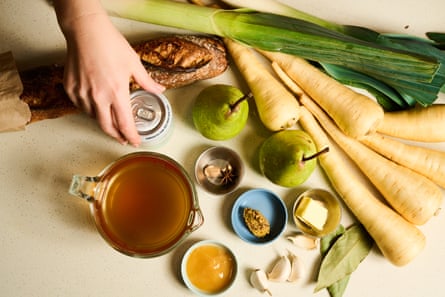
When you aren’t relying on time to extract flavour from ingredients, think about the liquids you use to cook, too. Every element should contribute to the overall taste, rather than diluting it. That’s why you’ll notice that rather than adding water to a quick cook like risotto, you’ll ladle in stock; or add orange juice to loosen a carrot puree for complexity.
Even if a recipe tells you to use water, consider replacing some or all of it with another liquid that’s congruent with the flavour profile, but adds a little oomph. For a neutral, lighter flavour, try a veg or chicken stock (or beef or fish if the recipe features those proteins). For more sweetness, try juice, or even the liquid from a compote or preserve.
For tang, vinegar, wine, beer or cider will give it a kick, but be sure to cook out some of the booziness by letting the pot burble away until your eyes stop stinging, before adding other liquids. For extra savouriness and seasoning, pickle or olive brine, kraut or kimchi juice are all winners – though these should be added towards the end of the cook to maintain their brightness, and hold off on the salt until you’ve tasted it all together.
Of course, when you’re grating and simmering something, you do lose the benefit of texture. To restore it, serve creamy, velvety dishes with some added crunch. This is also my favourite way to turn a bowl of soup into a meal of soup.
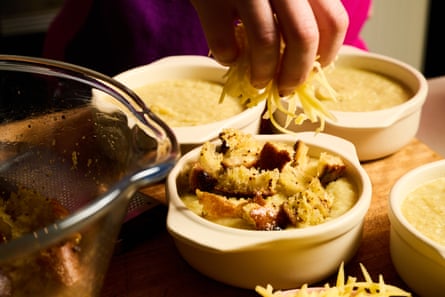
Like in this creamy parsnip and pear soup, which is a retro combo that’s ripe for revival. The sweetness of these autumnal ingredients blend beautifully, further enhanced by the cheesy, crunchy croutons bobbing about on top. It’s très french onion soup, with a root and fruit twist.
If you’re in even more of a hurry, get clever with your timings and gratinate the croutons on a lined baking tray, then top each bowl of soup with the bubbling bits. You can also make the soup the day before, along with the rubbed bread, then heat and gratinate as you need.
Grate parsnip and pear soup with cheesy, mustardy gratin toasts – recipe
Serves 4, with some extra for the freezer
Prep 15 min
Cook 25 min
2 leeks
6 small to medium parsnips, about 650g
2 firm pears, about 450g, cored
20g butter, or a heaped tablespoon
2 tbsp olive oil, plus extra for drizzling
4 cloves garlic, roughly chopped
375ml dry cider – whichever is your favourite, bonus point for a local producer
½ tbsp honey
500ml chicken or vegetable stock
2 bay leaves
1 star anise
¼ freshly grated nutmeg, or ⅛ tsp nutmeg powder, plus extra for finishing
For the cheesy mustardy toasts
2 tbsp olive oil
1 tbsp seeded mustard
½ sourdough baguette, roughly torn into pieces
100g cheddar, coarsely grated
Split the leeks lengthwise down the middle, then give them a good rinse under running water, rubbing between the layers. Lop the dark green tops off and whack them in the freezer scrap bag, to make a stock another time. Finely slice the remaining pale green and white parts of the leeks across the grain into half-moons, and pop into a salad spinner to soak. Spin out to dry when ready to cook. If you don’t have one, pop them into a bowl with plenty of water for a wash and rinse, being careful to get the grit out.
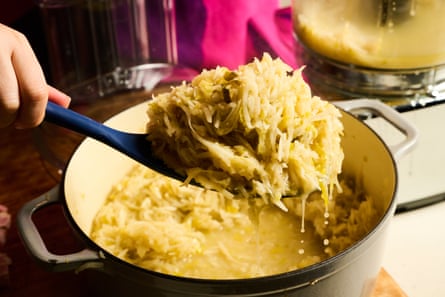
While the leeks soak, coarsely grate the parsnip and pear (no need to peel), either with a food processor or the coarse side of a box grater.
Spin-dry or drain the leeks well. Pop the butter and oil in a heavy, high-side cast iron pot, or large saucepan with a lid, on medium heat. Once the butter is foamy, add the leeks, garlic and a splash of water and listen for the sizzle, then drop to a medium-low heat. Whack the lid on for 10 minutes, checking and stirring halfway to keep the bottom from catching.
Once the leeks are softened and the garlic aromatic, splash in the cider to deglaze and cook on high heat for five minutes, or until your eyes stop stinging, then stir through the honey to soften the cider tang.
Add the parsnip and pear, along with the stock, 500ml of water, bay leaves and star anise. Cook with the lid on until the parsnip can be squashed between your fingers, about 20 to 25 mins.
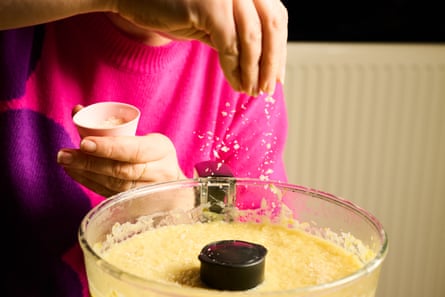
Switch off the heat, remove and discard the bay leaves and star anise, grate in four good rasps of nutmeg and stir it about.
Use a stick blender to whiz the lot to a creamy consistency in the pot. If you don’t have a stick blender, cool the soup slightly, then carefully blitz in batches in the food processor or blender (this is important – hot soup in a blender can explode!), then return to the pot. Taste and adjust with salt and pepper, remembering you can always add more salt but it’s harder to take it away.
To make the cheesy mustardy toasts, in a medium mixing bowl, combine the olive oil and seeded mustard. Add the torn baguette and half the cheddar. Mix about to coat everything.
Preheat the grill function on your oven or crank it to 240C/220C fan. Ladle warm soup into heat-proof serving bowls, pop the mustardy bread and cheese mix on top, then sprinkle the rest of the cheddar over the bread.
Pop the bowls into your preheated grill oven and cook until the bread and cheese is golden – about five to 10 minutes until the cheese has melted and the croutons are burnished at the tips.
Serve with another rasp of nutmeg, a drizzle of oil and a sprinkle of salt flakes.