2 months ago
80
2 months ago
80
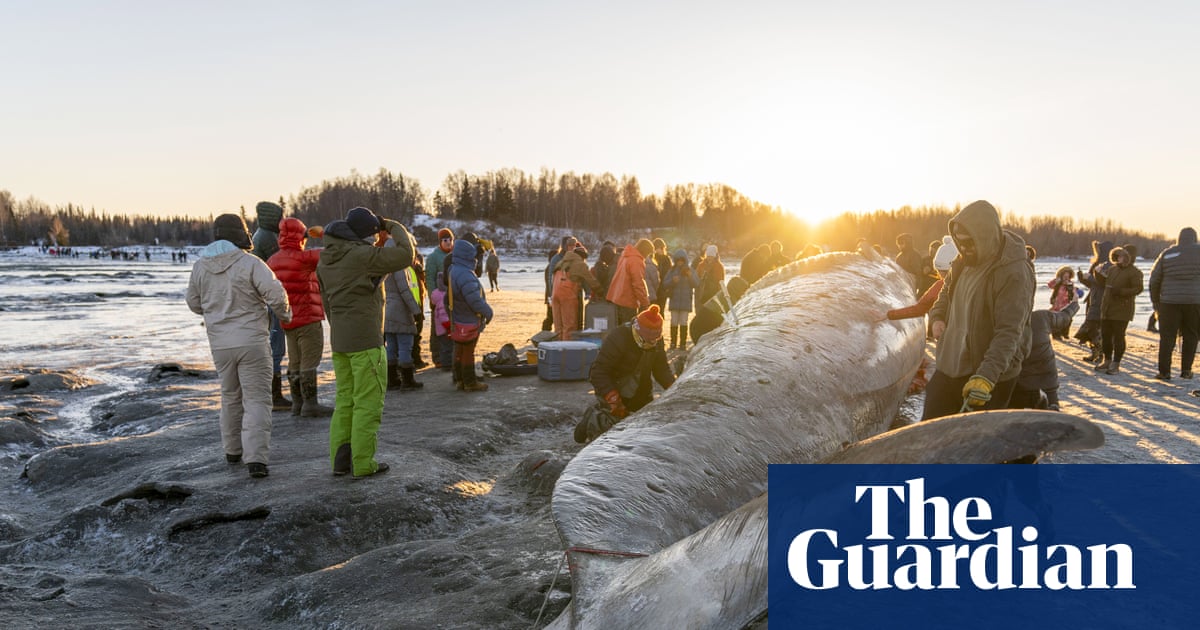
Between the cliffs and the sea at Jan Juc, on Victoria’s Surf Coast, researchers scour the shore platform for evidence of life from 25m years ago, as beachgoers revel in the sand and surf nearby.
“You can be there discovering a fossil that might change our understanding of the evolution of life on Earth. And you’re sharing it with a family that’s just gone down to the beach for the day,” says Dr Erich Fitzgerald, senior curator of vertebrate palaeontology at Museums Victoria Research Institute.
As powerful Southern Ocean swells erode the rock face and shift massive boulders, a new fragment of whale bone might be revealed, or a battered shark tooth – remnants of the Oligocene, a pivotal moment in the history of the planet, and in the evolutionary story of whales.
For Fitzgerald, the place is “like a magnet”, with every visit offering the tantalising possibility of new discoveries.
Sign up: AU Breaking News email
Fossils from Jan Juc have revealed the existence of tiny-toothed baleen whales such as Janjucetus dullardi, primitive dolphins with long narrow jaws, and “rather substantial” penguins over a metre tall – all likely to have been preyed upon by a large prehistoric shark called Carcharocles angustidens, ancestor to the terrifying megalodon.
The hunt for fossils is often associated with the outback, places such as Winton, “Australia’s dinosaur capital” in central-west Queensland, a 15-hour drive from Brisbane. But novices, enthusiasts and experts alike can travel back millions of years only a short day trip from Melbourne.
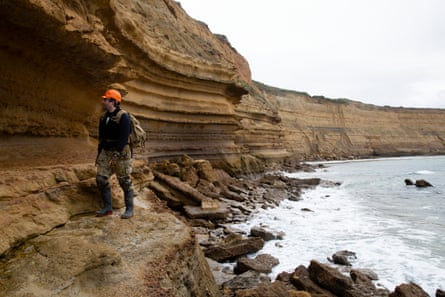
“You can find fossils of nearly all geological periods in Victoria … if you know where to look,” says palaeontologist Prof John Long, who began searching the state for specimens at age seven.
“Victoria is a small state, but it’s got the mountain belt – the Great Dividing Range – coming right through and twisting around. And because it’s had lots of geological upheavals over millions of years, it’s got very good exposure of almost the entire geological timescale, from the Cambrian to the recent.”
Fossils are ‘everywhere’
The state has a storied fossil record. Australia’s first known dinosaur specimen – the claw of a small carnivore from the cretaceous period – was found in 1903 near the seaside town of Inverloch, by geologist William Hamilton Ferguson, who was searching for coal. Local discoveries include some of the oldest examples of land plants, extraordinary examples of extinct marine organisms called graptolites, early fish from the Devonian, and world famous polar dinosaurs.
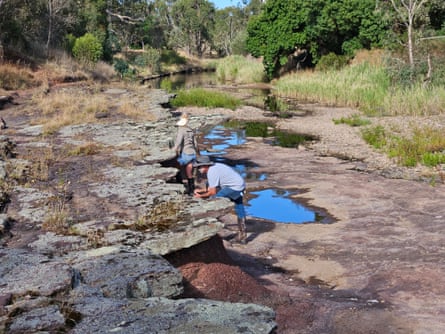
A more recent example was the discovery of fossilised claw prints about 354m years old – the oldest evidence for amniotes, the ancestors of reptiles, birds and mammals – by locals Craig Eury and John Eason on the banks of Broken River near Mansfield, 200km north-east of Melbourne.
Their interest was sparked many years ago, when Long gave a talk at the local library, later taking an enthusiastic group to search at some local sites. “We found plates of ancient armored placoderms. I just showed them how easy it was to actually find stuff, once you knew what you’re looking for. Since then, they’ve been going out by themselves and walking the whole of the basin, finding more material.”
Significant fossils are being uncovered every year, says Sally Hurst, the palaeontologist and archaeologist behind Found a Fossil, which offers advice for people who have discovered a fossil or artefact and don’t know what to do next.
“You can find them on a beach. You can go on a bushwalk and potentially find something. They are everywhere, and most of the time they are not found by scientists, they’re found by members of the public,” she says.
Dinosaurs may be the first thing that comes to mind, but fossils can be any living thing from a past geological age – plants, bacteria or animals that have died and then become mineralised.
Finding them can take a bit of practice, she says. It’s a good idea to visit the museum first to know what you’re looking for, and keep an eye out for interesting textures that look different from rock.
But there are a few ground rules. No tools, as digging is usually prohibited without a permit. And if you find something of interest, take a photo, drop a GPS pin and contact the museum or Found a Fossil. It’s best to include something in the photo for scale, Hurst says – that could be a ruler, coin, a pencil or even a banana.
If you happen to see a dig under way, Hurst says, go and say hello.
“Palaeontologists are a very friendly bunch. We’re always happy to answer questions.”
Relying on the public
Ben Francischelli, a palaeontologist, can often be found in his scuba gear at Beaumaris beach, 20 minutes south of Melbourne’s city centre.
The bayside beach with its “strikingly beautiful ochre cliffs” is one of Australia’s most significant urban fossil sites, he says, a treasure trove of marine and land fossils from 5m to 6m years ago.
It’s best to visit at low tide and when winds are light, he says, and be careful of the cliffs, which have been known to collapse. It’s suitable for first-time fossil hunters, who may spot a heart urchin or shark’s tooth on the sand. “All you need are your eyes,” he says.
Francischelli prefers to search the seafloor, taking care not to disturb any local inhabitants such as blue-ringed octopus or giant smooth stingrays. “My favourite thing to do is to just hold my breath and sink to the bottom, and then kind of walk like a moon man looking for fossils.”
Local discoveries can be seen on display next door at the Prehistoric Bayside Museum, housed at the yacht squadron.
Those on the hunt for dinosaurs should head east, down the Bass Coast, to a 40km stretch of coastline between San Remo and Inverloch.
Lesley Kool, is the longtime coordinator of a project called Dinosaur Dreaming. In 30 years of prospecting at the site, scientists and volunteers have uncovered a diversity of Cretaceous dinosaurs – small and speedy plant-eaters called ornithopods, ankylosaurs, meat-eating theropods, along with freshwater plesiosaurs and flying pterosaurs – along with early mammals (including a minuscule monotreme called Teinolophos trusleri) and the monster amphibian Koolasuchus cleelandi, all living in what was then a polar environment.
At the time, 125m years ago, the coast was a vast rift valley between Australia and Antarctica, and much farther south, she says. “You could have actually walked from the south coast of Australia to Antarctica, [although] you would have had to cross a few rivers.”
Bunurong Environment Centre runs guided tours of local fossil sites during school holidays, but because the site is part of the Yallock-Bulluk marine and coastal park, finds can only be collected by someone with a permit. Those wanting to join a dig can register their interest with the Dinosaur Dreaming project.
“We really do rely on the public doing the right thing and letting us know when something really significant has been found,” says Fitzgerald. “That enables us to spring into action … collecting those fossils, saving them for science, but also enabling us to save them for everyone to enjoy and learn from.” Finders are recognised in the museum’s collection register.
“The search for fossils and learning about our deep prehistoric past must be one of the most satisfying, enriching activities,” Fitzgerald says. It’s “95% walking and looking”, he says, which “forces you to actually stop and just pay attention to your surroundings.
“That really opens you up to a whole world of enlightenment and discovery about nature and, indeed, our place in the universe.”