2 months ago
108
2 months ago
108
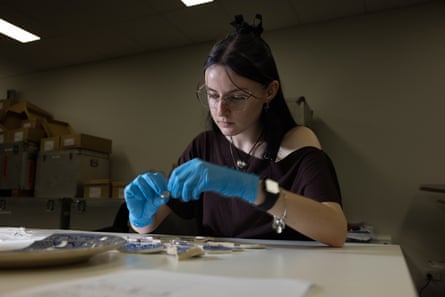
In a white and sterile office that could belong to any one of the warehouses that dot this industrial strip between Brisbane’s airport and horse-racing precinct, a young woman is engrossed in a puzzle.
Only this puzzle comprises, perhaps, three different sets, each almost (but not quite) identical to the other – and none likely to be completed.
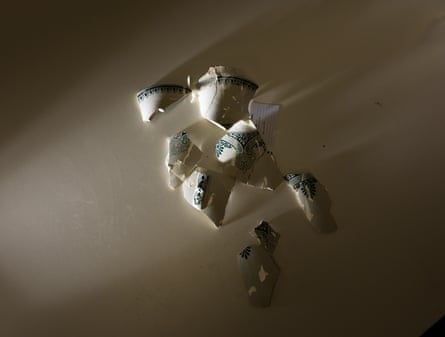
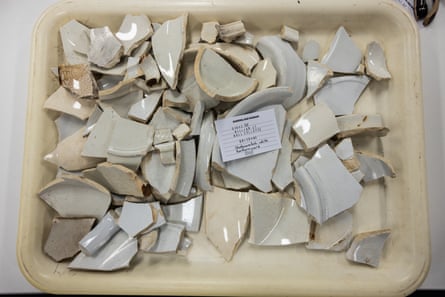
Emily Totivan wears blue plastic gloves. She is an archaeology student helping to catalogue artefacts. The office is in a Queensland Museum storage facility. The ceramic shards she assembles are from dinner plates – upon which persons unknown ate about a century and a half ago in the early years of Brisbane’s transition from penal settlement to river port capital of the new colony of Queensland.
Frontier violence was waged in other parts the colony, but these fragments tell of a life more genteel. Intricate blue and white patterns on the plates depict a watery scene of pagodas, willows and swallows in a Chinese-inspired style that Totivan says was “insanely common” on tea sets, platters and vases of the day.
“It’s like the world’s hardest puzzle,” Totivan says. “But also, the most rewarding.”
Part of a generation hurtling into a future of artificial intelligence and climate crisis, Totivan is among a new cohort of young people choosing not only to peer into the past, but to reach out and touch it.
Despite pop cultural depictions of archaeologists raiding the tombs of Egyptian pharaohs or unearthing hoards of Viking silver, many of Totivan’s fellow students will go on to work in Australia’s major cities, unearthing and examining artefacts such as these blue China plates.
“Honestly, I’ve never even seen Indiana Jones,” the 19-year-old from the old sugar town of Maryborough says.
Sign up: AU Breaking News email
Brisbane is on the brink of something of a boom in what is known as salvage archaeology, as the city prepares to host the 2032 Olympics. Vast quantities of soil will be dug up to make way for new infrastructure – including a proposed 63,000-seat stadium on the site of a park that is heritage listed, in part, due to its rich Indigenous, colonial and multicultural history.
Working beside Totivan is fellow 19-year-old Elisha Kilderry, who has been passionate about the past since getting “really into dinosaurs” as a child.
Kilderry studies genetics and archaeology, and hopes to use bone and genome analysis to reveal stories of human and biological evolution. In this room, she is working with a different set of larger pieces of white ceramic shards, bearing a geometric design of viridian green.
Initially, she imagined her career in archaeology would take her to Europe or to remote Indigenous cultural heritage digs in Australia. Instead, she finds herself sifting through what is known as the William Street assemblage, a collection of quotidian fragments from the 1870s, 80s and 90s – from clay pipes and rum bottles to ceramic dolls and a bone toothbrush.
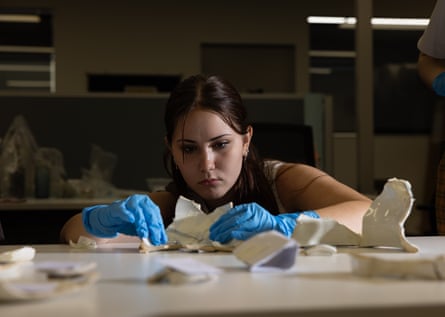
“Being able to look at stuff that belonged to people who were living practically on the same street I am, that is kind of surreal,” says Kilderry, who lives in student accommodation a short walk away.
Some of the artefacts are relatable to these students, others are very much of their era. As the object before Kilderry takes shape, we see it has a narrower base that curves out to a wide open rim.
“This is definitely a chamberpot,” she says.
Ten other University of Queensland archaeology students work alongside the pair, forming clusters around scattered fragments of ceramic, glass and bone. Many more applied for this week-long, hands-on experience in January. It’s the first of its kind offered by the university.
Lecturer Dr Caitlin D’Gluyas says the teamwork involved in a project like this is one of the great joys of her profession.
“It’s a very intimate and intense thing to do, to excavate with other people,” D’Gluyas says.
“Often you are living together and working together and it can be around the clock. Working side by side, in the trenches … you really get to know one another, in a way that I don’t find happens in an office space.
“That can be a really beautiful side to the work.”
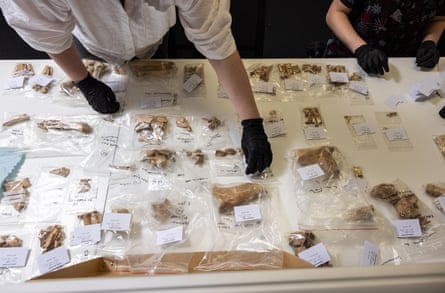
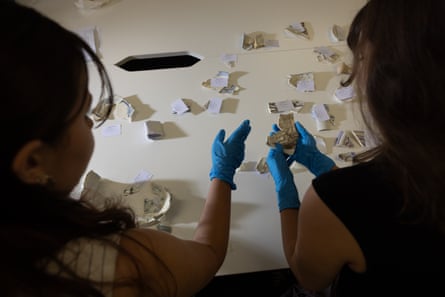
The William Street assemblage, however, was not unearthed by excavation. Its journey into the bowels of the Queensland Museum began abruptly, during the height of the 2011 floods, with a burst water main.
Several tens of thousands of artefacts were dislodged from under the street and began cascading past the convict-built Commissariat Store, one of Queensland’s oldest buildings.
Working alongside the emergency crews restoring access to one of the city’s major streets was the University of Queensland Archaeological Services Unit (UQASU). Nick Hadnutt, Queensland Museum’s archaeology curator, says: “It was a race against time to salvage what archaeology they could.”
Although this kind of archaeology against the clock is more common than many might think, Hadnutt says, it is usually associated with big infrastructure builds like the Cross River Rail tunnel or construction projects like Brisbane’s new Glasshouse theatre.
“At the Queensland Museum, we don’t have many assemblages that are acquired because of a plumbing disaster,” he says.
Faced with an overwhelming amount of material, the UQASU team salvaged the most unusual or noteworthy items, and those that gave insight to everyday life of the era – torpedo-shaped Hamilton bottles that, kept on their side, held carbonated liquids; a particularly ornate toilet seat.
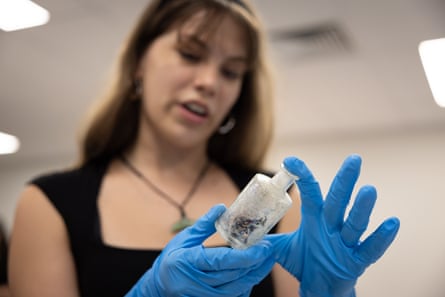
One of the few intact objects is a small ink bottle that would have been used in the now heritage-listed government printing house. It still retains a dash of ink, last used more than a century ago, perhaps on an act of parliament. Now an exquisite shade of midnight, it stains a paper towel the students used to clean it.
One of the students working on the bottle is John Duckett, a 21-year-old from Queensland’s beef capital of Rockhampton who likes playing video games “and looking at Instagram”.
But in an age of digital addiction, the physical and local still holds its appeal. Duckett previously volunteered for a dig on a bronze age brewery in Norfolk, England.
“It’s one thing to play Assassin’s Creed and see a replica of Egypt or whatever, but it is another thing to actually go outside and touch something from that time period,” he says.
Given their violent dislocation from their resting place – which is a key source of archaeological information – the William Street objects hold little scientific value, Hadnutt says. They were acquired by the museum for more emotive reasons.
“Archaeology is as much a physical pursuit as an intellectual one,” he says. “There is a physicality to archaeology, there is a weight and a texture and a smell to it – you are handling history.”