2 months ago
85
2 months ago
85
Newcastle supporters are starting to regard Eddie Howe’s team as an unreliable friend. Catch them on the right night and they invariably prove the life and soul of the thrillingly high-intensity party but, on other days, the once-dependable Sandro Tonali and company simply fail to turn up.
As if that were not bad enough, their second-half game management has become suffused with a chaotic streak. Howe’s players visit Manchester United on Boxing Day having dropped 13 Premier League points from winning positions this season and are without a clean sheet in 10 games in all competitions. Victory at Old Trafford would be only their second away league win.
Conversely, they have lost once in six league matches and, despite sitting a modest 11th, are only six points adrift of a top-four place. Throw in an impending two-leg Carabao Cup semi-final against Manchester City and a decent chance of progression to the Champions League knockout phase and it is easy to appreciate why Howe is cautiously optimistic about the evolution of his alternately bewildering and bewitching team.
“We don’t just have problems,” said Newcastle’s manager. “We have strengths as well. My glass is very much half full at present. I know everybody else might have a different opinion but I feel we’re improving.”
Whether Howe’s players can reprise – or even eclipse – the highs of last season’s Carabao Cup triumph and fifth-place league finish remains to be seen as they juggle a congested fixture list.
The resultant exhaustion perhaps explains why Newcastle could not sustain the brilliance of their first-half performance against Chelsea last Saturday and surrendered a 2-0 lead to draw 2-2.
Fatigue is also possibly the reason why Newcastle “did not perform”, to use Howe’s words, during a damaging 1-0 defeat at Sunderland this month. Four days earlier they had been held to a hard-fought Champions League draw at Bayer Leverkusen and despite the relative shortness of the journey from Germany, appeared jet-lagged as Régis Le Bris’s side beat them to virtually every second ball.
Howe’s forte is coaching, but playing twice a week has radically reduced training time. That is slowing the team’s stylistic adaptation to operating with Nick Woltemade rather than Alexander Isak at centre-forward. Isak’s £69m replacement is an immensely talented, technically gifted player but Woltemade lacks the now Liverpool striker’s searing counterattacking pace and capacity for pressing.
Indeed Newcastle’s high, hard press has sporadically malfunctioned in recent months. It does not help that a key component – Joelinton – has been debilitated by injuries, and two expensive newcomers, Anthony Elanga and Jacob Ramsey, have struggled to adapt to Howe’s regimen after arriving for a joint sum of more than £90m.
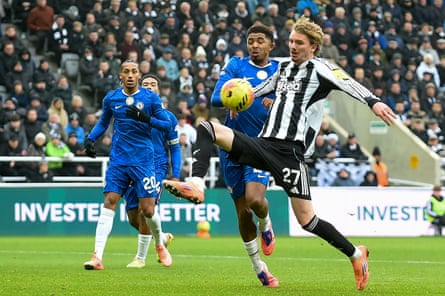
Elanga was billed as an upgrade on the underrated Jacob Murphy but has failed to replace the latter as the first-choice right-winger, while on the left wing Anthony Gordon’s extreme inconsistency is emblematic of the team’s erraticism.
If Howe’s cause has been further hindered by an alarming recent dip in the form of Tonali, his hitherto outstanding midfield anchor, the manager’s preferred 4-3-3 does not always serve the team as well as in the past.
A switch to a back three could arguably assist – or at least it might if Newcastle were not in the midst of a defensive injury crisis that will leave them without Dan Burn, Tino Livramento and Kieran Trippier at Old Trafford – but improved game management could also help.
At their high-tempo best Howe’s XI are almost unplayable but they struggle to sustain such intensity over 90 minutes and their plan B often involves dropping into a passive counterattacking 4-5-1 that sometimes self-destructs. On other occasions they embrace tactical anarchy while chasing victory. “The Chelsea game became chaotic at 2-2,” Howe said. “But we were trying to win. We always try to win.”
If a middle way seems called for featuring better possession retention, a midfield skilled at slowing the tempo and a pragmatic willingness to occasionally settle for a point, a determination to compete on four fronts is stretching limited squad resources.
It may seem heretical to Newcastle fans but their manager might have been better off fielding weakened teams in the early rounds of the Carabao Cup and avoiding a semi-final in the midst of an already packed January schedule.
Howe’s hand has been strengthened by Yoane Wissa’s recent return to fitness but it will be intriguing to see his team for the home FA Cup third-round tie against Bournemouth. With a two-leg Champions League playoff potentially beckoning in February and hard Premier League yards to make up, the need to prioritise seems imperative.
“When you’re involved in this club the pressures are big,” Howe said. “Every moment’s critical. We have work to in the Premier League. We’re in the Carabao Cup semi-finals, we want to progress in the Champions League and do well in the FA Cup.
“We’re moving in the right direction but we have lots of work to do to become the consistently winning team we want to be. The ability to put winning runs together has eluded us this season.
“The challenge is to hit those levels we know we’re capable of. I believe the confidence we can do that is returning internally. But now we have to show it. It ain’t all bad in this moment but the next few weeks will decide a lot.”