2 months ago
70
2 months ago
70
Minister confirms support package may be offered as experts predict energy price cap to rise by £288 in July
From tomorrow the Ofgem price cap goes down from £1,758 to £1,641. The government is highlighting this as one of its cost of living support measures, because the cap is coming down as a result of decisions taken in the budget.
Here is a chart from Ofgem explaining how they calculated the new figure, which will apply for three months (from 1 April to 30 June).
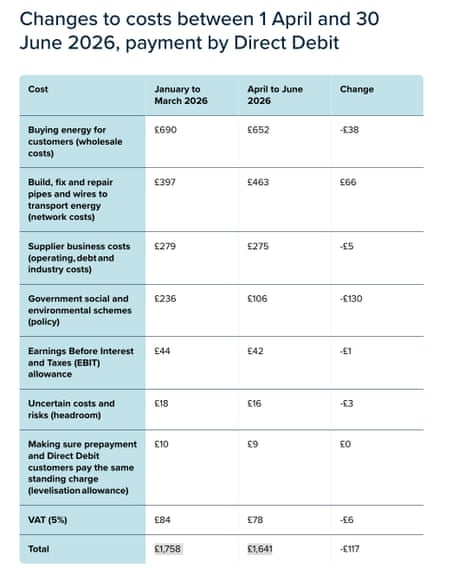
It is important to stress what the price cap actually is. It is not a cap on the amount people will pay for their energy. Many people (around 50%, to be more precise) will pay more, because the cap applies to what can be charged for units of energy, not the overall bill. The Ofgem headline figure is the amount an average household would pay assuming typical household useage.
And it only lasts for three months. There will be a new figure for July to September and this morning Cornwall Insight, an energy consultancy whose price cap forecasts are widely respected in the industry, is predicting that for Q3 the cap will rise to £1,929. That is an increase of £288, or 18%, on April’s cap.
Craig Lowrey, principal consultant at Cornwall Insight, said:
A rise in July is pretty much unavoidable, but how high prices go remains to be seen.
There is some relief in the timing, summer is when energy demand is at its lowest, which should soften the impact on household energy expenditure.
If higher wholesale prices continue, it will be the effects on the October cap that have the most impact, and that is when the question of government support for households is likely to be revisited.
In response, Martin McCluskey, an energy minister, confirmed that the government was willing to intervene to help some consumers with energy costs if necessary. He said.
Tackling the affordability crisis is our number one priority and I know many families will be thinking about how events in the Middle East might impact the cost of living at home.
We will continue to fight people’s corner through this crisis and, as the energy secretary has said, if it’s necessary to intervene, we will.
Key events Show key events only Please turn on JavaScript to use this feature
The Conservatives have responded to the Cornwall Insights energy price cap forecast (see 10.18am) by renewing their call for the government to allow more oil and gas drilling in the North Sea. Claire Coutinho, the shadow energy secretary, said:
Shutting down the North Sea means we are losing out on £25 billion in tax receipts that we could use to cut bills and reduce the cost of living.
The government must adopt the Conservatives’ cheap power plan to cut bills by £200 immediately by taking VAT, taxes and levies off energy bills without costing taxpayers a penny. We would cut bills for everyone rather than taxing working people to fund yet another bailout for people on benefits.
Minister confirms support package may be offered as experts predict energy price cap to rise by £288 in July
From tomorrow the Ofgem price cap goes down from £1,758 to £1,641. The government is highlighting this as one of its cost of living support measures, because the cap is coming down as a result of decisions taken in the budget.
Here is a chart from Ofgem explaining how they calculated the new figure, which will apply for three months (from 1 April to 30 June).
It is important to stress what the price cap actually is. It is not a cap on the amount people will pay for their energy. Many people (around 50%, to be more precise) will pay more, because the cap applies to what can be charged for units of energy, not the overall bill. The Ofgem headline figure is the amount an average household would pay assuming typical household useage.
And it only lasts for three months. There will be a new figure for July to September and this morning Cornwall Insight, an energy consultancy whose price cap forecasts are widely respected in the industry, is predicting that for Q3 the cap will rise to £1,929. That is an increase of £288, or 18%, on April’s cap.
Craig Lowrey, principal consultant at Cornwall Insight, said:
A rise in July is pretty much unavoidable, but how high prices go remains to be seen.
There is some relief in the timing, summer is when energy demand is at its lowest, which should soften the impact on household energy expenditure.
If higher wholesale prices continue, it will be the effects on the October cap that have the most impact, and that is when the question of government support for households is likely to be revisited.
In response, Martin McCluskey, an energy minister, confirmed that the government was willing to intervene to help some consumers with energy costs if necessary. He said.
Tackling the affordability crisis is our number one priority and I know many families will be thinking about how events in the Middle East might impact the cost of living at home.
We will continue to fight people’s corner through this crisis and, as the energy secretary has said, if it’s necessary to intervene, we will.
Grooming gangs inquiry to examine role of ethnicity, culture and religion
The grooming gangs inquiry will directly examine whether ethnicity, culture or religion influenced offending and whether they shaped the institutional response, the Press Association reports.
BMA dismisses Starmer’s 48-hour warning over resident doctors’ strike plan, calling for talks not 'threats'
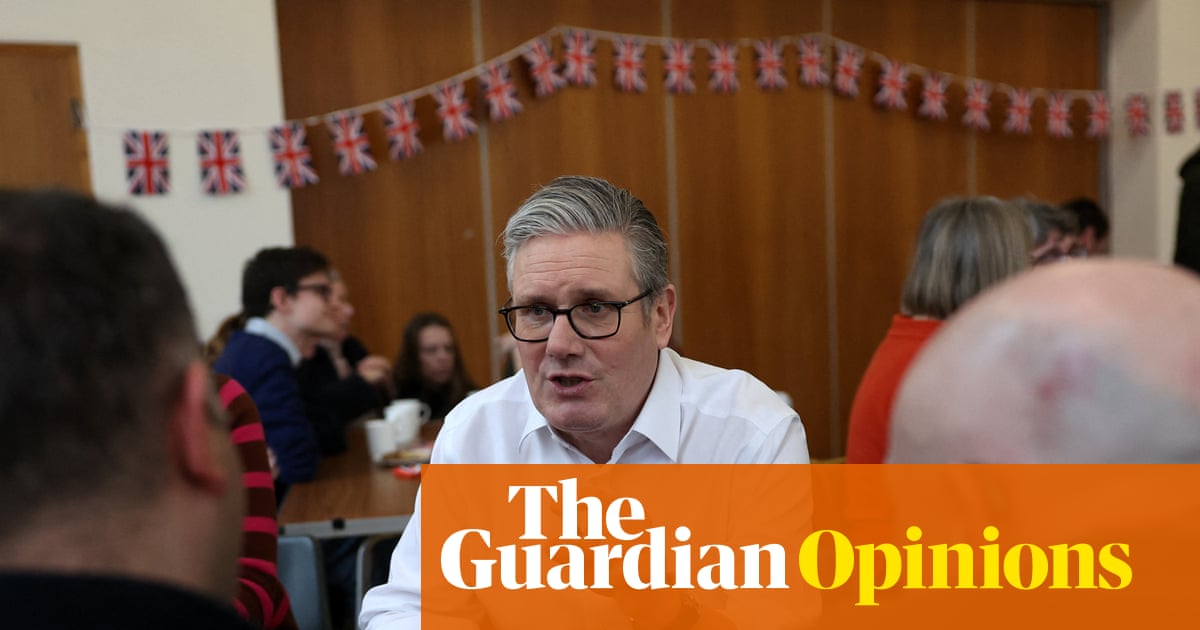
Good morning. Keir Starmer is chairing a meeting of the government’s Cobra emergency committee later to discuss the Iran war, but domestic issues don’t go away and he (or, to be more accurate, his staff) have also found time to write an article for the Times delivering a warning to resident doctors in England planning to go on strike. As Jamie Grierson reports, the PM is threatening to withdraw an offer of thousands of extra NHS training posts for resident doctors if they do not call off the strike within 48 hours.
Judging by what Dr Jack Fletcher, chair of the BMA resident doctors committee, told the Today programme in an interview this morning, Starmer may have as little success with his ultimatum as Donald Trump seems to be having with his inconsistent and increasingly apocalyptic warnings to what is left of the Iranian government.
Fletcher told Today:
I’m very happy to sit down with the government at any point to try and negotiate a settlement, but I don’t think that’s done by writing in newspapers and issuing threats unilaterally.
He also claimed that the BMA had been pushed into strike action because the government changed the terms of what it was offering at the last minute. He said:
The government made very late changes to the pay offer, reducing the pay investment and stretching it over a longer period in a way that had not been previously talked about.
Ministers effectively moved the goalposts on the deal at the last minute.
But these negotiations are not about arbitrary cut-offs as the prime minister seems to think.
Any ‘deadline’ disappears the moment there is a credible and sustainable offer on the table.
Our focus remains on getting a good deal for both doctors and for patients, and we are seeking to talk once again with the government later today with every intention of achieving a meaningful outcome that could see the strikes called off and a pay deal we can support.
Asked if it was true that he had personally been in favour of giving his members the option of voting on the pay offer, Fletcher replied:
Two weeks ago, the government took that investment, reduced it, and then stretched it over three years. That is a very, very, very different outcome to the one that we were discussing just two weeks ago.
Here is the agenda for the day.
9am: The Home Office publishes the terms of reference for the national grooming gangs inquiry.
Morning: Zack Polanski, the Green leader, launches his party’s campaign for the Senedd election in Cardiff.
Morning: Kemi Badenoch is on a visit in south-west Hertfordshire.
Morning: John Swinney, the SNP leader and Scottish first minister, is campaigning in Dundee and Stirling. Alex Cole-Hamiliton, the Scottish Lib Dem leader, and Anas Sarwar, the Scottish Labour leader, are also doing media-focused campaign events.
11am: Nigel Farage, the Reform UK leader, and Robert Jenrick, his Treasury spokesperson, are holding a press conference at Heathrow airport to publicise a cost of living announcement.
Afternoon: Keir Starmer chairs a meeting of the government’s Cobra emergency committee to discuss the Iran war.
Starmer is also meeting Ahmed al‑Sharaa, president of Syria, in Downing Street at some point today.
If you want to contact me, please post a message below the line when comments are open (between 10am and 3pm), or message me on social media. I can’t read all the messages BTL, but if you put “Andrew” in a message aimed at me, I am more likely to see it because I search for posts containing that word.
If you want to flag something up urgently, it is best to use social media. You can reach me on Bluesky at @andrewsparrowgdn.bsky.social. The Guardian has given up posting from its official accounts on X, but individual Guardian journalists are there, I still have my account, and if you message me there at @AndrewSparrow, I will see it and respond if necessary.
I find it very helpful when readers point out mistakes, even minor typos. No error is too small to correct. And I find your questions very interesting too. I can’t promise to reply to them all, but I will try to reply to as many as I can, either BTL or sometimes in the blog.